

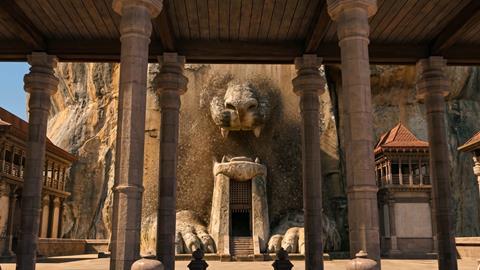
Breathtaking digital reconstructions explore how buildings rose - and fell
Distributor: BossaNova Media
Producer: Like A Shot Entertainment
This eight-part series uses breathtaking digital reconstruction to tell the stories behind some of the world’s most famous ruins, revealing how the buildings were constructed and how they fell.
The show takes viewers to 24 sites around the world, including Sigiriya in Sri Lanka and Ephesus in Turkey to Vindolanda on the Roman frontier, Hitler’s Wolf’s Lair and vast underground Nazi war factories.
Guided the archaeologists and historians, each episode unpacks the ambitions and ingenuity beind the structures, before exploring how conflict and catastrophe turned them to ruins.
“The idea for Ruins: Rise and Fall grew out of our experience of travelling and filming all over the world on other productions,” explains Danny O’Brien, head of development at Like A Shot Entertainment and EP of the show.
“We were constantly coming across extraordinary ruins with fascinating stories attached to them, but often there simply wasn’t enough of the original structure left to visually bring those stories to life,E he continued.
The answer was to use cutting-edge digital technology to faithfully reconstruct the buildings in situ, showing audiences not just what a ruin looks like today, but what it looked like at the height of its power.
Each episode then tracks how and why the buildings fell.
Each ruin was reconstructed with historical accuracy at the heart of the process, with extensive research, archaeological data, LiDAR scans, physical measurements and information from reliable academic and site-based sources used.
“The production team then worked with a specialist architectural graphics and modelling team to faithfully recreate each site, before taking the models through a range of specialist software and emerging AI tools to build up the finer details and textures, including photorealistic sand, dust, vegetation and water.”
The variety of structures were chosen to offer “genuine variety”, O’Brien said, “not just in the appearance and scale of the ruins, but in the periods of history they represent, taking audiences from the ancient world through to much more recent history.
“But the stories were just as important as the locations themselves. With three ruins in each episode, we were looking for a combination of sites that would feel visually distinctive while also giving each film a strong narrative rhythm.”
Filming took place across 24 sites, which O’brien says presented a huge logistical undertaking – “from securing access across multiple countries and languages to managing different seasons and weather conditions around the world.”
The digital reconstruction process brought its own set of challenges, he adds. “There was no single formula that could be applied to every ruin; each had to be approached differently depending on its condition and the amount of surviving evidence.
“Some sites had extensive archaeological research and existing datasets to draw on, while others had very little information available, meaning we effectively had to build the evidence base from scratch. It was a huge undertaking, but that complexity is also what makes the finished series so rewarding.”
The variety of visually striking historic locations from around the globe will make the show appealing to buyers, says Tatiana Grinkevich, head of sales at BossaNova.
“The graphics bring the ruins back to life, creating a sense of time travel and allowing viewers to step though history. We truly believe this project has all the ingredients for a recipe for success and the potential to become a returning series.”