

Russ Shaw, founder & head of virtual production at Quite Brilliant, reveals its work on a commercial for Warburtons
Virtual production is now a fixture of commercial filmmaking. So much so that on many productions, the specific technology running behind the LED wall doesn’t get much attention. On Warburtons’ 150 Years In The Baking it ended up being a decision that shaped what we could actually achieve on the day, so it’s worth going into. You can watch the ad above.
The commercial covers fifteen distinct environments, which were captured across five shooting days at Twickenham Studios, with around half shot on the LED volume. Locations and times were expansive and included Victorian Bolton, a 1960s mission control room, and an eighties montage, all the way through to the present day. For a project this broad, planning was more important than ever. We had to figure out how to get that range of scenes to feel like a single coherent film rather than a sequence of disconnected sketches. The plan really started to come together at the previz stage where we worked in close collaboration with director Declan Lowney and production designer Damien Creagh, making sure that the virtual and practical elements of the shoot were designed to meld together from the outset.
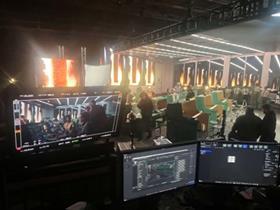
One of the key decisions that came out of that prep process was to use Chaos Arena for the Mission Crumbtrol sequence rather than the Unreal Engine pipeline we used elsewhere on the production. Most LED volume work runs on Unreal, which uses rasterisation (rendering environments quickly and reliably) and for a large proportion of VP work it’s entirely the right choice. The question on Mission Crumbtrol was whether it would give us what we needed for a sequence that required working screen content, practical desk surfaces, digital people in the mid-ground and reflections that needed to hold up through older, fast-glass anamorphic prime lenses.
Arena uses path tracing, which calculates light by following rays from the camera back through the scene and working out how they interact with each surface they hit. In practice on set, that meant reflections across physical surfaces behaved as they would in a real space, and the screen content, digital characters included, was captured in-camera rather than added later. The burned-in timecode was the only element that went in post, and that was a late decision. Everything else in that room was done on the day using in-camera VFX.
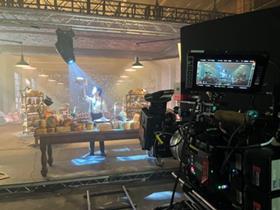
The direct consequence was that Declan and the DOP were able to look at something very close to the final frame while they were shooting it. It’s not a position teams are often in, and it meant that decisions like lens choice, camera position and depth of field could be made on set with a reasonable degree of confidence rather than being left to be “fixed in post”. That doesn’t always happen on a volume shoot, and it made a real difference to how the sequence came together.
It’s worth being clear that Arena was one tool among several. Unreal drove the Victorian bakers’ environment, Assimilate Live FX handled plate playback and image-based lighting, and we had Flame on set for last-minute adjustments. Post was led by Freefolk, who worked with us across several sequences, and Wunderbar contributed matte painting and AI-augmented backgrounds built from original 3D environments. What was captured in-camera was a solid foundation, not a finished result, but it gave Freefolk something strong to build from.
The wider point is about the conversation that happens at prep around which pipeline suits which sequence, and being willing to make that call deliberately rather than just defaulting to what the team knows. Thanks to recent developments, this conversation is becoming easier to have. As path-traced pipelines become more accessible and teams build more experience across different render approaches, the decision gets clearer earlier in the process.
Russ Shaw is founder & head of virtual production at Quite Brilliant

No comments yet