

Federation sales chiefs Guillaume Pommier and Monica Levy on how the TF1/Netflix deal is impacting rights discussions
As buyers descend on the UK capital for Showcase, London TV Screenings and Mip London this week, Broadcast International speaks to Federation’s co-heads of distribution, Guillaume Pommier and Monica Levy, about the key trends and challenges facing the business.
What was the single biggest challenge for your business in 2025?
Our biggest challenge is clearly keeping faith and staying agile during an exceptionally turbulent phase for our industry. The shifts we’ve been experiencing require constant recalibration, clear vision, and the ability to adapt at speed.
What are your top three growth priorities for 2026?
Looking ahead to 2026, our ambition is to strengthen the already active pillars of our strategy. First and foremost, we are continuing to expand our English-language slate, a driver of global reach that is finally opening doors which, until recently, had been only slightly ajar.
We are deliberately investing in high level, ambitious projects with meaningful talent attached, rather than multiplying B level series. At the same time, we are accelerating the non linear exploitation of our content to ensure it lives widely and travels deeply across platforms. And finally, we are doubling down on pre sales and international co productions — an area in which Federation has long excelled - a model that enables us to finance increasingly ambitious series while forging strategic alliances with new and prestigious broadcasters and streamers worldwide.
Streamers have struck some eye-catching deals directly with YouTube creators over the past year. What do you make of this trend and do you see it impacting your business?
The surge in streamers partnering directly with YouTube creators shows how quickly advertising is shifting toward digital platforms. This inevitably impacts our long standing broadcast partners and their ability to commission. Our job is to support them - they’re still the ones who can pre finance premium series - while ensuring our IP continues to hold its value in an increasingly fragmented market.
Broadcaster-streamer IP pacts have also become popular across Europe, in particular the TF1/Netflix deal starting this summer. How will such arrangements affect your business; will we see a similar deal in the UK; and, what do they mean for the future of second windows?
We’re watching these hybrid partnerships very closely, as the TF1/Netflix model has already started to be replicated across Europe and beyond.
France has really become a ‘testing’ ground - from TF1/Netflix to the recent France Télévisions, M6 and Amazon arrangements - and we fully expect more partnerships to follow. For us and other distributors, the real impact will come down to how second windows evolve. They won’t disappear, but they will need to be defined with far more precision to protect long term rights value and keep the downstream ecosystem healthy.
What impact will the WBD-Netflix deal have on your business and the wider industry, if it goes ahead?
At this stage, with the process still evolving and discussions ongoing, it’s hard to draw firm conclusions about what a potential WBD–Netflix deal might mean.
We are concerned of course that the pure number of potential partners is diminishing with the buyouts, and therefore competition between streamers is also lessening.
What we’re watching most closely is the impact on cinema, especially the commitment to theatrical releases. If Netflix or Paramount acquires Warner and does not privilege a minimum of theatrical films with a theatrical release before heading to the streaming platforms, our entire ecosystem will be destabilised.
How will Channel 4’s nascent in-house production (and IP ownership) strategy affect your business and the broader distribution sector?
The move toward greater in house production is part of a wider global shift, with platforms and broadcasters everywhere looking to secure more of their own IP. Apple’s acquisition of the Severance IP is just one example of how quickly this trend is accelerating. For international distributors, it reinforces the need to build relationships early and stay ahead in identifying IP with real travel potential. All this notwithstanding, even channels with in-house productions will need distributors for their series.
If we gave you £2m to invest in a show of your choice with a view to getting the biggest returns within five years, what kind of show would it be?
With £2m and a five-year horizon, we’d back a focused slate of premium, English language thrillers - sharp premise, character-led, talent-driven shows, bascially what we do now. The genre travels exceptionally well and, with the right talent, can deliver strong international sales while broadening our global footprint. This approach gives us immediate traction and, just as importantly, builds durable library value.
Tell us about your key title for LTVS and what makes it stand out?
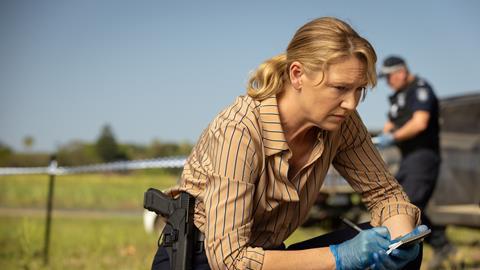
Our flagship title for the London TV Screenings is Dustfall, a premium English-language drama led by the extraordinary Anna Torv. We’ll be screening the first episode in London ahead of its competition slot at Series Mania next month - an impressive milestone given that only nine series were selected out of more than 375 submissions.
Dustfall is a tense, atmospheric 6 x 52-minute ‘Tropic Noir’ thriller that follows a detective whose moral compass is pushed to its limits in a world where victims struggle to be heard and predators often slip through the cracks. Produced by Soapbox Pictures and Moonriver for ABC Australia, in association with the BBC, and based on Vikki Petraitis’ acclaimed novel The Unbelieved, the series is directed by Emma Freeman (The Newsreader). The screening will be followed by a Q&A with the creative team and talent.






No comments yet