
Self-censorship and budget cuts are impacting artistic freedom amid political turmoil, execs argue
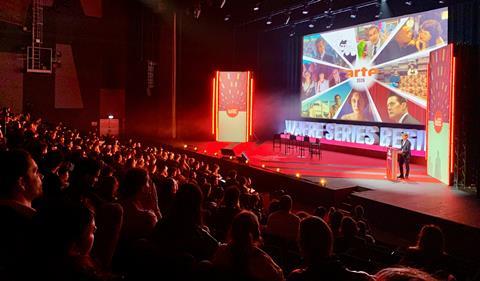
European public broadcasters are addressing societal issues through their scripted content, including shows with more politically incorrect themes, but pressure is building on artistic freedom, according to a host of execs at Series Mania.
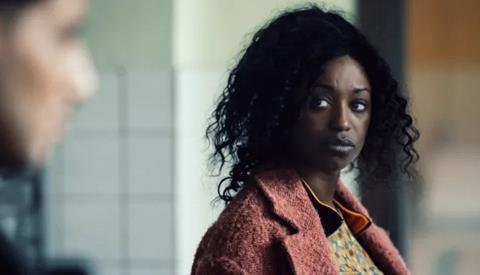
Shows such as Belgian series The Best Immigrant reflect the trend of PSB’s attempting to deliver a broad range of drama to audiences but the challenges for public broadcasters are multiplying across Europe.
The Federation of Screenwriters in Europe (FSE) warned of the threat to creativity and the risk of self-censorship during a panel this week, which came atfer the organisation issued its report written by David Kavanagh and Carolin Otto (Right to Write: Screenwriters and the Growing Threats to Freedom of Artistic Expression in Europe) in Lille.
“The challenges to freedom in journalism are also emerging in audiovisual creation,” said the FSE’s recently installed managing director, Dennis Goulette.
The report warns of growing pressure on culture and media in many countries - particularly on public broadcasters - and on the very definition of what is considered ‘truth.’ “This is a direct concern for storytelling,” Goulette commented.
“The key issue is not direct censorship - it is much more subtle than that,” he explained. “Stories are quietly pushed aside through mechanisms including commissioning decisions, funding approvals or editorial feedback. These appear to be normal decisions, because selection is part of the job.”
Otto pointed out that the issue has been growing for years, highlighting that it was in 2018 during a screenwriters’ conference on freedom of expression in Berlin that a member of the FSE from Poland first sounded the alarm regarding the influence of right-wing parties on PSB’s.
“Public broadcasters still fund the majority of audiovisual creation in Europe, not the streamers,” she said.
Moderator Thomas Gammeltoft, head of programme at the European Writers Club, added that in Denmark, “the right wing is in favour of cutting down our public service completely and we see that everywhere.”
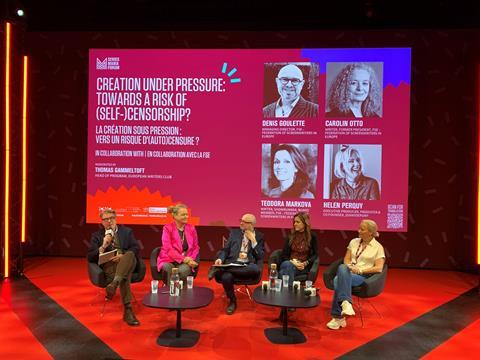
Self-censorship can be also be an easy trap, Otto added, highlighting that writers will not spend time developing a show that will not be picked up.
Attacks and misinformation on social media were also highlighted as an issue, a sentiment echoed during the following commissioners’ panel session featuring a host of senior PSB execs.
Manuel Alduy, head of international and young adult drama at France Télévisions, spoke about the polarised attacks that his public broadcaster received when its streamer launched Phoenix, marking the broadcaster’s latest international co-production with Nordic commissioning alliance New 8.
Phoenix follows a group of young European activists who kidnap the children of powerful chief execs to force them into climate action.
The series was accused of encouraging kidnapping, whereas Alduy argued the show was actually asking whether the means justified the end. The issue has already been used against the French public broadcaster during a parliamentary inquiry commission currently underway, itself initiated by a far-right-friendly party.
Marianne Furevold-Boland, NRK’s head of drama, added that a key focus was “to create stories with new perspectives that spark conversation.”
She continued: “If we start to fear the debate, then we have already lost. I do not want to be on the national news, but that is part of the job. We cannot leave that conversation to the comment sections.”
Alliances & the New 8
Pressure on European public broadcasters has been building across the continent, but alliances are delivering results on screen.
Phoenix was among highlights of the New 8 session, with the show originally devised as a French project before gaining momentum at the European Writers Club, where it caught the attention of German broadcaster ZDF, which plans to air the series next month.
The future of the co-production partnership also looks steady for the foreseeable future. Established three years ago by DR (Denmark), NPO (Netherlands), NRK (Norway), RÚV (Iceland), SVT (Sweden), VRT (Belgium), YLE (Finland), and ZDF (Germany), the pact has been renewed and VRT head of drama, Wim Janssen, was clear about her thoughts on the developing relationship. “We still love each other, in fact, we love each other even more.
“We have come to understand each other better, and we now know what works for our partners,” she said, with a focus on bold and entertaining series that portray society on screen.
Other highlighted shows included Breendonk, whose catchphrase is ‘When will you rise up?’ The series tackles Flemish history including labour camps during World War 2, a subject that has not been widely explored before. “It is also a story about today,” said Janssen.
Another New 8 show in progress is an as-yet untitled Dutch series following the rise of the Red Light district in Amsterdam, tackling themes such as sexual freedom, power, and control.
Arte’s digital strategy
Bold, European series was also the takeaway from Franco-German broadcaster Arte’s packed showcase, which detailed how the broadcaster’s Arte+ European platform project is developing.
Bruno Patino, president of Arte France, described the streamer as a “solution of platform interconnection,” with Arte+ intending to work with partner public broadcaster’s own streaming efforts. AI and other industry challenges carry a risk of standardisation, he added, a threat that Arte aims to counteract with its offering.
Coproductions and alliances are also central to the group’s strategy, with a recently announced first copro with Channel 4 in the UK from Slow Horses creator Will Smith. The Siege tracks the Iranian embassy siege in London, with NBCUniversal Global TV Distribution selling globally.
There is also a partnership with MovieStar+ in Spain, with Anatomy of a Moment - screening at Séries Mania Festival - among shows emerging.
The Iranian creator of shortform series Happiness, which Arte renewed for a second season, Pouria Takavar, was also in Lille and moved the room by reflecting on events in his country.
“More than ever, Arte’s support is more important than ever before,” he said. While the first season of Happiness is a roadtrip movie following a young woman in her identity quest as she searches for her father, the second is about her exile.
France Télévisions freedom bid
France Télévisions’ tagline was “The freedom to create” and group programmes and channels director Stéphane Sitbon-Gomez was clear about the pressures on her organisation, explaining that “everything nowadays restricts our field of vision.”
The ambition is to expand that view and to not fear social media reaction and self-censorship. Head of drama, Anne Holmes, added that diversity and boldness are central to the editorial strategy, but the broadcaster is facing an ongoing squeeze.
France Télévisions recently faced budget cuts and is facing a drive for more savings, including cuts to its commissions, while a new ‘streaming-first’ organisation is set to launch later this spring.
These challenges and the ongoing parliamentary inquiry into its future were avoided during the presentation, but there were several subtle allusions to the issues, while several creators expressed their gratitude to the pubcaster.
Here too, co-productions took center stage. France Télévisions announced UK-France project Free Pass (from iGeneration Studios and Summertime) as one of the three winners of the Alliance’s (ZDF, RAI, and France TV) call for romcom projects.
Additionally, the Alliance’s adventure series, The Emperor’s Stone, is set to begin filming, and a co-production with a streamer was also highlighted: Rally 82, with HBO Max in France.
The French pubcaster has also picked up British series King & Conqueror, as well as the Mussolini biopic M: Son of the Century from Sky Italia and Pathé, as well as The Best Immigrant.
Concluding the session, France TV president Delphine Ernotte acknowledged her organisation was going through tumultuous times. “We have the intention to stay the course - you can count on us, it is your freedom to create that we are the most attached to,” she said.



No comments yet