


Week-long set of events draws buyers from around the world as UK capital finds itself at centre of global industry
There was a different feel to London TV Screenings this year, with the triumvirate of more international buyers, steadying budgets and impending consolidation delivering a heady mix of cocktail chat through the week.
Yet one of the most common topics was the UK itself: London TV Screenings might have emerged organically in the global events calendar – albeit built on the back of BBC Studios Showcase – but it is now widely seen as a must-attend for those in North America, Europe, and beyond.
Buyers in town
Most importantly, buyers seem to like London TV Screenings. They were certainly out in force this year, with strong representation from regular UK collaborators such as Australia and Canada, but also from Europe and Asia.
Buyers from across the Atlantic were also back in their droves compared with recent years and the vibes were good. Not only had Stateside execs made the journey, they’d brought (some) spending power with them.

Netflix and Paramount+ are among companies understood to be ramping up their acquisition spending, with exec additions also being mooted as streamers prepare for what looks set to be a turbulent few years with consolidation looming.
Despite all the likely disruption caused by M&A (more of that below), the initial signs at the screenings themselves were positive. Events were packed – BBC Studios is understood to have welcomed more than 750 buyers from 50 countries alone – while screenings thrown by Banijay Entertainment, ITV Studios and All3Media International (Fremantle wraps the week of events on Friday) were standing room only.
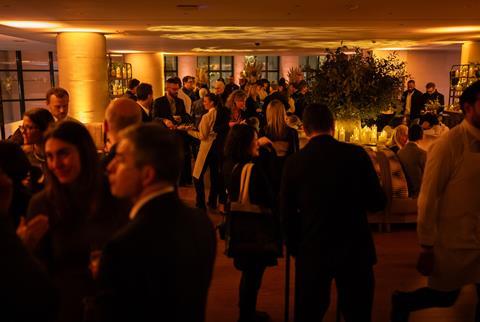
It was by no means just the super-indie groups, however. There was not a spare seat in the Soho Hotel basement for Viaplay’s Monday morning screening either, while Avalon’s opening night party – held at cabaret nightclub The Box – delivered plenty of entertainment for international execs who descended on the Soho stalwart in their hundreds.
The UK company’s flagship drama, Tall Tales & Murder for the BBC and RTE, was among scripted shows getting serious buzz through the week.
There was also the now customary packed house at The Century Club for BossaNova, one of the savviest operators in the business which has been holding events during what is now London TV Screenings week since before the more organised set of events came to being.

Talent was also on display, with ITVS bringing stars such as Graham Norton, GK Barry, Ruth Madeley and Dougray Scott to its Leicester Square event, while BBCS hosted Claire Danes, Charlie Cox, Lucy Worsley and Tommy & Tuppence star Josh Dylan at its two-day takeover of 180 Studios on The Strand.
The US studios, not to be outdone, were also active on the selling side. Sony Pictures Television had Shemar Moore in town to woo global clients as they got their first look at S.W.A.T. Exiles and Glenn Close for Up To No Good, while Minnie Driver fronted Fox’s push for The Faithful, with a premiere held at the august National Gallery.
Senior US execs were also circulating – there was a generous slice of Paramount’s top brass flown over, while plenty of NBCUniversal’s c-suite were in the capital having celebrated NBCUniversal Entertainment chairman Donna Langley’s Bafta fellowship from rince William on Sunday.
Consolidation concerns
All this bodes well but there’s little telling as to how London TV Screenings will look next year.
There was no escaping M&A chatter across the week, aided and abetted by Paramount’s improved offer for Warner Bros Discovery on Tuesday and the potential impact it might have on the international business.
Even prior to Netflix walking away from talks later in the week, US and European execs were clear that Paramount was in the ascendancy and preparing accordingly.
Having forced its way back into discussions, the Landman outfit had the momentum, plus the deep pockets and the political ties, to pull off what would be some coup given the direction of travel just a few weeks ago, execs suggested.

But what it all means for the rest of the world depends on who you speak to. Several senior execs running UK-based groups said Paramount would be the better buyer for them, with more incentive to continue international spend.
A stronger WBD-Paramount entity would also provide increased competition to Netflix - a potential boon for those producing or selling to the streamers - but the David Ellison-led bid would also create huge overlap. Paramount has already said its bid comes with $6bn of synergy savings, meaning more job cuts on top of the 2,000 that were delivered when Ellison combined Skydance and Paramount.
Others believe Netflix would be a better bet, partly because they view it as a more stable custodian of WBD brands such as CNN and CBS, but also because it would deliver a deal that preserves the independence of the legacy cable networks, potentially increasing competition on the buying front in the short term.
WBD’s future was by no means the only deal being discussed, though.
All3Media and Banijay’s potential merger was also on people’s lips, with the merger (or acquisition, depending who’s talking about it) seen as very likely to come to fruition. Synergies are the motiviating factor and, with such overlap, the impact on jobs will be great, as numerous industry insiders told Broadcast International.
Another deal likely to happen sooner rather than later is the Sky and ITV combination – and eyes are now turning to who could emerge as a potential buyer of a standalone ITV Studios. Julian Bellamy’s production and distribution powerhouse has provided plenty of much-needed support to its broadcaster sibling, but there’s no doubt it will become a takeover target when/if the Sky/ITV deals happens.
Private equity groups and European outfits such as Mediawan were mooted as potential buyers by several sources this week, although the latter has yet to complete its sizeable deal for Peter Chernin’s The North Road, so whether another game-changing merger would be in the offing any time soon seems questionable.
It is much clearer, however, that consolidation is rife at all levels. Most producer-distributor groups in the mid-sized category are looking at their options if not actively engaging banks to take them to market, while numerous smaller boutiques are also exploring their next moves as they seek to compete.
It is not surprising. Pressures are apparent on all sides, particularly with buyers look to get ROI on every buck, pound or euro spent.
For distributors in London this week, diversifying is key. Having been gap financiers for years, they are now becoming direct-to-consumer operators in many cases, delivering content to viewers on their own FAST channels or YouTube, as well as leveraging their brands for maximum returns.
All3Media International’s chief exec Louise Pedersen points to licensing as a key focus, having rolled out live events for shows such as The Traitors, and Mark Bishop, co-president of Blue Ant Rights, adds that he is also looking at consumer products “to extend brands into new revenue streams beyond the screen and build long-term value for our partners”.
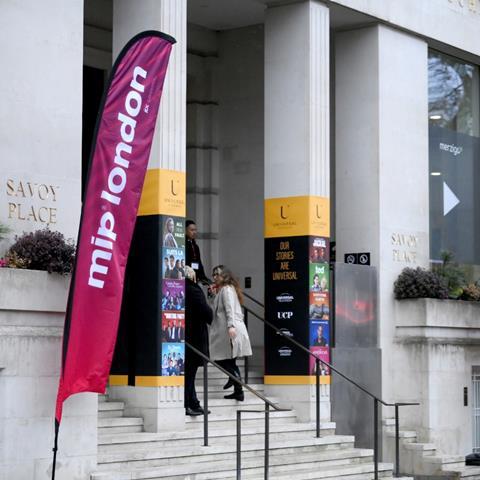
YouTube was a key focus at Mip London, which returned for a shorter three-day edition at the start of London TV Screenings. Organisers RX France said the second iteration had attracted almost 2,000 delegates from 74 countries, with a focus on the creator economy, branded content and microdramas.
Attracting buyers during what is a hugely competitive week remains a tough ask, however. RX France said 750 were registered, with the UK, the US, France, Germany and Spain most represented.
It is understood that a decision on Mip London’s return is yet to be made as post-event debriefs continue, with the initial two-year contract at The Savoy and The IET London now up.
Window pains
Certainly the events in London this week have reflected a rapidly shifting industry, with distribution strategies having to adapt – not least because licensing is becoming an increasingly complicated and challenging business.
One senior sales exec this week said windowing has become like a “contracting concertina”, but with buyers not necessarily paying for the privilege.
Many on the sales side are watching events in France closely, where Netflix and TF1 struck a far-reaching deal last summer that will bring the broadcaster’s content onto the streamer. What it means for the second window is unclear, but concerns are high.
Moritz von Kruedener, managing director of Beta Film – which unveiled sales for Channel 4’s Patience this week and brought premium drama Ludwig to buyers in London – told Broadcast International that all eyes are on the Netflix-TF1 deal because similar partnerships are spreading across the continent.
Guillaume Pommier and Monica Levy, co-heads of France’s Federation, are equally circumspect. “We’re watching these hybrid partnerships very closely, as the TF1/Netflix model has already started to be replicated across Europe and beyond,” they say.
“France has really become a ‘testing’ ground – from TF1/Netflix to the recent France Télévisions, M6 and Amazon arrangements – and we fully expect more partnerships to follow.
“For us and other distributors, the real impact will come down to how second windows evolve. They won’t disappear, but they will need to be defined with far more precision to protect long term rights value and keep the downstream ecosystem healthy,” the duo say.
Mark Young, exec vice-president of EMEA distribution and networks at Sony Pictures, agrees that windowing has become “more bespoke and complex” and therefore it has become “more critical” to be even more strategic and deliberate about rights.

He believes windowing will persist but that “they’ll become more about broadening an audience and amplifying the content across platforms rather than just pure sequencing.” It means talking to buyers at the correct time to ensure they get the coverage they need has never been more important.
And that’s partly why London TV Screenings is finding itself top of mind when it comes to must-attend events on the global industry’s calendar. It provides an opportunity towards the start of each year for execs from North America and Europe to gather, acting as a cost-efficient gateway for buyers, sellers and producers.
London is also seemingly a draw for key decision makers, particularly against the current backdrop of US politics, while the lower cost production capabilities on this side of the Atlantic, the push into English-language dramas from Europe, and the increasing necessity to co-produce and share costs and rights in a squeezed sector, make the UK capital a sensible choice.
London TV Screenings may look considerably different in 12 months time given the rampant consolidation hitting the sector. But as events come to a close, 2026 looks likely to go down as the year that London took the Screenings crown.




No comments yet