

Recouping scripted advances is taking longer for distributors and the industry is feeling the pinch
Financing scripted content has never been a straightforward business but stubborn budgets and ailing spend is causing headaches that may last some time.
While US investment on international projects may be picking up in places, the considerable decline in Stateside investment compared with the level of just three or four years ago has left many producers scouring other parts of the globe for partners and ever more soft money.
Even the entrance of major players such as HBO Max into the UK isn’t leading to more opportunities for most producers, meaning those filling funding gaps in drama must find new ways to support projects.
This task has largely landed on the desks of distributors, which have long provided the vital deficit financing to get shows screen-bound. But recouping those increasingly large advances is a time-consuming process – and the timeframes are only getting larger.
Risk, reward & timing
“We’re all having to re-look at our financing plans,” said Banijay Rights chief exec Cathy Payne, speaking on the Distribution State of the Nation panel at the Broadcast Summit earlier this month. “What’s the level of risk [you put in], if you’re not able to get co-productions on as many shows?
“You’ve got to have a look at that and take a view on how long it’s going to take to recoup.”
Senior distribution and production execs have been hinting to Broadcast International for the past 18 months that the timeframes for recoupment have been increasing at a fair clip over recent years.
“Anyone investing in scripted has a longer view on returns than they would have had four years ago”
Cathy Payne
It is, some argue, simply a reflection of the broader market as audience fragmentation and reduced focus on exclusivity allows shows to have increasingly long tails from a revenue raising perspective.
But it is also a development that has become central, against a backdrop of a scripted industry dealing with lower levels of commissioner spending but stubbornly inflated production budgets.
“Anyone who’s investing in scripted has a longer view on the investment return than they would have had maybe four or five years ago,” Payne added.
Julie Meldal-Johnsen, exec vice-president of global content at ITV Studios, offered a similar assessment. Her company counts big hitters such as Ludwig and Vera among its slate, but even tentpoles are changing financing projections.
“You can only invest what you can afford to lose, but five or six years ago I didn’t really consider an investment as being successful unless we were writing the producer net cheques after two years.
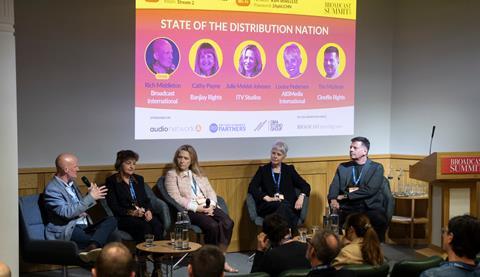
“Now, you’ve gone from a three-to-five-year cycle to more like 10. There are still some shows that the producers are receiving cheques after 18 months, but there are now just one or two examples.”
Louise Pedersen’s All3Media International bet big on Playground’s reboot of All Creatures Great and Small in 2020, with the show going on to become a bona fide hit for both Paramount-owned 5 and the distributor, with hundreds of deals struck around the world.
The show was extended into seventh and eighth seasons last year, something only made possible by All3MI’s “really significant advance” paid at the outset that helped to get the series off the ground.
And while there is no doubt that Pedersen’s hunch on the show’s success was correct, it underlines the problem for both distributors and producers operating in today’s environment of tightened budgets.
“We will be fine of course, we’ll get that [advance] money back, but it does suck up a lot of cash. Cashflow and where it’s going is quite an issue in distribution at the moment. You need deep, deep pockets to [support] some of these shows.”
Producer impact & consolidation
Inevitably, the squeeze on cashflow is being felt by producers. With distributor advances on scripted series tied up in ever-longer recoupment cycles, there is less money around to invest into new projects.
And with the deficits distributors are expected to fill showing little sign of any meaningful decline, packaging has become the go-to model for risk management.
“When we see a project we really like, often the deficits are huge so we’ll try to work with the producer to bring a pre-sale in,” says Tim Mutimer, chief exec at Cineflix Rights, which is behind USA’s upcoming series Anna Pigeon. “And then it’s all about packaging.
“All3 and Banijay’s merger is a good thing for the industry - our clients are consolidating and we need powerful groups to counter that”
Tim Mutimer
“You really have to make sure there’s talent involved that’s going to resonate, whether that’s in front of the camera or behind the camera. You need IP – that’s the other key factor. You want to be going into a territory with something that’s got recognition already.”
Payne, whose company sells shows ranging from HBO and BBC drama Half Man to long-running procedurals like Grantchester, agreed but also nodded to the fact it’s part and parcel of operating in a creative business.
“You can have your projections and shows you might make an investment in but then sometimes the one that sells is the last one you would expect to. If we all knew the answers, it would be easy. So you continue to invest, but you have to be working realistically in terms of where the market is at.”
And while all four execs suggest US activity is showing some signs of recovery, it is not expected to return to previous heights. Neverthless, Pedersen said the distribution sector is adapting.
“The thing is not to forget Europe [and beyond]. It’s easy to get very focused on the US, but we’ve co-produced shows with ZDF in Germany, Stan in Australia, ARD in Germany. There are lots of other markets and they can bring in very useful amounts of money – just not quite the amount the US did in its heyday.”

With the US still relatively cool on co-pros, deficits refusing to narrow, and recoupment taking longer, the financial heft of a distributor has never been greater.
For Pedersen and Payne, this scenario is of course in play with the combination of All3Media and Banijay, and distribution is likely to be one of the major areas for cost-saving.
Neither exec would comment on the upcoming deal, although Payne acknowledged that, for producers, there was potential for “scale, the ability to do more and bring in more revenue”.
Perhaps more surprising, both ITVS’s Meldal-Johnsen and Cineflix’s Mutimer also enthused about the deal, highlighting that producers need larger groups to compete in an increasingly consolidated commissioner landscape.
“We’re talking about our [broadcast and streamer] clients and they’re all consolidating and becoming much bigger,” said Mutimer. “We need powerful producer groups and distributors to counter that.
“And there are other distributors out there who producers can work with. You’ve lost one but we’re still here.”
Meldal-Johnsen agreed. “Financing shows is hard. Having strong distribution partners out there who are well-financed, well-established and have got gravitas in the market to go out and sell your shows widely and at scale – that is going to be good for you.”





No comments yet