


Signs of how boss plans to run Skydance are quietly emerging - not least in his Q3 earnings call earlier this week
It is less than six weeks since Skydance wrapped its $111bn deal for Warner Bros Discovery and while many questions remain unanswered around what comes next, a direction of travel is beginning to emerge.
The Hollywood behemoth’s Q3 results and subsequent earnings call - its first as a combined company - hardly provided the dream start for Ellison, with shares diving 8% on news that WBD’s Q4 film performance would likely miss targets.
And while the Q3 results came too soon for those looking for pointers as to the health of the combined company (indeed, there was no mention at all of WBD’s numbers), the subsequent earnings call threw out subtle indicators of what might come next.
Supersizing synergies
Having already discussed the $6bn synergies target relating to WBD, Ellison reflected on what had happened at Paramount since Skydance’s takeover last year.
His company had, he said, taken over the “underperforming business and made significant improvements”, focusing on “better content, more disciplined investment and a focus on efficiency” to beat what had been pencilled in initially as $2bn worth of savings.
That figure will stand at $2.7bn by the end of the year, Ellison said, and the implication was clear: a similar playbook is being employed on the WBD deal.
There are 20 “workflows” in play at present that are focused on reducing spend in areas such as corporate overheads, real estate, marketing, technology and third-party spend. Five weeks into the job, co-chief exec Ynon Kreiz added that he had seen “very large areas of opportunity to reduce cost.”
Kreiz said he had “very strong confidence” in achieving the $6bn savings, and if Skydance’s approach to Paramount is replicated on the WBD deal, there is every chance that figure will grow. Around 30% of the savings would be found within the first year of the deal, Skydance said, with a further 70% pencilled in to take effect in the subsequent 12 months.
Clearly, for those in the C suites down to the suppliers of their preferred fruit platters, the cuts are coming. But there will also be more prosaic changes - London was highlighted as a city that has multiple offices, and Kreiz said the company would “rationalise” its footprint.
Streaming and reach
As expected, the first move to combine Paramount+ and HBO Max - with a combined 203 million subscribers worldwide - will come in the US in early 2027, with a bundle set to become available to consumers.
Ellison described the move as “a first step towards a fully unified offering”, with FAST offering Pluto TV and Paramount+ sharing the same tech stack. HBO Max’s move would come “much faster” than the combination of P+ and Pluto TV had, he continued.
While Skydance’s film business remains a challenge in the short term thanks to the “softness” inherited from WBD (longer term issues include Ellison’s need to find a further eight movies by 2028 to honour his promise to regulators), momentum is at least moving in a better direction within the TV and streaming portion of the business.
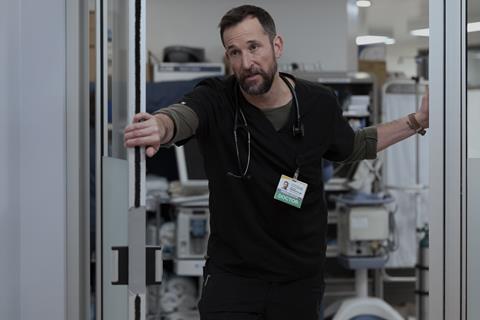
The Skydance chief exec noted HBO Max’s revenue growth and some predictable hits in the form of The Pitt S2 and House of the Dragon S3. Less expected was the shout-out to Richard Gadd’s Half Man, produced with the BBC by Banijay’s Mam Tor Productions.
Ellison noted his company’s “extraordinary libraries, franchises and creative talent”, and spoke more broadly about the need to “greenlight more selectively” while prioritising “profitable streaming growth over subscriber counts”. Paramount has doubled down on its franchise strategy over recent years - from Yellowstone to Fire Country - and there seems little doubt that will change, with content chief Casey Bloys having to finely balance mainstream hits with HBO-style premium fare.
Kreiz also alluded to the economies of scale that Skydance now employs, specifically pointing to the ability to “amortise content” investments across a larger base, “which will make our economics very different than the old days.” Added to that will be the combined leadership across DTC and linear, able to make decisions that deliver the best results for the company. What that means for third-party, independent producers, is less clear.
Skydance also wants to “optimise” its linear operations but Kreiz noted that “cost synergies” are not the only game in town, adding that “significant revenue synergy opportunities” are also emerging.
That should enable the various brands - CBS, CNN, Paramount+, HBO Max and the like - to deliver greater returns than they would standalone. This is classic 1 + 1 = 3 stuff - and in the US the dovetailing on CBS with a big streamer makes sense. A $1bn cut to marketing spend will be enabled by using the clout of cross-promotion on Skydance’s various platforms. Less clear is how that strategy plays out with a broadcaster such as 5 in the UK and Skydance’s sibling streamers HBO Max and Paramount+, another area to watch.
Content spend, global vision & distribution
“Revenue synergies” are also expected in content licensing, with 15,000 movies and hundreds of thousands of TV hours in the catalogue. Kreiz said the heft of the organisation would provide “more opportunities and more flexibility around windowing, particularly in the second-run licensing business” for both TV and film.

Skydance pointed out that its annual content spend of $30bn is the highest in the industry - but a cut to that extraordinary amount was not explicitly mentioned.
Instead, Kreiz said he wanted “to optimise that budget to maximise value across the company”, going on to explain that the focus will be on better monetising commissioned IP across all its platforms.
“With the reach of our combined platforms across streaming, broadcast and cable, each title can work harder for us,” he said, suggesting an ever-closer union between streaming and linear. “And as one company, we can make smarter choices about how we distribute and monetise both new content and library content,” he added.
There has been little detail on how Skydance’s operations around the world will operate, with Reemah Sakaan’s 5 in the UK and Network 10 in Australia ultimately falling under the remit of JB Perrette.
Another level of management will be installed between Sakaan and Perrette, however, as part of his plan to have four regional non-US leaders overseeing the key regions of the international business.
What’s becoming clearer is the push to align those international operations with what’s happening in the core US market. Kreiz alluded to exactly this in the call, with a plan “to manage the company holistically as part of one global strategy so that we can take advantage of our scale, our strength and our capabilities.”






No comments yet