
Streamers and broadcasters unveiled a strong line-up at La Rochelle but producers know financial pressures are only growing
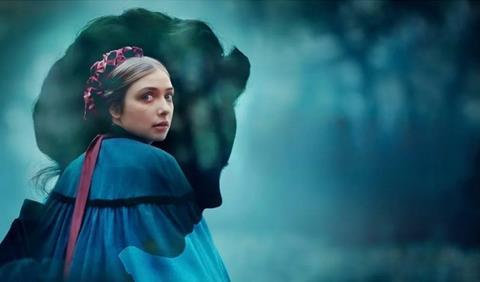
For those at the preview screenings of Festival de la Fiction in La Rochelle earlier this month, French drama looked in great shape, with broadcasters premiering event-driven series with high production values.
M6 debuted Le Charles, shot aboard the eponymous aircraft carrier, while Arte presented the cinematic Belgian co-production Eldorado, about the 1980s great oil-sniffer hoax. France Télévisions highlighted Nourrices, about young nannies exploitation during the 19th Century and TF1 premiered one of its most expensive production to date: the €24m La Comtesse de Monte-Cristo, starring HPI’s Audrey Fleurot, also backed by Netflix.
Meanwhile, HBO Max previewed its first French genre original, dark thriller Paolo.
Pressures on traditional funding
Despite the dynamic screen line-ups, the atmosphere remained rather heavy amid concerns over falling funding at TF1 and France Télévisions. News came in that the French government was planning a further €47m (£40m) budget cut for the public broadcaster next year (following an €80m in 2026), and combined with falling advertising revenues, it means a €90m shortfall, according to president Delphine Ernotte-Cunci. As a result, commissioning budgets are likely to shrink by a further €20m.
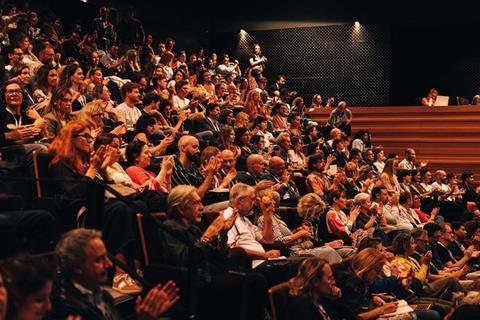
Meanwhile, TF1 chief exec Rodolphe Belmer warned that the TV advertising market has dropped 10% this year with “no sign of recovery”. The blame is largely pointed at YouTube, which is now widely watched on TV sets and is consequently capturing former TV ad spend, but does not have the same stringent rules that TV players have to abide by.
Producers are backing TF1’s call for the French government to rectify the asymmetrical regulations, starting with advertising (such as ad airtime limitations and retail sector bans), and removing the 66% discount that video-sharing platforms enjoy regarding the CNC tax. Another approach to rectifying the disparity could lie in Brussells, with the upcoming possible revision of the AVMSD. “It’s a difficult battle,” said European deputy and vice chair of the committee on culture and education, Emma Rafowicz, “but that has to be driven [forward].”
“We have built our cultural exception model on linear channels, then we started including streaming platforms, and we now we need to translate it fully into the digital world,” said Belmer.
Netflix - France’s second biggest scripted backer
Local trade body Arcom was in la Rochelle to reveal its figures for 2025, which showed that overall investment in French and European TV works and film production, as part of broadcasters’ and streamers’ obligations, is stable at €1.62bn (+2%), but with stark shifts.
Broadcasters’ investment dropped 8% to €1.1bn, while streamers surged 32% to €525m, mostly due to more platforms contributing, Arcom said. Nevertheless, Netflix has become the second-largest investor at €308m, trailing France Télévisions (€476m) but ahead of TF1 (€241m).
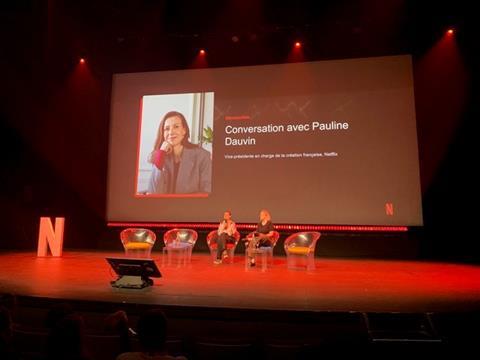
Netflix’s presentation also revealed some tensions within the current regulations, with vice president of content of Netflix France, Pauline Dauvin, criticising movie windowing and the recent genre sub-quota decree that requires streamers to dedicate 20% of their investment obligations to animation and documentaries.
“We are asked to invest more and more in movies, yet the window is getting longer and longer [17 months after theatrical release] while rights are getting shorter and shorter - it doesn’t make sense economically,” she said. “As for the new decree, we consider it discriminatory and disproportionate.”
Having filed an appeal with the State Council this summer, alongside Disney+ and Prime Video, Dauvin argued the rules double what had been negotiated in trade agreement with producers and that they threaten editorial freedom.
“In the long term, we are worried that if nothing changes, Netflix might become the biggest investor in French creation, ahead of France Télévisions. This is not good news for the sector, nor for us,” she also said. Netflix is asking for a ceiling on its investments.
Despite the friction, Netflix unveiled a strong slate including Lupin Part 4; Quasimodo l’âme de Paris, set in a revolutionary period Paris affected by cholera; the first comedy series by the highly popular French comedian Dany Boon; the recently launched Call My Agent! movie; and the sharks of Under Paris will also return in a second opus. “Don’t try to tick boxes,” Dauvin told producers. “Submit us projects with strong creative ambitions.
HBO Max, which agreed a trade agreement aligned with the new decree including around local documentaries, announced in La Rochelle two new French series commissions with horror-thriller Bodycam and medical drama Rush.
Public broadcaster’s balancing act
Budget cuts might be hitting France Télévisions but it won’t stop them from having ambitious projects. “If volume is impacted, quality won’t be,” promised Anne Holmes, France Télévisions’ director of creation. In addition to fewer commissions, especially in TV movies, mini-series have fewer episodes.
France Télévisions’ upcoming mini-series includes two major co-productions with HBO Max in the first window: Alice, about silent movie director Alice Guy, and’ Rallye 82, set during the 1980s World Championship. New period drama projects in production include Louise Michel, a Montmartre teacher turned 19th-century revolutionary figure, and Rimbaud-Verlaine, which explores the dark relationship between the two poets.
The next Alliance major coproduction with ZDF and RAI is The Emperor’s Stone, which has a pre-buy from CBS Studios in the US. France Télévisions is also making a move into action series, with three currently underway, the first of which is Stunts.
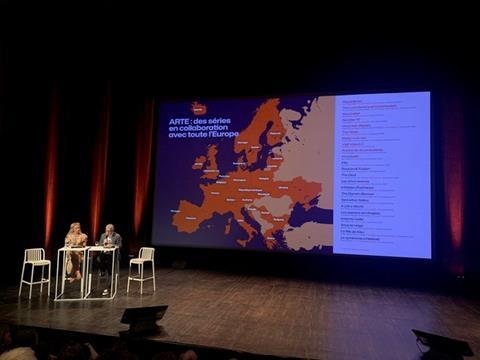
Fewer projects might come out of the Alliance, said director of international drama and movies Manuel Alduy, as it remains difficult to find projects fitting all partners’ priorities. France TV is looking to diversify international coproduction partners.
France Télévisions and Arte won most awards in La Rochelle this year. Its missing soldiers costume drama Les Disparus des Argones won best series, Ça Va Bien se Passer best comedy and TV movie Au Sein des Autres - exploring breast cancer - also landing prizes. Arte’s Un Jour On Fera l’Amour took best comedy mini-series, while Impossible won out in the best suspense one-off.
Arte has a smaller scripted budget, but that is being increase slightly, said the channel. Alongside high-end French author-driven fare, as described head of drama Agnès Ollier, Arte continues building its European footprint. “European series are currently taking on a new dimension on Arte,” said deputy head of drama, Alexandre Piel. Movistar coproduction Anatomy of a Moment is a flagship launch this autumn.
New copro partners include Channel 4 with Will Smith’s The Siege and Royal Blood, a six-part period drama directed by Erik Richard Strand (Occupied) and coproduced with the Scandi alliance (TV2 Denmark, TV4 Sweden, and TV2 Norway).
Arte is also exploring more faraway coproductions with a goal to “bring the European puzzle to life,” he said. Arte has stepped into the Baltic’s The Last Divorce of Communism, by Teodora Markova and Stanislavs Tokalovs (Soviet Jeans), and Michal Blaško’s November is coproduced with Slovakia. Arte’s platform now carries 50 series permanently, and ran to a total of 1,200 hours from 33 countries last season.
Ecosystem under pressure
As demand for high-end series remains, Haut & Court TV’s Simon Arnal announced that The Creatives, which regroups nine prodcos from Europe and beyond, is going to set-up a joint company with a light team to focus on more ambitious projects.
Production costs remains stubbornly high, however, and producers are the ones who need to find deficit financing, unions stressed, with the market getting more difficult to navigate especially around international sales.
There are questions on how hyper-distribution agreements between channels and broadcasters might disturb the exploitation of rights, too. FranceTV’s Stéphane Sitbon Gomez argued that it is thanks to the deal with Prime Video that france.tv now reaches 45m users every month.
Disney+, who recently struck an agreement with M6, pointed that the streamer makes deals on a selection of curated shows rather than the entire service, “and that enables us to experiment with new windows,” said senior vice president and country manager, Hélène Etzi.
“It complicates everyone’s task, but it is necessary to make progress,” she added, reminding the audience that the group has long worked in partnership with local broadcasters and producers since its arrival in France, initially licensing programming the other way around.
Next to high-end and regular scripted fare, public broadcasters are also developing short form series, including verticals, to target younger audiences on social platforms, and that offers new space for scripted.
And despite the many issues facing the genre, the festival remained driven by creative. “We live in a world of abundance of content and that means the audience wants to make choices quickly, favours what is familiar, and therefore demands [well-known] IPs,” said producer Lorenzo Benedetti. “But on the other hand, abundance also creates an interest for what is different.”



No comments yet