

Simon Corney, executive producer at Whisper, reveals what went into the Red Bull and Disney+ show with F1’s Max Verstappen
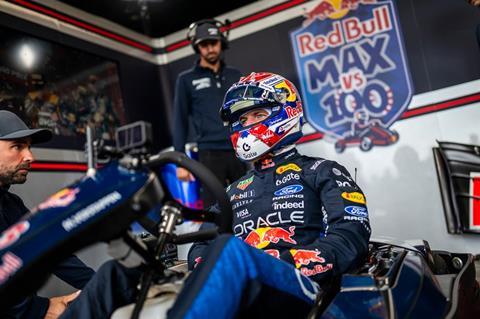
Red Bull is constantly developing ideas with its athletes. Many get pitched but few ever make it into production. Max vs 100 was one of the exceptions.
The idea was brilliantly simple: put 100 creators, celebrities and athletes on track, give them a head start and then send four-time Formula 1 World Champion Max Verstappen after them. If Max passed you, you were out. Survive for 30 laps and you’d beaten one of the greatest racing drivers in the world.
Crucially, Max bought into the idea early and Red Bull began working out how to make the project a reality. Disney subsequently came onboard as the global broadcast partner and we at Whisper joined the project later still, just eight weeks before transmission, with the challenge of turning a great event concept into a live entertainment show.
We were confident immediately though. One of the biggest stars in world sport, genuine competition, a simple premise, brilliant jeopardy, Disney’s global reach and a Red Bull brand and event team that knows how to put on a spectacle. It had everything!
From the beginning, we planned to lean into everything that made this different from traditional motorsport coverage, particularly access.
We could be with Max in places an F1 broadcast simply can’t. We filmed inside his Race Director briefing, interviewed him right up until the start and spoke to him while he was actually racing.
Early in development we decided to mic all 100 competitors and take the ‘Team Radio’ concept further by borrowing the sensibilities of gaming ‘proximity chat’. Working with Spiritland, who designed and built the bespoke audio solution, we created a system that allowed us not only to hear Max and the other drivers, but to open conversations between them during the race. Max could talk to someone he was hunting down, drivers could react to each other, and we could even create mini ‘conference calls’ between multiple competitors.
This was done by using the Spectera system from Sennheiser which combines the Mic and IEM into one single, small form beltpack. Custom pockets were added to the arms of all the race suits to allow the antennas to project while not getting in the way of the karter.. Once coverage around the entire track was in place there was a custom switching system developed which meant that on demand different drivers could be put into the different call groups with Max or with their other competitors. The broadcast team in the commentary box or studio could also interact live with the drivers. Managing these as group calls meant we could editorialise the discussion and help the viewer understand who they were hearing from at what time.
All of the karts with onbaord cameras also had their microphones embedded to these pictures at all times, this was used by many of the creators on their own streams to tell their story of the race and cross promote the full race coverage on Disney+ extending the overall reach of the event.
That gave us something completely different editorially. Instead of watching people race, the audience could be inside it with them, hearing the nerves, excitement, competitiveness and trash talking in real time.
We worked hard to get as many of the 100 drivers into the broadcast as possible. These weren’t anonymous competitors, they were creators, athletes and entertainers with a combined social following of over half a billion. They had their own audiences around the world who we needed to serve.
The scale was vast. One hundred drivers on track could very easily have become visually and editorially overwhelming, so our graphics needed to do the opposite. Working with our GFX design company, Chapter 3, we designed the entire broadcast brand and on screen design package from scratch, deliberately simplifying and ‘gamifying’ them so someone who had never watched a motor race could immediately understand what was happening, who was left, who Max was chasing and how close he was to catching them.
We had some development work done to get live data out of the driver audio system that we could integrate with the GFX engines… this was done to facilitate a “who’s talking” graphic automatically based on which microphones are in which conference and transmitting audio at that time. When there are 100 mics on track, this type of system was to help the viewer understand whose voice they were hearing from inside the helmet.
Working with our outside broadcast partner NEP, we built a production capable of covering both the sporting detail and the sheer scale of the event. Drones were identified as crucial very early, particularly the FPV drone. We wanted a dynamic ‘game view’ that could follow the action, put the audience into the chase and show 100 karts filling the circuit in a way conventional cameras couldn’t.
As well as the drones we had 20 race cameras including a mixture of super slow, robotic and RF cameras and a further five cameras for the presentation side of the production.
To ensure the flexibility required for presentation NEP installed comprehensive RF coverage across the kart building, track, paddock, pits and grid areas. This meant the presentation team could spend their time out and about in the various areas of the race rather than in a fixed studio location.
The RF coverage was also critical for the 30 onboard cameras on track. With forward and driver facing cameras installed on 15 karts they were designed in a way that they could be moved from kart to kart as they were built into custom nosecones which were easily interchangeable. This meants we could prioritise the drivers we wanted to based on their times in free practice.
All of the coverage came from two of NEP’s large scale, IP OB trucks, Venus and Albiorix. These units provide a shared infrastructure which is ideal for productions like this where directors want to share cameras across the two vision mixers and both units need comprehensive talkback to each other.
Talent was another important part of making the programme accessible. Mo Gilligan brought entertainment, humour and broad audience appeal, complemented by Nicki Shields and the wider broadcast team who brought genuine motorsport expertise. We also localised the broadcast into five additional languages via a London hub, to maximise its international reach.
Localisation was done by using remote commentary infrastructure and central mixing at Gravity Media’s Westworks facility in London. By conducting the commentary remotely we could source the best commentators in each territory without the need to travel them to London, we simply sent them to a suitable commentary studio near their location and managed it all from London. By using this central London hub we also had an on-network transmission centre to send the required signals to the Disney MCR in the USA for encoding and putting onto the Disney + / ESPN platforms worldwide.
With only eight weeks from Whisper joining the project to transmission, collaboration was everything. Disney, Red Bull, Whisper, our talent, the event operation, NEP, Spiritland and the wider technical teams all had to be pulling in the same direction. There simply wasn’t time for organisations or departments to work in isolation.
The response since transmission has been overwhelmingly positive - there was something for everyone. It worked for petrolheads, for casual motorsport fans, for kids and for people who would never normally choose to watch motorsport. The audience loved seeing a different side of Max, the innovation around the coverage and a motorsport show that didn’t take itself too seriously.
We had a brilliant experience working with Disney and Red Bull and we’re already looking at adjacent ideas in motorsport but we believe the opportunity goes much wider. At Whisper, sport meeting entertainment is right in our lane. Take genuinely elite sporting talent, create a simple, accessible challenge around them, add creators and personalities who bring their own communities, then use top class production and technology to give audiences access they wouldn’t normally get.
Max vs 100 showed what can happen when all of those things come together.
We’re already thinking about what comes next.
Simon Corney is an executive producer at Whisper



No comments yet