

The FX5 brings Open Gate shooting, Dual Gain mode, three base ISOs and 32-bit float audio to a portable body

Sony has launched the FX5, a new full-frame camera in its Cinema Line series.
It has a newly developed fully-stacked CMOS image sensor, 15+ stops of dynamic range, a Dual Gain Shooting mode, and three base ISO settings.
For the first time in the Cinema Line FX series, it supports Open Gate shooting as well as in-camera recording in X-OCN, Sony’s proprietary RAW format.
The camera is capable of shooting in 5K at up to 60 frames per second, in 4K up to 120 frames per second and in FHD up to 240 frame per second.
These features bring together the Cinema Line look and operability designed to meet the needs of production environments in a compact, highly portable body, says Sony.
Sony has also released two optional accessories – a detachable OLED viewfinder and an XLR Handle that enables recording in-camera at up to 96 kHz, 32-bit float.
“The new FX5 removes creative barriers to deliver a performance and flexibility that the filmmaking community can excel with. Its compact design, image quality and workflow deliver the precise tools that take the FX series to the next level,” said Florence Quintin, video and cinema marketing lead, imaging products and solutions, Sony Europe.
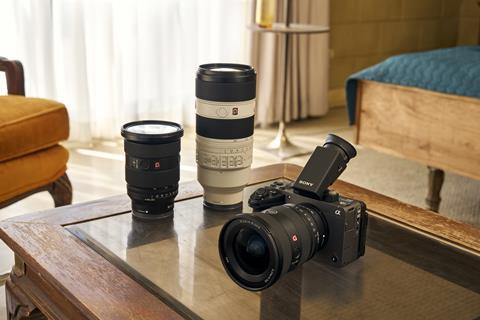
The camera is equipped with a full-frame fully-stacked Exmor RS CMOS image sensor and the latest high-speed BIONZ XR2 image processing engine, which includes a dedicated AI processing unit.
When shooting in S-Log, the camera achieves 15+ stops of dynamic range. The broad latitude and low-noise performance enable seamless roll-off from highlights to shadows and natural texture reproduction, even in high-contrast scenes, says Sony.
Three base ISOs of ISO 800, ISO 4000, and ISO 12800 enable low-noise image expression under a wide range of conditions. The Dual Gain Shooting function, supported for the first time in the FX series, maximises the performance of the image sensor to enable smooth gradation reproduction with even wider latitude, while effectively reducing noise without compromising shadow detail.

Insight: The FX5 sits between the Sony FX3 and FX6 in Sony’s camera range. It is aimed at videographers as well as cinematographers, as a B or C camera to the Sony Burano or Sony Venice camera.
Sony anticipates the camera to be popular for commercials, music, events and online entertainment shoots.
It is also well-suited to owners of the FX3 who have perhaps outgrown the camera and are looking for an evolution and expansion of the camera’s features.
The camera offers support for in-camera recording in X-OCN, Sony’s proprietary 16-bit scene-linear RAW format, enables high-quality recording without the need for an external recorder.
In addition to X-OCN LT, the camera supports newly added X-OCN C1 and X-OCN C2 codecs. By reducing data size, these codecs enable high-speed transfer of high-quality images and reduce data volume, helping streamline post-production workflows.
Subject recognition using AI-based human pose estimation technology allows the camera to accurately detect not only the position of a person’s eyes, but also the position of the body and head, delivering high AF performance even in dark scenes, explains Sony.
The camera also supports real-time tracking, which automatically tracks subjects and enables stable focus work.
When shooting with Auto Tracing White Balance (ATW), the camera uses information from visible light and IR sensors, as well as deep learning-based light source estimation, to identify scenes with high accuracy. AS a result, Sony says it achieves more stable and natural white balance in shaded areas, indoor scenes, and other situations.
The camera also features a desqueeze function that supports anamorphic lenses, enabling shooting with 1.3x, 1.5x, 1.6x, 1.8x, and 2.0x anamorphic lenses.
The camera also features 5-axis optical in-body image stabilisation. In addition to optical image stabilisation and Active Mode, the camera features Dynamic Active Mode, enabling stable image expression even during handheld shooting.
When combined with the newly developed XLR handle unit, the camera supports high-quality audio recording of up to 96 kHz, 32-bit float, and 4 audio channels. It is also compatible with the optional 0.58-type tilting OLED viewfinder, which enables accurate monitoring even in bright environments.



No comments yet