
Continental co-production pacts and Netflix’s court case against local investment obligations point to an evolving landscape

US-based streamers have made an indelible mark on Europe’s audiovisual sector over the past decade or so, pumping billions of dollars into the creation of shows from the continent and pulling out billions of Euros in subscriptions in return.
That equation, which also includes thousands of hours of US shows being funnelled into Europe, had been largely accepted until recently. But with the extending reach of the streamers and the challenges faced by European broadcasters, as well as a shifting geopolitical situation in the US, the rules of engagement are changing.
The push-and-pull between US streamers’ demands for independence and Europe’s attempts to protect its cultural diversity are probably best evidenced in the French-speaking region of Wallonia-Brussels.
It was here that Netflix attempted to push back against the European Union’s Audiovisual Media Services Directive (AVMSD), part of which allows countries to impose local content investment obligations on streamers. This was central to a long-running case that has been closely watched and, when the Belgian court ruled largely in favour of the EU late last month, the reaction from the production sector was clear.
“This case goes beyond the framework of a purely Belgian dispute,” a raft of European production unions said. “It raises a central question for the future of the European cultural model: can global platforms develop in national markets without contributing in a fair and proportionate way to the creative ecosystems that make these markets attractive?”
Netflix, which was joined by Disney as an interested party in the case, noted the decision. Some of its arguments, including whether acquisitions can count as part of the obligatory local investment spend, are being sent on by the Belgian court to the European Union’s Court of Justice for further clarification, a move welcomed by the world’s biggest streamer.
But the broader question, as the production unions noted, is around “the future of the European cultural model” and working out just how the US streamers’ international divisions fit into that structure.
Co-production transparency
“Cultural diversity” is the major focus for Alain Berset, secretary general of the Council of Europe, who was at Series Mania in Lille last week at a signatory event for the Convention on the Co-production of Audiovisual Works for Series.
Billed as the first international legal framework to support co-productions, the aim is to create “transparency around the rules to allow the market to develop,” Berset told Broadcast International in Lille.
“We want to create a playground where it is easier for independent producers to find their place,” he continued, adding that the framework would support smaller producers “to ensure they are not being discouraged by huge administrative complexity.”
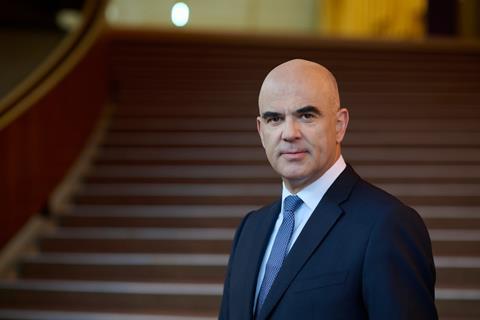
“It is about recalibration – it helps to recalibrate the relationship between big producers and small independent producers and streaming platforms, huge actors in the US and smaller producers elsewhere. It allows the latter to play an important role.”
The CofE represents 46 member states, all of which are encouraged to sign up to the co-pro convention, but non-member states can also sign up. It will come into force upon ratification by three members, and promises “clearer criteria” for financial and creative contributions, as well as more predictable rules around ownership and rights. Designated co-productions will also be able to access national financial support in participating countries more easily.
Just how broadly this framework is used by producers remains to be seen but, arguably, the fact that it even exists is the most immediately noteworthy point. Local investment obligations via the AVMSD, itself under review this year, have already nudged Netflix into the aforementioned legal action in Wallonia-Brussels, and now another pan-European body in the shape of the Council of Europe – an entity separate to the European Union – is looking to strengthen the hand of producers further.
Collectively, these are signs that Europe is flexing its various muscles in a way not seen before. The co-pro convention “underlines the importance of diversity,” Berset added, a point underlined in a recent study by the European Audiovisual Observatory, the data and analytical division of the Council of Europe.
Its rather timely report found that US films and TV series made up nearly half of all content available on streamers and VoD services in the European Union in 2025, with European originated programming – shows from all 46 Council of Europe states – accounting for 32%.
Berset is clear about his wish to empower European producers, and during his Series Mania keynote he urged the continent to create conditions that allows its creatives to “tell their own stories”. The president reflected on recent events including Donald Trump’s vision to own Greenland, US-driven political change in Venezuela and the Iran war, adding that the world was being pushed ”deeper into rupture”.
“The temptation is to tell ourselves that this is the new reality, that we need to accept this and that we can compromise on our values without losing out who we are. We can call this pragmatism, but if we stop asking what order we want to defend, we will drift from concession to concession until we stand for nothing at all.”
‘We need to take action’
Such a scenario does not seem to be on Berset’s agenda – indeed, he is feeling bullish that the landscape is already changing, fitting perhaps given the push by European public broadcasters to embrace riskier projects and a recent report from the Federation of Screenwriters in Europe underlining the dangers of self-censorship.
“We need to take action,” he told Broadcast International. “Maybe I’m too optimistic, I don’t know, but my impression is that we have developed in a positive direction over the last two or three years in very difficult conditions.
“We needed to change something, we needed to be more active. We need to be more coordinated, because we are seeing the rapid evolution at a technological level, with the geopolitical crisis, with the brutal war in Ukraine and now with the war in Iran – what does it mean for all of us?
“We are all concerned with what’s happening, and there’s also generative AI. What does it mean for information, disinformation, news, fake news? What does it mean for the quality of the debate for democratic values? What does it mean for all those important elements [affecting] the European continent?
“Everybody knows now that we need to decide how we want to manage this – that’s why I’m more optimistic today.”
Berset adds that all European institutions “should play their role at the highest possible level. For the Council of Europe, we are not a strong power in terms of finances – we are not able to change the reality of the continent just by investing money or [introducing] subsidies but we are able to do this by developing frameworks, by developing common ground – for example, here with series.
“It is one element, but we have other actors – public and private, national and international – along with the European Union. They all need to play a role at the highest possible level to make sure that we have strong production in Europe. It’s not this approach or another approach - it must be both.”
How this all plays out on a continent in which there is growing demand for US streamer shows – and the vital finances they plough into the European audiovisual sector - remains unclear. What is evident, however, is that Europe is no longer sitting back: instead, it is coordinating action across the continent like never before.






No comments yet