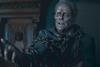
Dimension’s virtual production producer Ozan Akgun reveals how it turned Hugh Bonneville into a ghost for Christmas Karma

CHK_STILL_R2_02161505_2025-06-26 copy

Christmas Karma is a modern retelling of A Christmas Carol and a bold reinterpretation of the classic tale. Moving away from the familiar Dickensian aesthetic, the film presents a world that felt more vibrant, and unmistakably contemporary. The ambition for interesting or unexpected visuals extended to one of the story’s most iconic figures: Jacob Marley, the ghost who sets the narrative in motion.

Instead of relying on traditional makeup or prosthetics, director Gurinder Chadha and her team opted for a fully digital version of Marley – one that preserved Hugh Bonneville’s human elements while the character was fully a part of the supernatural. To achieve this realistic depiction of a spectral figure shackled in chains and dragging heavy safes behind him, the crew turned to a virtual human powered by Dimension Studio.

Capturing Hugh Bonneville: building the performance from the ground up

To bring Marley to life, or more accurately back from the dead, we started off by running a full performance capture session with Hugh Bonneville on a motion-capture stage. Chadha directed closely throughout, shaping the emotional tone and physicality of the performance.

Knowing Bonneville’s interpretation of Marley would lean heavily on expressive nuance, our team chose a FACS-based facial capture rig combined with a head-mounted camera (HMC) to secure the highest level of anatomical accuracy.

Marley_BTS Capture

This allowed us to capture even the most subtle muscular shifts around the eyes, cheeks, and mouth. Vital when the character transformation would later obscure large parts of his face with ghostly effects.

The body was captured using Vicon’s Valkyrie 26-megapixel cameras, which include zoom lenses for fine-tuning coverage. The team used a traditional marker-based suit to secure the highest possible fidelity, particularly for finger motion and weight distribution.

Hugh had to be scanned three different ways within a single session. The first was a neutral photogrammetry scan without makeup, and then again with full makeup so the team could reference exactly how Marley should look on camera and lastly, the mocap suit for performance capture.

Each element had to happen in the right order to ensure the team had all the reference data they needed; for anatomy, costume fit, skin detail, and facial expression calibration. The entire shoot was completed in a single day due to Hugh’s limited schedule.

O_CK_MAR027_0030_comp_slap_lighting_A_v005.1001

During the session a digital proxy of Hugh was built using Unreal Engine’s Metahuman. This meant that during the shoot, Hugh could see himself on the monitors as a rough version of Marley. Chadha could then frame shots more accurately thanks to virtual set markers and physical tape on the floor that indicated bed corners, doorways, and walls. This helped prevent the actor from walking through virtual geometry that didn’t physically exist.

Once the performance was captured and the data processed, the team could move into finalising and refining the digital character.

Finding the balance between ghost and human

With Hugh’s mocap performance in place, Dimension’s character team, of around ten specialists, began working with Chadha on the digital Marley. This process - which involved character creation, mocap retargeting and an animation polish - took approximately five months and involved a detailed pipeline that moved between Unreal Engine and Maya.

CloseUps.0007 (1)

Eyes, teeth, tongue, beard, eyelashes, and hair were all built, with styling which historically has been one of the hardest areas of real-time content development. With the design underway, the performance was also retargeted, bringing together the scan data and our digital twin.

Hugh’s mocap performance was retargeted onto Marley’s facial and body rig. His posture, weight, and expressive intent, especially important given the heavy chains and safes Marley drags behind him, were preserved through detailed animation polish inside Dimension’s real-time pipeline. The character’s final look-dev, including final animations across 34 shots, was delivered to the VFX vendor for cloth and chain simulations, and final renders.

The biggest creative challenge on this project, however, was finding the sweet spot between Marley’s ghostly, unsettling aesthetic and the emotional truth of Hugh’s performance. The look of the character went through multiple iterations, including several experimental designs that dialled up the horror: skull-like transitions when he grew angry, ghostly bone structures under the skin, and different hair “grooms” ranging from full, dishevelled locks to the sparse, final look that communicated his suffering in the afterlife. Some ideas were ultimately toned down to maintain the film’s PG rating.

Marley_01

Chadha remained closely involved throughout, providing precise and emotion-focused notes. She remembered every nuance of the performance she had directed on the mocap stage, and she wanted that same emotional presence carried into the digital version. Her first reaction when seeing Marley animated, “I can see Hugh in his eyes”, became a defining validation for the team.

A ghost for a new generation

Christmas Karma demonstrates how digital production techniques can bring classic characters to life in new and unexpected ways. By grounding the supernatural in the tangible emotional reality of Hugh Bonneville’s acting, Chadha and Dimension have created a Marley who feels both recognisable and entirely new—a ghost reimagined for a modern audience.

Ozan Akgun Dimension

Ozan Akgun is virtual production producer at Dimension Studio