

The AI Training Network returns for the second year at MPTS 2026
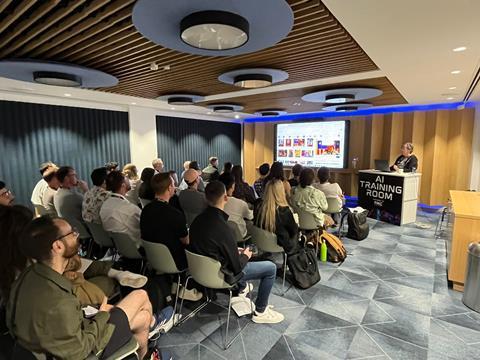
The AI Training Network returns to MPTS this year, once again delivered by FMC.
Back after proving a popular choice for industry specialists in 2025, the series of two-hour workshops will feature world-class AI creativity experts from the US and UK sharing breakthroughs in everything from generative design and sound to the legal pitfalls of AI. You can see the full programme by clicking here. It takes place over both days at MPTS 2026, 13-14 May, in person at Olympia London.
The workshops are ticketed and available from £199-per-session, and you can buy your own ticket here.
Ahead of the AI Training Network’s return next week, Broadcast Tech spoke to instructor and consultant Luisa Winters, who will be leading several of the sessions on offer.
The AI Training Network has returned to London after its successful debut last year. What can attendees expect from this year’s workshops?
Attendees can expect practical, real-world training that is not just about “look what AI can do,” but about how we can actually use these tools in production, broadcasting, editing, and storytelling. My goal is always to make the technology feel approachable. We’ll look at where AI can save time, where it can open creative possibilities, and just as importantly, where human judgment still matters most. These workshops are designed to help people leave with ideas they can use right away, not just theory.
With all the emerging changes in technology such as AI and immersive media, there is a lot of information to take in. How have those topics matured, and what new conversations are shaping this year’s workshops?
AI has matured very quickly. Last year, a lot of the conversation was about curiosity and experimentation. People were asking, “What is this? Can it really help me?” This year, the conversation is much more serious and much more practical. We are now asking, “How do we use this responsibly? How do we fit it into real workflows? What happens when AI is not an option? And how do we protect creativity, accuracy, and trust?”
In my workshops — “AI Video Editing/Broadcast TV: Frame the Future” and “AI Broadcasting: Smart Strategies When AI Isn’t an Option” — I want to explore both sides of that conversation. Yes, AI can be powerful. But professionals also need strategies for moments when AI tools are unavailable, inappropriate, restricted, or simply not the best choice.
The workshops are covering a lot of fundamentals in AI, and are even sharing space with Post Production World Conference this year. What does the scope of the event as a whole say about how job roles are changing in media creation?
It says that the walls between job roles are getting thinner. Editors are being asked to understand graphics, audio, delivery, social media, AI tools, and sometimes even strategy. Broadcasters are thinking about automation, metadata, accessibility, speed, and audience engagement. VFX artists, colorists, producers, and editors are all being affected by the same wave of change.
AI is absolutely automating many tasks, especially the repetitive ones. But so far, it has not replaced human ingenuity, taste, experience, or heart. It can assist with the work, but it does not truly understand the emotional reason behind a cut, the responsibility behind a news story, or the creative instinct that tells you when something feels right. That is still us.
Looking ahead, how do you see the role of the post-production professional evolving over the next 3–5 years, and how are this year’s workshops designed to prepare attendees for that future?
I believe AI will become mainstream in post-production. It will not be something “extra” that only a few people use. It will be part of everyday workflows, the same way non-linear editing, digital cameras, and cloud collaboration became part of our industry.
The professionals who know how to use AI thoughtfully will have an advantage. Those who ignore it completely may find themselves falling behind. At the same time, I think we are going to see more unified laws, regulations, and standards around AI-generated content. Governments and industry organizations will need to address disclosure, authenticity, copyright, and the danger of presenting something created solely by AI as if it were real.
That is why these workshops are not just about tools. They are about judgment. They are about knowing when to use AI, when not to use it, and how to stay relevant while still protecting the integrity of the work.
The AI Training Network caters to professionals from across the entire post-production ecosystem, from VFX supervisors and colorists to editors and broadcasters. How important is this cross-disciplinary gathering in today’s fragmented media landscape?
I think it is incredibly important. We are all dealing with different parts of the same transformation. An editor may be thinking about speed. A colorist may be thinking about consistency. A broadcaster may be thinking about accuracy and trust. A VFX supervisor may be thinking about experimentation and cost.
When all of those people are in the same space, the conversation becomes much richer. AI gives us the ability to try things that would have been too expensive, too time-consuming, or too risky in the past. But we need to learn from each other to use it well. This kind of gathering helps people see beyond their own lane, and that is very valuable right now.
Many creatives are trying to future-proof their careers amid rapid technological change. What skills or mindsets do you think are becoming essential right now?
Communication is becoming essential. So are the arts and humanities. I know we used to call these “soft skills,” but I don’t think they are soft at all. They are going to be the differentiators.
Anyone can learn where the buttons are. But not everyone can tell a compelling story, ask a thoughtful question, work well with a team, understand an audience, or recognize when something feels emotionally true. The people who combine technical curiosity with creativity, ethics, communication, and critical thinking are going to be the ones who thrive.
The AI Training Network can be overwhelming, especially for first-time attendees. How should someone approach the workshops strategically to get the most value from their time?
I would say, do not try to learn everything at once. That is the fastest way to get overwhelmed. Instead, look at AI as one more tool in your toolbox, not as the solution to every problem.
Choose workshops that connect to your real work. Ask yourself, “What do I need help with right now? What part of my workflow is slow, repetitive, or difficult? What would help me be more creative, more efficient, or more confident?” If you approach the event with a few clear goals, you will get much more out of it.
Networking has always been a big part of the event experience. How are you fostering meaningful connections and peer learning opportunities this year?
For me, teaching does not end when the workshop ends. I am planning to run free webinars to continue helping people build the skills they need to survive and grow in this rapidly changing market.
I want people to feel that they are not alone in trying to figure this out. We are all learning. We are all adapting. The more we can share what works, what does not work, and what we are worried about, the stronger we become as a creative community.
What trends or industry shifts do you expect to dominate conversations among attendees in the hallways between workshops?
I think people will be talking a lot about trust. How do we know what is real? How do we disclose AI use? How do we protect artists, editors, writers, performers, and audiences?
I also think there will be many conversations about jobs. People want to know what AI means for their careers, and that is a fair question. There will be excitement, but also concern. We will probably hear a lot about automation, synthetic media, virtual production, content authentication, copyright, and the pressure to produce more content faster than ever.
But I hope the bigger conversation is this: how do we use these tools without losing the human purpose behind the work? Because that is where the real future is.
If someone is on the fence about registering, what would you say is the single biggest reason to attend the AI Training Network this year?
The biggest reason to attend is simple: this is the moment to learn. AI is not a future conversation anymore. It is already here, and it is already changing the way we work.
You do not need to know everything before you arrive. That is the whole point. Come curious. Come with questions. Come ready to see what is possible, what is useful, and what deserves a little caution.
Register now, join us in London, and give yourself the chance to understand these changes before they pass you by.



No comments yet