

Move comes as other European broadcasters develop digital-friendly formats that serve their PSB missions
Public service broadcasters across Europe are looking to initiate original formats that serve their missions and are digital-friendly.
Nathalie Wogue was recently appointed to the newly created position of senior vice president of unscripted format creation at France Télévisions and showcased Memory Hunter at Mipcom this week, underlining a growing trend of PSB’s looking to evolve their offering.
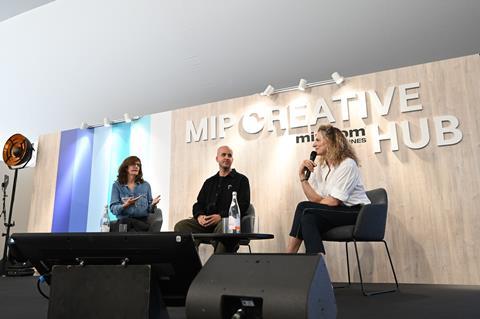
Wogue and the format’s creator, YouTube director Martin Coulaty, were on hand to discuss the format, which is one of three winners of a call for projects organised before her arrival that was aimed directly at individual authors and creators, rather than producers, who were selected as a second step.
“France Télévisions wants to push into original format creation, and this was a first initiative in that direction,” she said.
Wogue added that the new formats developed will also serve the pubcaster’s new streaming-first strategy and can find a home on streamer france.tv as well as linear and social media. “To put it simply, we are looking to build 360-degree brands.”
The concept of Memory Hunter is to tell France’s history through individual stories, with Coulaty travelling around France in his truck — a mobile studio — to meet archive owners and edit their stories.
Individuals are selected after pitching their story on a dedicated platform. “Over 1,000 have pitched already,” Coulaty said. The launch is scheduled for the end of the year.
“There are a few formats already on the market playing with nostalgia, but what is interesting with this one is that it is a journey, and it’s very authentic,” Wogue commented. “People today need authenticity.”
Wogue, who is also in charge of spotting acquisitions, told Broadcast International she was in Cannes looking for more “formats with a purpose”, adding that “both paper formats and completed” format were being considered.
The European Broadcasting Union (EBU) was also at Mipcom where it organised a public service media showcase.
Norway’s NRK highlighted Team Spirit, in which a group of disabled children are pushed to their limits by a national sports icon. “It is not just a competition, it is about friendship and courage,” said Randi Helland, NRK executive producer.
She said the series enjoyed a strong 1.5 million viewers, “out of a total population of 5 million”, and that a third season is in the works. A Danish adaptation is already underway, and Primitives is distributing the format internationally.
Another show highlighted as a success was RTÉ’s Uncharted with Ray Goggins, which pushes the limits of celebrities, this time as they have to survive in the wild by connecting and relying on one another.
The 4 x 50-minute adventure series has a third season in production and Teresa Smith, commissioning editor for factual entertainment, described it as a “relationship-driven show, not a producer-driven one”.
She added: “The celebrity aspect is taken away, and you get to see the real person. It worked very well: episodes achieved a 31% audience share, it enjoyed strong performance on our platform, and it has a real impact on social media because the series is so clippable—there are many special moments.
“This format shows that public service broadcasting can be innovative and entertaining, but also impactful.”
RTBF Creative wants to battle misinformation with The Fact Check Awards, a gameshow hosted by a Professor Faky where classes of 16-to-17-year-old students compete in quizzes, fact-checking, and aesthetic challenges to recognise what is true or false and learn how to spot AI and verify fake news.
Here too, “it is not a traditional TV format but a digital-first one, the seven episodes will premiere on RTBF’s platform before linear and social media,” said
Laura Jadot, journalist at RTBF.
Other PSB-friendly formats included Techegram, which was ordered by Rai as part of a drive to connect its archives with young, digital audiences.
“Archives are very important to us; we are so proud of our heritage,” said creative and content production manager Davide Di Stadio. The digital-first studio format, featuring a host and a guest celebrity, plays with the idea that Techegram is a social network featuring archive reels.
He explained that there was an intensive campaign on social media, with the show first launched on demand before being scheduled on TV, and then returning to digital with clips on social media throughout. “
“Archives are very popular on social media,” explained Di Stadio. “It worked very, very well.” Two new seasons are commissioned. “We need to adapt television to audiences, not adapt audiences to television,” he concluded.




No comments yet