















Alice Guy’s contribution to cinema has largely been forgotten, but HBO Max and France Télévisions’ drama aims to bring her back into the frame
More than 130 years after Alice Guy first recognised the storytelling potential of the moving image, the French filmmaker is finally taking centre stage in a limited series of her own.
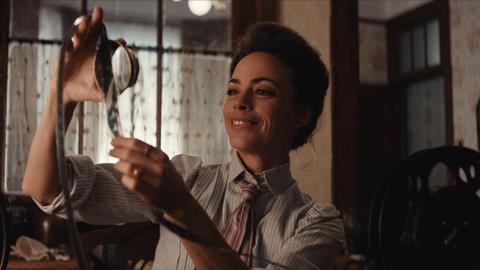
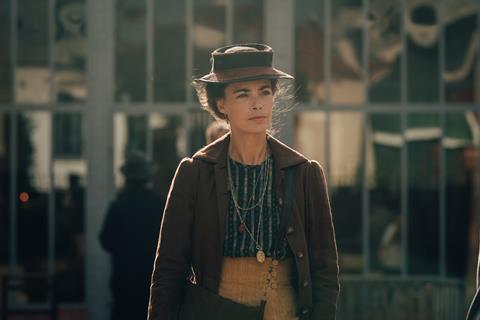
Oscar-nominated French actress Bérénice Bejo (The Artist) stars in Alice: Pioneer Of Cinema, a six-part period drama charting Guy’s rise from a 22-year-old starting out at Gaumont in Belle Époque Paris to a filmmaker and studio boss, first at Gaumont and later in the US, where she founded Solax Studios and became one of the silent era’s most prolific directors.
Guy wrote, directed or produced more than 1,000 films during her career, but was subsequently largely written out of the history she helped to create. Her reputation has undergone a significant reassessment in recent decades, including a posthumous Directors Guild of America lifetime achievement award in 2011 and a golden statue unveiled during the Paris Olympics opening ceremony.
Tim Loane (Versailles) and Claire Lemaréchal (Drops Of God) have created and written the series, with André Gulluni (Rematch) as co-writer, and the €20m (£18m) France-Belgium-Canada co-production is directed by Virginie Verrier and Guillaume Lonergan. France’s Wild Bunch and Ligne de Front produce alongside Belgium’s Panache Productions and La Compagnie Cinématographique and Canada’s Sphère Média, with SND handling international sales.
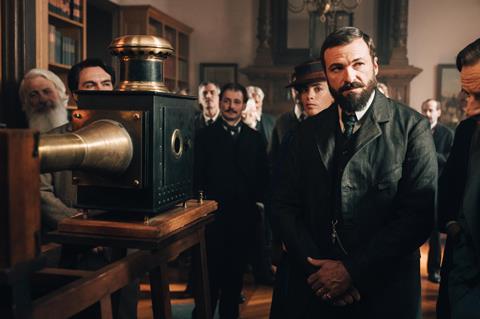
Bejo plays Guy across several decades, with Oscar Lesage as her husband Herbert Blaché and Thibaut Evrard as film industry giant Léon Gaumont, alongside Irène Jacob, Sophie Nélisse, François Arnaud and Yannick Choirat.
HBO Max will launch the series in France in December, ahead of France Télévisions, with further broadcasters including HBO Max in Belgium and Crave in Canada. It had its world premiere in the Toronto International Film Festival’s Primetime section and is headed to the Lumière Festival in Lyon and The American French Film Festival in Los Angeles.
The show’s international structure fittingly mirrors Guy’s own journey across the Atlantic, decades before Hollywood emerged as the centre of the global film business.
Loane became involved in late 2019 following his work on Canal+ drama Versailles, working with French filmmaker Jean-Jacques Annaud on the project, which was initially conceived in English. Having spent lockdown writing the first episode, development progressed and the team felt the language needed to reflect the story’s French roots and subsequent move to America. The finished series is around 70% French and 30% English, with the first three episodes set in France before the action shifts to New York.
“I’m so glad to see it in French,” says Loane. “Versailles being in English was part of a trend and a way of getting a big show made. Now, dare I suggest, it’s more acceptable – and desired – that an international audience watches shows with a specificity of location and language.”
The shift also led to Lemaréchal joining the project. “It seemed odd that the story of a young woman should be written by a middle-aged white guy,” says Loane, who was matched with her by the producers. “Claire and I were a blind date,” he jokes.
Filling in the blanks
The writers treated The Memoirs Of Alice Guy Blaché as a starting point and “gospel truth” before dismantling it as they sought architecture for a six-part drama spanning countries, decades and languages.
Loane describes the task before them: “How do you deliver satisfying chapters when they aren’t necessarily there in her life, go from one continent to another, maintain consistency of character and bring an ensemble from France to America and back again?”
Finding emotion was even trickier. “[Alice] was very factual in the way she told her story,” says Lemaréchal. “The difficult part, but also the most interesting part, was imagining what could fit between what we actually knew and drawing an emotional arc from 1895 to 1932.”
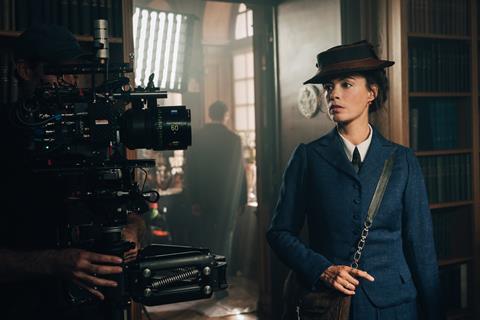
Questions including why Guy left France at the height of her career and the true nature of her relationships gave the writers room to imagine and “to reach between the lines and invent what was missing without betraying, we hoped, what could be the truth,” says Loane. “Alice’s heart was the heart of the series.”
The creators found their dramatic engine in what they describe as a “tragic romance”, involving Guy, Blaché and her bond with Gaumont. A possible romance between Guy and Gaumont was explored before the writers pulled back.
“We realised that would be taking too much licence because we didn’t know that they slept together,” says Loane. “But we believe they had deep feelings for each other. Their unrequited love, that stifled passion, became a touchstone for how they felt about each other.”
“We wanted to respect Alice’s legacy, but also the legacy of Gaumont and Pathé”
Caroline de Jenlis, Ligne de Front
Wild Bunch retains rights to Guy’s memoir, with her family having no creative involvement. “We had complete freedom,” says Ligne de Front producer Caroline de Jenlis. Gaumont was similarly hands-off creatively but opened its museum and archives to the production. “We wanted to respect Alice’s legacy, but also the legacy of Gaumont and Pathé.”
Rather than a conventional birth-to-death biopic, Alice begins with Guy at 22 and follows her rise alongside the fledgling film industry. While Léon Gaumont was absorbed by the technological possibilities of moving pictures, Guy saw something else: “She was asking, why don’t we use this new technology to tell stories?” says Lemaréchal.
The series also explores the fierce rivalries of early cinema, including between Gaumont and Charles Pathé, when competitors stole ideas and equipment and the rules of a new industry were still being written. “It’s about old and new worlds colliding,” says Loane. “It’s about commercial interests taking advantage of creators. She creates something original and other people steal it from her and use it to their advantage. That’s something audiences today can surely recognise.”
Alice marks the first production-stage collaboration in France between France Télévisions and HBO Max, with discussions beginning in 2024 while the series was in development.
“We immediately saw its international potential. The bigger challenge was putting the fi nancing together by the producers, but once HBO came on board, everything fell into place,” says Morad Koufane, director of international drama at France Télévisions.
“We were seduced by the vision behind it – paying homage to Alice Guy while making something entertaining, with themes that still resonate today”
Guillame Le Gros, HBO Max France
HBO Max France vice-president of programming and acquisitions Guillaume Le Gros says the project’s ambition and cross-border appeal were key. “We were seduced by the proposition and the vision behind it – paying homage to Alice Guy while making something entertaining, with themes that still resonate today.”
The streamer and broadcaster worked closely throughout, co-ordinating producer feedback. “It created a virtuous circle. We were able to speak in one voice,” says Le Gros.
For France Télévisions, Alice is an early marker of Koufane’s fi ction strategy, working alongside Manuel Alduy, director of cinema and international fi ction. “Alice is the fi rst development we signed, our first baby,” says Koufane.
The series also refl ects SND’s global scripted push, with Alexis Reybet-Degat working on sales for the Groupe M6-owned company, whose distribution team is led by Ramy Nahas.
Multi-level appeal
Reybet-Degat, hired to lead international TV series and library sales in 2025, says the show speaks to all audiences and works on two levels at once: “It’s an intimate, deeply emotional portrait and a sweeping chronicle of the birth of cinema itself. This is exactly the kind of ambitious event series SND wants to bring to the world.”
HBO Max will retain the original bilingual version for its December debut, launching the fi rst three episodes together, followed by the remaining three a week later. English-language portions will be dubbed into French for France Télévisions, with the original also available on its platform. The broadcaster has yet to set a date, but its cinema focus and typical streamer-to-broadcaster wait period could make the Cannes Film Festival in May an apt window.
Alice’s scale required a complex financing structure, with French and European public funding secured alongside Belgian and Canadian co-production partners. It was greenlit in March 2025, with filming running from September through December across France, Belgium and Canada.
“We always wanted to shoot in real locations – that’s what gives the series its character,” says De Jenlis, whose Ligne de Front joined Wild Bunch as a co-producer shortly after the project was ordered.
The show was mostly shot on location, including Paris’s Palais Royal gardens, historic brasserie Bofinger and ornate 19th-century Galerie Vivienne, with the Camargue also featuring. Recreating Belle Époque Paris brought practical challenges: fi lming at the Palais Royal, says de Jenlis, meant ensuring there were “no people wearing sneakers in the background”.
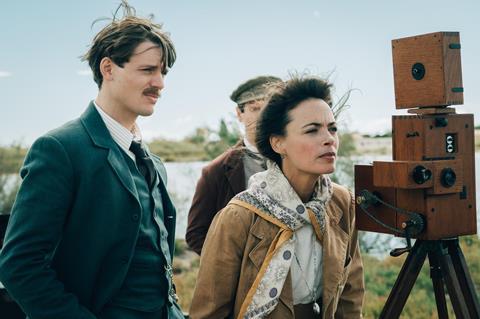
Three weeks were spent in Belgium, with Mons’ Maison Losseau doubling for Pathé’s offices and the Unesco-listed former mining complex at Bois-du-Luc used for Gaumont’s interiors.
It then moved to Canada, using Old Montreal to double for New York, while studio sets were built for interiors including Guy’s Solax Studios. VFX work was handled by Add Fiction, while Benuts Studio used AI to age Bejo and Evrard across the decades, as well as to de-age Bejo for her younger scenes. Costume designer Thierry Delettre (The Count Of Monte Cristo) joined a team that also included Emilia Pérez line producer Olivier Thery Lapiney.
Guy’s story explores an extraordinary career in a male-dominated industry, attempting to tackle issues such as birth control and traffi cking on screen. The team was keen, however, to avoid imposing a modern label on Guy, focusing instead on restoring a complex human being to the broader story of cinema.
“Alice’s life and work were feminist in spirit, but she did not defi ne herself as a feminist activist in the modern sense,” says Lemaréchal. “We wanted to remain true to that distinction. But there’s no getting around the fact that she pushed against the constraints of her time and, in so many ways, succeeded.”
Koufane adds: “It’s the story of a French woman who goes to America, becomes the head of one of its biggest studios and makes a fortune in the process. She embodies the American dream – or rather, the Franco-American dream.”






No comments yet