








 Sponsored content
Colin McKeown reflects on his road to starting his own company and how working in range of TV roles gave him experience and confidence to go it alone
At what point in your life do you think: “I need to start a company?” The reality is that you initially set out on a journey to develop your skillset and what creeps up on you is experience. Some of the choices you make without any particular thought process define who you are – and my journey was technically based to be a production trainee engineer at Granada Studios in Manchester.
It started out as an elaborate modular training, with schooling in every single department. I remember saying to my mum: “I’m in make-up this week” and her being horrified that her son who was earmarked to be a broadcast engineer, would be doing stints in wardrobe, design and props.
That kind of training means you get to the core of every single film-making contributor, and by fluke, unknowingly in my case, it ends up as the perfect precursor to be a producer. To work alongside the technical and creative, and be somewhere in the middle at times, is a phenomenal learning experience.
I was 21, and at one point I was working in racks, which meant you controlled the iris of cameras, and you made the luminous content up to a volt – a technical requirement imposed by, well… engineers. However, the director explained, quite reasonably, that the aim was to try to make this set look like a coal mine. The project was called Sam, and the battle lines were drawn between creative and technical.
Learning to cope with these kinds of dilemmas and finding a compromise, often a solution to both sides, really defined me and a whole generation of film-makers at that time.
What stayed with me was giving people the opportunity to make mistakes, to learn, to gain knowledge when actively at the sharp end of the process. In football terms, it was like being a goalkeeper - you couldn’t make many mistakes, as people could see them, and were hard on you anyway.
I soon became a senior engineer, working on bigger productions. For instance, I was involved with Lawrence Olivier Presents, shows like Cat on a Hot Tin Roof with Natalie Wood and Robert Wagner, and at the time ITV was making 70% of network drama.
Invaluable experience
Another common factor in our industry is fluke of circumstance. Engineers had to operate the big two-inch VT machines which we used in editing, so you became an effective assistant editor. It was fairly obvious the tricks you needed to get a production out of trouble when it was badly shot, when a scene didn’t run smoothly, when bad performances needed more space, and my time in VT editing proved absolutely invaluable as a career path.
The ACTT [Association of Cinematograph Television & Allied Technicians] blocked new technology, and so I took a radical decision to move to the Middle East to take an opportunity to train Arabs to make a whole array of programmes with said technology.
I was posted to the remote location of Buraydah in Qassim. The incredible challenge in that station, which was typical of lots of locations within Saudi Arabia, was that you looked after the production of a variety of genres, and then you transmitted them on site, then looked after the transmitter, therefore putting to use the whole circle of expertise I had gained in my Granada days.
I even had a phone call one time from Colonel Gaddafi who scolded me for televising the Hajj at Mecca, as it had never been done before, and I was giving away religious secrets to the world.
I came back to the UK, and I was given the job of helping ITN at Wells Street transition over to ENG [Electronic News Gathering] from Film. Nobody trusted this new video lark, and cameramen used to have a 16mm Bolex in their boot. That is until we filmed the game changer, which was the Iranian Embassy Siege – the iconic image of the Embassy exploding is something that could never have been as effective as seeing it live, shot on 330P Sony Cameras.
My two years at ITN and my experiences working in the Middle East in Mecca, ended up being the precursor to a soap set in my hometown of Liverpool, entitled Brookside. I was able to crew it with local people who had no or very little knowledge of what they’d been drawn into, but neither had the Arabs I’d worked with many years ago when setting up stations in the Middle East.
In the same way Brookside became the forerunner to a whole series of new film-makers, developing their skill, a lot from scratch. Our writing team brought together now iconic talents, such as Jimmy McGovern, Frank Cottrell Boyce, John Godber, Kay Mellor, Andy Lynch and a whole host of people with none or very little literary experience, who later on in their careers, all became household names.
It was a similar situation with the crew, with talents like Ken Horn who now produces Line of Duty, and Terry McDonaugh, who has just finished The Iris Affair.
“We have made a steady stream of Bafta-nominated or winning projects… We have also added factual projects, for instance Merseyside Detectives, which also been award winners”
Colin McKeown
Post Brookside, I did a lot of big, flamboyant London shows like Thief Takers for ITV. I’d also had a stint doing some writing on Emmerdale and EastEnders, and therefore I was ready to do that thing – start a company.
Therefore, more than 25 years ago, in November 2000 I created Liverpool Film Academy Educational Trust. However, working with some Americans, they had the clever idea of shortening it to Liverpool Academy (LA) Productions. We have made a steady stream of BAFTA-nominated or winning projects, which have also been Emmy nominated many times. In turn we added factual projects, which have all gone on to be award winners too.
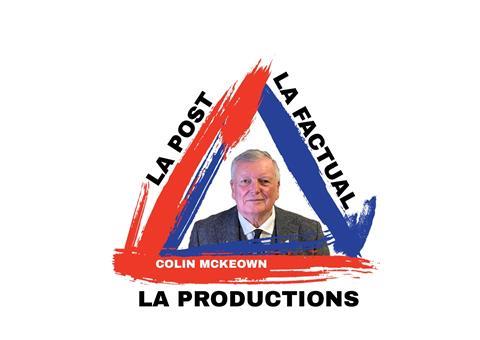
At the base of all of that, in the triangle foundation of LA Productions, was the aim to create a postproduction department, which we did – so now we have the final version, my company LA Productions, with the structure of the solid three parts.