

Hoon Kim, CEO of Beeble.ai, looks at what the industry needs from AI tools
In high-end production environments, revolutionary matters far less than how a tool performs under pressure. A system only earns its place when it proves dependable during a 3am delivery crunch. For broadcast and VFX teams, a tech stack is only as good as its ability to withstand the punishing rigours of a live production pipeline.
While the consumer world has been captivated by the sheer novelty of AI, the professional reaction has been more measured, and for good reason. For an artist working on a flagship drama or a complex commercial, an unpredictable tool is worse than a slow one. Against a backdrop of shrinking schedules and escalating delivery requirements, the industry is now moving past the wow phase of AI and into a much more difficult conversation: how do we make this stuff actually work for us?
From the machine rooms of Soho to the virtual production stages of LA, the demand from artists is clear. They don’t want more randomness. They want four specific things: predictability, repeatability, physical grounding, and seamless integration.
The prompt myth
Respecting the director’s vision is at the core of a production, from top to bottom. Preserving that intent is always the priority. Therefore, instead of hallucinations or magic tricks, professionals need predictability.
When an artist adjusts a light source in a 3D scene, they know exactly how the shadows will fall. When they grade a shot, they expect the highlights to roll off in a specific way. Many current AI models fail this basic test; you change one parameter, and the entire composition shifts.
For AI to be a pro tool, it needs to offer granular control. If a creative wants to alter the weather in a scene, the system shouldn’t decide to also change the lead actor’s wardrobe or the architecture of the background. Predictability enables iteration; in production, iteration is how quality is achieved.
The version 2 problem
The biggest hurdle for AI in a VFX pipeline is often repeatability. Production is an iterative cycle of notes and revisions. A shot is never finished on the first pass; it goes through several rounds of internal QC and client feedback.
If an AI tool produces a stunning result for Version 1, but cannot recreate that exact look with a slight modification for Version 2, it is effectively useless. In traditional workflows, specialists use seeds and procedural nodes to return to a project weeks later and know exactly how the image was constructed.
If yesterday’s approved look cannot be reliably reproduced or modified today, the tool poses a significant risk. For AI to move from an experimental toy to a production staple, it must behave consistently under the same conditions. This is the difference between a lucky accident and a trusted process.
Physics accuracy is essential
Seasoned pros think in terms of cameras, focal lengths, light transport, and depth. A scene isn’t just a collection of pixels; it’s a physical space governed by rules. When AI ignores these rules, producing shadows that don’t align with light sources or perspective that shifts across a camera move, the internal logic of the frame collapses, resulting in a jarring visual disconnect that pulls the viewer out of the story.
Physically grounded AI respects the laws of optics. It understands that light has direction and fall-off, and that objects have mass and volume. This grounding is particularly vital for video. While a slightly off AI image might pass as a still, the moment the camera moves, any lack of physical consistency becomes a glaring flicker or a shimmering artefact. Artists need AI that goes beyond the 2D plane.
Pipeline integration
No matter how impressive a solution’s output is, if it requires breaking the workflow, it will face resistance. Professional pipelines are built on stability. They rely on standard file formats, metadata preservation, and software interoperability.
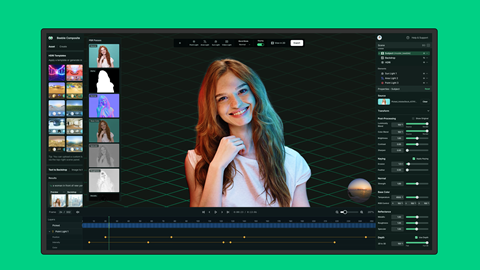
Integration means the AI must operate within the artists’ environments, inside Nuke, Fusion, or Unreal Engine, for example. It needs to support incremental adoption, serving as a smart assistant for tedious tasks such as rotoscoping, plate cleaning, or up-scaling, rather than attempting to replace the entire stack.
From novelty to infrastructure
In an era where AI innovation moves at breakneck speed, the tools that will truly endure are those that offer predictability, repeatability, and physical grounding within existing workflows.
This is ultimately what artists are asking for: solutions that shoulder the burden of tedious, repetitive tasks, freeing up the time and mental energy required to focus on the creative process and the preservation of the director’s vision.
Hoon Kim is CEO of Beeble.ai






No comments yet