

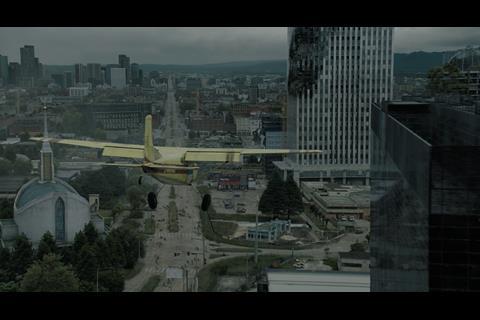
VFX house BlueBolt constructed a sprawling 3D post-pandemic Denver from Italian locations, complete with fully digital Cessna flying sequences
BlueBolt delivered 92 visual effects shots for Ridley Scott’s The Dog Stars, spanning extensive 3D environment work to create post-pandemic Denver and the hero Cessna flying sequences.
Led by VFX supervisor Henry Badgett, working closely with production VFX supervisor Charley Henley, BlueBolt transformed the Italian filming locations into a recognisable yet abandoned Denver, where years without human presence have left buildings derelict and nature beginning to reclaim the city.
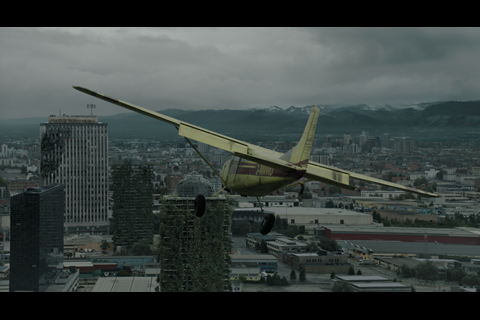
Hig’s (Jacob Elordi) flight over the deserted city’s downtown at the beginning of the film is key to establishing the film’s horrific reality.
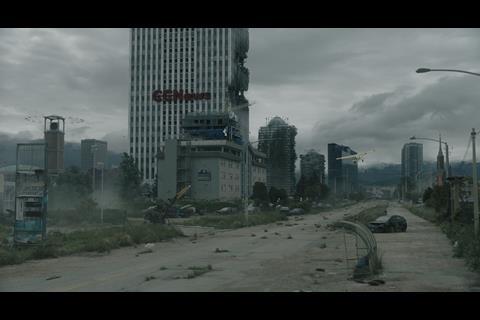
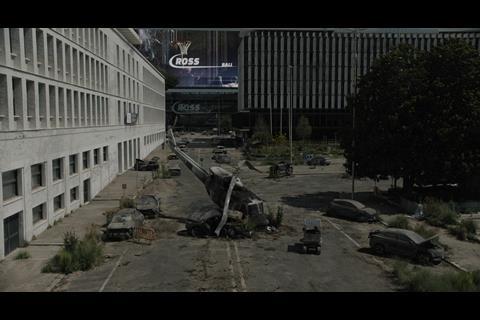
Much of the distant Denver environment was built in 3D rather than digital matte painting, allowing the team to support multiple camera angles and complex aerial views. The build comprised more than 180 assets, including buildings, wrecked cars, street furniture and props, with wide shots featuring around 1,600 building variations, from hero foreground architecture to the distant city panorama.
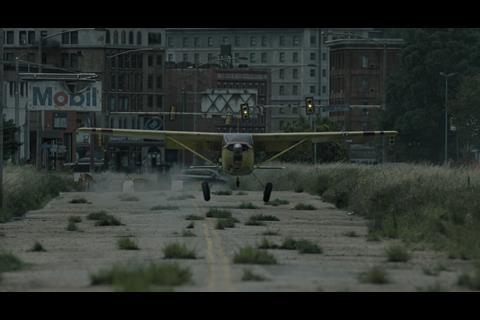
Ridley Scott’s storyboards provided a key visual reference throughout, alongside real-world architectural references used to develop the city’s buildings and preserve Denver’s identity. BlueBolt layered in key details to convey the passage of time, augmenting the practical set dressing, from weather staining, dust, broken windows and roads, glitching digital displays and abandoned infrastructure to familiar commercial layout and signage.
BlueBolt used subtle movement and vegetation to help bring the deserted city to life. Swaying trees, moving shutters, blinking traffic lights and plastic caught on telephone wires suggest a world that, despite its lack of human presence, is still alive. The team carefully balanced the growth of vegetation, including ‘living buildings’ inspired by examples in Milan, Italy and Chengdu, China to create a sense of nature reclaiming the built environment.
BlueBolt also contributed extensively to the film’s Cessna flying sequences. Helicopter-shot aerial photography was stitched and augmented with environment extensions, while bluescreen cockpit photography was completed with digital wings, tail sections and instrument details. A CG cockpit enabled dynamic lighting, with moving sunlight helping to sell the sensation of flight, alongside carefully controlled stabilisation and vibration.



No comments yet