

Alibaba Cloud is deploying AI-powered replay systems, automated content tagging and cloud-based distribution infrastructure at Milano Cortina 2026
Delivering the Olympic Winter Games has always required extraordinary coordination. For broadcasters, the challenge is even more complex: capturing fast-moving competition across multiple venues, processing vast volumes of content in real time, and delivering it seamlessly to audiences around the world.
For Milano Cortina 2026, that complexity is being met with a new layer of intelligence. Alibaba Cloud, in partnership with Olympic Broadcasting Services (OBS) and the International Olympic Committee (IOC), is deploying advanced cloud and artificial intelligence (AI) technologies designed to make broadcasts more dynamic, workflows more efficient, and Olympic moments more accessible at scale.
Building on previous deployments at Tokyo 2020, Beijing 2022 and Paris 2024, Milano Cortina 2026 marks another step in the IOC’s transition towards cloud-based, AI-enabled broadcasting.
According to Kirsty Coventry, president of the International Olympic Committee (IOC): “Building on innovations delivered at recent Games, Milano Cortina 2026 represents a major step forward in cloud-based, AI-enabled broadcasting and operations, setting a new benchmark for future editions. Together with Alibaba, we’re not only ensuring the Games remain efficient and sustainable, but also remain engaging through sports media technology to audiences, athletes and fans worldwide.”

Reimagining replay and analysis
One of the most visible applications of AI at Milano Cortina 2026 will be in live replay. Alibaba Cloud is introducing upgraded Real-Time 360º Replay systems capable of delivering immersive replays with fluid camera movement and stroboscopic visual effects. Powered by AI algorithms that separate athletes from complex backgrounds such as snow and ice, the system enables three-dimensional reconstructions of key moments in as little as 15 to 20 seconds, fast enough for live broadcast use.
Ilario Corna, chief technology and information officer of the International Olympic Committee, describes the shift clearly: “Milano Cortina 2026 marks a defining moment in the integration of AI into the Olympic Movement. Alibaba Cloud has been incredible in putting these leading capabilities to work in very practical, helpful ways—not only enhancing the everyday experience for our fans through first use of LLM technologies at the Olympics, but building intelligent systems such as Sports AI that will preserve historic Olympic moments for generations to come.”
The technology will be deployed across 17 sports and disciplines, including ice hockey, freestyle skiing, figure skating and ski jumping. In addition to the BulletTime effects first introduced at Beijing 2022, which provide frame-freeze and slow-motion views, the platform now features a new Spacetime Slices capability. This visualises multiple phases of an athlete’s movement in a single composite image, offering viewers deeper insight into technique and performance.
For broadcasters, the benefit lies not only in visual impact but in speed. Rapid processing ensures that immersive analysis becomes part of live storytelling rather than a post-event feature.
Yiannis Exarchos, CEO of Olympic Broadcasting Services, noted: “Alibaba Cloud provides the foundation that makes large-scale AI possible, making our operations more efficient and unlocking new opportunities to enhance viewers’ experience and deepen their understanding of the sport and athletes’ performances on the world’s biggest stage.”
Smarter media workflows at scale
Beyond replay, AI is being embedded into the core media workflow. OBS is in the early development phase of an Automatic Media Description system powered by Alibaba’s Qwen large language model. The system automatically identifies athletes and key moments, generates event descriptions and tags video assets within seconds, significantly reducing manual processing time.
Using natural-language queries such as “find the figure skating gold medal performance”, OBS teams can retrieve relevant content almost instantly. This enhances searchability across thousands of hours of footage and enables faster content development and distribution across platforms.
At a Games where more than 5,000 short-form pieces, including behind-the-scenes footage, highlights and emotional reactions, will be distributed through the cloud-based OBS Content+ platform, intelligent discovery tools are increasingly critical. For global rights holders working under intense time pressure, the ability to locate, edit and publish content efficiently, regardless of location, represents a tangible operational shift.
Cloud broadcasting becomes the standard
Milano Cortina 2026 also reflects how cloud-based delivery has moved from optional to foundational.
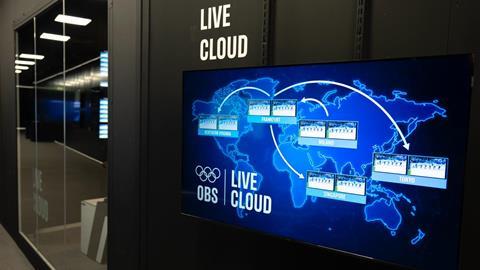
Since its introduction at Tokyo 2020, OBS Live Cloud has evolved into a core distribution platform. At Paris 2024, it became the primary method for remote broadcast delivery.
For the Winter Games in Italy, the Live Cloud platform will support 39 broadcasters, delivering 428 live video feeds, including 26 in ultra-high definition, alongside 72 audio feeds. By replacing traditional satellite links and dedicated transmission lines, cloud-based delivery reduces cost, setup time and technical complexity while improving flexibility and resilience.
For the first time, the OBS Olympic Video Player will deliver high-definition live streams using Alibaba Cloud’s infrastructure. This enables smaller broadcasters to access professional-grade broadcast capabilities without heavy upfront investment, lowering barriers to participation while maintaining quality standards.
From archive to living knowledge library
The integration of AI extends beyond live production into long-term preservation. Alibaba Cloud continues to enhance Sports AI, a cloud-based media archiving solution first introduced at the Paris 2024 Games. Managing more than eight petabytes of historical Olympic media, the upgraded system uses proprietary AI algorithms to automate tagging, categorisation and multimodal search across decades of content.
New conversational search capabilities, powered by Qwen, allow users to retrieve specific clips using natural language commands. By integrating with the IOC’s media asset platform, Flex, the solution enables fully automatic tagging of Olympic multimedia assets, transforming previously underutilised archives into a searchable knowledge resource.
Milano Cortina 2026 also marks the first use of large language model technologies at the Olympics. The IOC has introduced “Olympic AI Assistants”, powered by Alibaba’s Qwen models, to support both fan engagement and internal operations.
Embedded on olympics.com, the Olympic AI Assistant provides multilingual conversational support and real-time event information, allowing fans to access official content through a chat-based interface. The same technology is being deployed at the Olympic Museum in Lausanne, where visitors will have access to personalised AI audio guides. Internally, National Olympic Committees can use a secure AI Assistant to locate documents, policies and grant guidelines through natural-language queries.
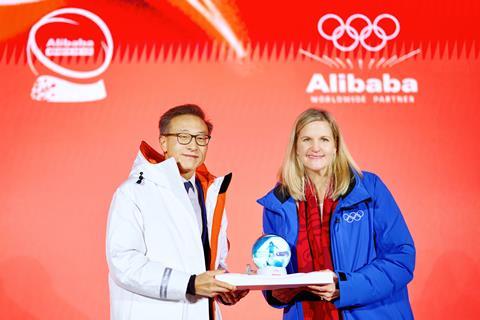
As Joe Tsai, chairman of Alibaba Group, explained: “Alibaba and the IOC share a simple belief together: technology should enable the Olympic Games to be more exciting, accessible, sustainable and connected. With the power of AI, we are moving from “Cloud Olympics” toward “Intelligent Olympics”, as AI helps us work better, make smarter decisions, and connect more meaningfully.”
Extending intelligence beyond the broadcast
In Milan’s Piazza del Castello Sforzesco, “Alibaba Wonder on Ice” offers a public demonstration of how AI and cloud technologies can create interactive digital experiences. Powered by Alibaba’s large language and vision models, the installation invites visitors to engage with AI-guided journeys and personalised content generation, illustrating how the same technological foundation underpinning broadcast operations can also support immersive fan engagement.
Milano Cortina 2026 reflects the continued evolution towards an intelligent, searchable and scalable media ecosystem, where speed, automation and insight are built into the fabric of Olympic storytelling.
This story is sponsored by Alibaba

No comments yet