

Broadcast Tech goes behind the scenes with Sennheiser to see how it handles audio at one of the biggest music broadcasts in the world
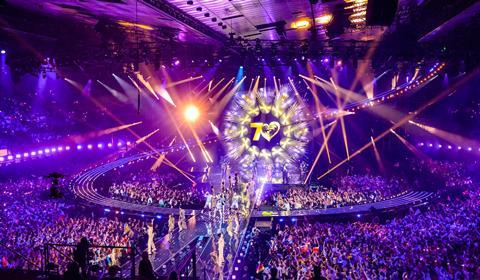
The Eurovision production is big.
Hundreds of production staff worked in over 50 sea containers and five OB trucks outside the Vienna Stadthalle this month to bring the 2026 edition to fans across the world, delivering footage from 28 Arri Alexa 35 Live cameras as well as three spidercams, two crane cameras, one wire cam, and three dolly cameras.
That’s before you get to what is possibly the most important aspect of a music broadcast, the audio.
Reidel handled production comms in Austria this year, but it was Sennheiser tech that was used to record the musical acts, audience and more as Bulgaria won the competition for the first time.

Broadcast Tech was onsite to see the production, which was run by host broadcaster ORF and technical production partner Agora, and as expected, audio was a huge and vital undertaking for the broadcast.
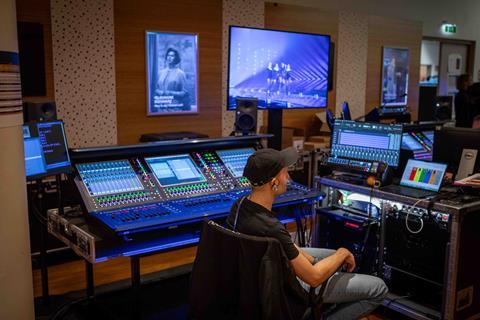
Over 150 live audio streams were in use across the production, transmitting wireless mics, in-ear monitoring and control data with the help of four base stations for connectivity, one one RF channel each. The four base stations were part of six Spectera stations in use across the venue, and of the extra two, one was exclusively dedicated to scanning the spectrum 24/7 but could also run as a spare as it was already linked with all antennas, and the other was a true spare unit.
Redundancy was in place across the whole production, including two separate audio mixing desks and even enough battery and generator power to keep the production going for two hours if there was a power cut.
Even with all of this in place, Dr. Sebastian Georgi, one of Sennheiser’s lead system architects, said that, “You can have perfect RF on the stage but it only takes a small movement and it fades, which is a very common Eurovision problem.”
His fellow lead system architect Jan Watermann added, “It was actually at the ESC in Copenhagen in 2014 when fading problems required me to develop some software fixes for Digital 9000. A former shipyard had been chosen as the ESC venue, measuring 160 metres by 160 metres, everything made of metal. No RF would work in that environment. No comms radio, no police radio, no radio networks of any public authorities. We got Digital 9000 to work by employing special filters and optimising antenna positions.”
This led to renewed focus on the development of Spectera, which had been in research since 2013, and uses a broadband channel of 8 MHz, which is not prone to fading. It also has the ability to sync the internal clock of the mics, to avoid phasing issues.
This was combatted by having all of the data from these units viewable from an RF control center in the sound room, which continuously provided a full overview of the current status of the Spectera wireless microphones and in-ears using Spectera WebUI and the Sonoros app.
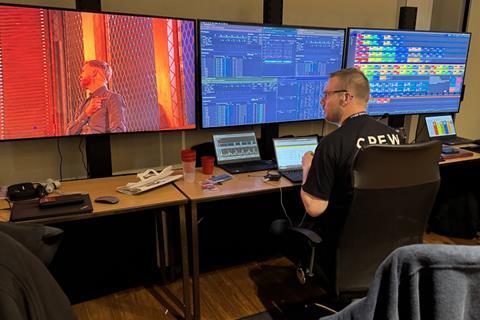
Volker Schmitt, joint head of Sennheiser’s technical application engineering (TAE) team, revealed: “During rehearsals, we had a small incident where the talent on stage said ‘I can’t hear myself.’ In the past, that would have meant that we had to dash out of the sound room and up onto the stage to check what was wrong with the device. Now, we could see the issue in the Spectera software, connect with the liaison manager, ask her to plug in the earphones of the talent, and all was set. Nobody was in panic mode, everything was calm, which gave us a very, very good feeling for this production.”
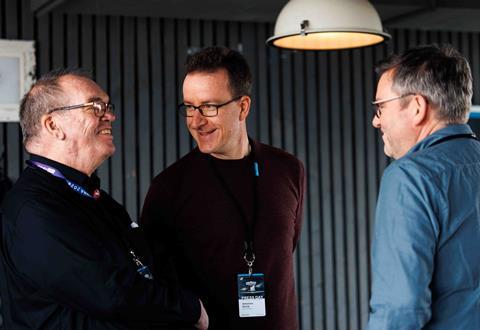
He added, “In the past, we didn’t have any feedback from the device about how it fared with the newly chosen costume, which in this case was studded with metal elements, making us wireless experts extra nervous. With Spectera, we could immediately see when RF health deteriorated and take counter-action, before the artists even noticed that something was not OK.”
Spectera DAD antennas were also mounted behind the stage to add extra coverage when the artists would enter the stage from behind its video wall.
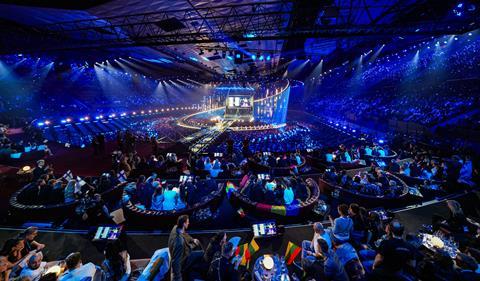
The sheer number of acts in quick succession at Eurovision throws up another challenge, with just 42 seconds between each three minute song to prepare for the next. The directing for each song is pre-planned and not done live, but for audio the team provided a mic rotation of six Spectera handhelds, using manufacturing samples of the yet to be launched Spectera handheld transmitter, an in-ear rotation of six Spectera SEK bodypacks working as in-ears only, and an ‘all-in’ rotation of six Spectera bodypacks with headsets mics and in-ear monitors.
In total, 46 Spectera SKM handheld microphones with Neumann KK 105 A super-cardioid capsules, 101 Spectera SEK bidirectional bodypacks, and four headmics (cardioid) were in use across the production.
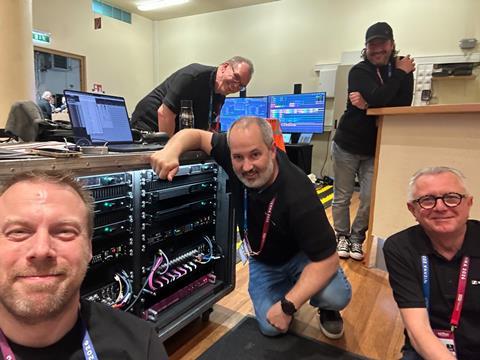
Jonas Naesby, Schmitt’s fellow leader of the TAE team, noted, “No other TV production builds in more redundancy than the Eurovision Song Contest. Almost the entire set-up has a full backup system ready to take over. Really, the only two things, where a dual set-up doesn’t work are the artist and the microphone in their hand, making it the single most important piece of equipment in the signal chain.”
Just to add even more to the production, while working on one of the biggest broadcasts in the world, Sennheiser also collected donations for St. Anna Children’s Hospital in Vienna, with the company matching the contributions and helped to host 16 young patients and their parents, who the ORF and EBU invited to a special backstage visit.



No comments yet