



















”Some moments in the drama edge towards theatrical cheesiness, but Graham has guided his play from stage to screen with verve and conviction”
Dear England, BBC1
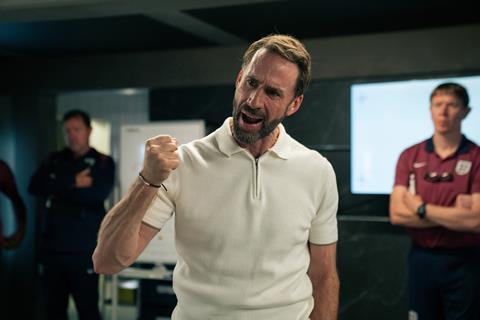
The play transfers to television smoothly enough, navigating the key problem of credibly recreating the football itself by using archive footage… Leading the team is Fiennes, reprising his acclaimed turn in the original National Theatre run – but the constant closeup of the small screen reveals his Southgate impersonation to be too much of a caricature. He looks eerily like him, and has many familiar eccentricities down pat: the extra blinks, the chin stroke followed by a knuckle dabbing the philtrum, the way Southgate never seems fully in control of his own lips. To these, though, Fiennes adds a bobbing head and a south London drawl out of the side of the mouth, creating a mass of tics that unfortunately pitch Gareth somewhere between Harold Steptoe and Captain Darling from Blackadder Goes Forth. Dear England somehow ends up not quite nailing the nuances of the man it celebrates.
Jack Seale, The Guardian
Above and beyond it all, Dear England has Joseph Fiennes as Gareth Southgate. Honed in the theatre over several years, it’s one of those performances that is so convincing and minutely observed that by episode two, Fiennes is more Southgate than Southgate ever was. Between them, Graham and Fiennes take an honourable if rather dull everyman and transform him into both a lion and a unicorn. Southgate was fascinated by the idea of telling new stories. With Dear England, James Graham and Joseph Fiennes have done exactly that.
Benji Wilson, The Daily Telegraph
Now, [James Graham’s] play has been made into a four-part BBC series – one that somehow makes Ted Lasso seem like a work of subtlety and restraint…Dear England suffers both in its conception and execution. The immediate problem to leap out – once you’ve blanched at [Joseph] Fiennes’s uncanny almost-Southgate face – is the dialogue, leaden and creaky, obsessed at all times with reminding you that this is a story not about football, but about Our Great, Troubled Nation…The first three episodes are, I won’t sugar-coat it, dismal, and the football sequences an interminable drag, mostly taking the form of penalty shootouts shot expressionistically against black backdrops.
Louis Chilton, Independent
There are some moments in the drama that edge towards theatrical cheesiness, such as when the players take their penalties, reciting out loud their “legacy number”, ie their place in the roll call of players who have worn the England shirt. But Graham has guided his play from stage to screen with verve and conviction, with a script that is thoughtful and nimble on its feet, a story that is narratively about football but really about universal human psychology.
Carol Midgley, The Times






No comments yet