

One of the Nordics’ oldest production companies is expanding its DTC ambitions with a move into Finland. Per Laursen explores how the strategy gives Nordisk Film a direct consumer relationship and allows it to maintain multiple distribution routes
Nordisk Film might have celebrated its 120th birthday this year, but the anniversary coincided with what appears to be a decidedly 21st-century decision: to expand its regional streaming service.
Nordisk Film+ has been available in Denmark as a pure direct-to-consumer (DTC) offering since 2022, but shifting into Finland this year marks a notable expansion for a service that is largely fuelled by its own shows – namely scripted series and films.
Nordisk Film is not trying to be a Nordic Netflix. Instead, its streamer is emerging as a DTC layer around the group’s IP, catalogue and customer relationships.
The strategy became clearer with the June launch in Finland, where the Danish production firm offered the streamer both as a DTC proposition and in partnership with Finnish media group Sanoma and its Ruutu streaming service.
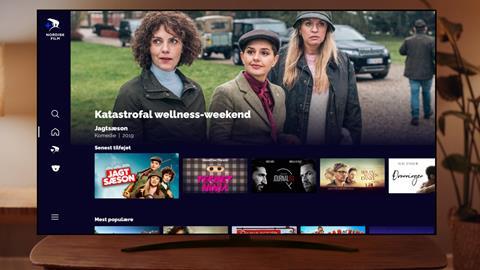
Kasper Bent Rasmussen, head of consumer channels at Nordisk Film, says the launch of the streamer in the company’s native Denmark has produced “strong and sustained subscriber growth”, which he puts down to “a unique selection of films, an affordable product and a clear profile”.
Subscriber numbers have not been revealed but the expansion into Finland suggests a company expecting to find demand, and regional streaming analyst Claus Bülow Christensen describes it as “a fairly clear signal” that the company wants to see how far it can develop the service as its own Nordic DTC platform.
“Nordisk Film is not choosing between the major global streaming services and its own platform. It is doing both,” he says.
The Finnish rollout also “completes the set of availability” across the region, with Nordisk Film having struck third-party distribution deals in Sweden and Norway, but it also provides “an end-user price point in Finland,” says Matt Trickett, head of media research at Ampere Analysis. Nordisk Film’s ambition is eventually to operate the service independently in Norway and Sweden, following the Danish model.
“Once you have an underlying service and own most of the rights, it makes economic sense to expand to the greatest extent possible”
Matt Trickett, Ampere Analysis
“Nordisk Film+ wants to expand by as many routes as possible,” says Trickett. “Once you have an underlying service and own most – if not all – of the rights, it makes economic sense to expand to the [greatest] extent possible, as every rollout brings more scale, with relatively low underlying expansion costs.” He adds that it’s unclear whether Nordisk Film will take it further.
There are, of course, numerous questions around how this relatively nascent strategy for an IP owner plays out in the years to come. How much content should Nordisk Film reserve for its own platform, and how much should continue to be licensed to third parties? How much traditional windowing will be required, and could a DTC service reduce licensing revenue – or ultimately increase the lifetime value of the content?
The company declined to comment on specifics, but Bülow Christensen says Nordisk Film+ has proved that it can build what he describes as a “rather smooth value chain” around its IP, particularly features.
“First, it makes money at the box office, then it sells the lucrative, exclusive streaming window to a global player such as Disney+, and afterwards the fi lms can return to Nordisk Film+ and generate value again,” he says.
Balancing act
The strategy requires Nordisk Film to balance its DTC ambitions with existing third-party deals. In 2025, the company signed a multi-year agreement with Disney+, under which the US studio became from 2026 the exclusive first-window streaming home for around 90 Nordic theatrical releases, after their theatrical and digital buy/rent windows.
“First, Nordisk Film had a major deal with Prime Video, and from 2026 it’s with Disney+. It’s an attractive first-streaming window for a large number of new Nordic fi lms and gives Nordisk Film substantial and relatively secure licensing revenues,” says Bülow Christensen.
For all the focus on YouTube monetisation, the backend on the Google-owned service remains scant for many IP owners. Yet a proprietary streaming service has, it appears, provided a Nordic production entity with the opportunity to unlock new revenue streams, strengthen customer loyalty and create valuable synergies across Nordisk Film’s broader ecosystem, including cinema operations, production companies, gaming businesses and content partnerships.
ABOUT NORDISK FILM+
Nordisk Film+ is focused primarily on Danish and Nordic films, supplemented by Hollywood titles and children’s content. The service launched in Denmark in 2022 and has expanded into Sweden and Norway through distribution partnerships, followed by a DTC service in Finland in June 2026.
The content portfolio varies from market to market, and is made up of shows from Nordisk Film Distribution’s catalogue of approximately 2,500 films and series. In Denmark, the streamer costs DKK59 (£6.75) per month or DKK590 (£67.50) per year and is ad-free. The service can be accessed on multiple devices, while films can also be downloaded for offline viewing on mobile and tablet devices. Nordisk Film has not publicly disclosed subscriber numbers.
Trickett points out that while it is “possible to own a service and license” shows, exclusive content at a “reasonable volume” is required to engage subscribers.

“For library content, many licensors and licensees have become more relaxed about having content non-exclusive and available widely,” he adds.
“As a pure distribution deal with a brand, the case in Sweden and Norway is probably a bit more compatible with third-party licensing and is really another form of licensing, just with a brand attached. Nordisk will ultimately have to be comfortable with lower direct licensing revenue because of DTC.”
Yet that seems to be a price worth paying. Nordisk Film’s experiment also seems to be a precursor to a broader shift to DTC from larger production-distribution giants in Europe. Ampere expects to see more of it as content companies increasingly view DTC as a key way to establish a direct consumer relationship and gain access to valuable customer data.

The broader approach, he says, is a “mixed model of distribution” via various means, “from title licensing to consumer brands to increase reach as much as possible”.
Ultimately, a regional DTC offering gives the group a direct consumer relationship while allowing it to maintain multiple distribution routes. For Nordisk Film, the strategic value of its own streamer may be less about replacing licensing with DTC than about adding a consumer-facing layer to a multi-route distribution strategy.


![IMG_4073[55]](https://d11p0alxbet5ud.cloudfront.net/Pictures/100x67/5/9/3/1489593_img_407355_748422.jpeg)



No comments yet