

Broadcast Sport visited Media City Studios, Salford, to see the BBC’s plans for the tournament
“If I was standing here saying everything is going to be done from a studio in Dallas, you would rightly be saying to me, ‘How can we justify that spend?’”
BBC director of sport Alex Kay-Jelski is very clear that the organisation’s decision to have its main World Cup studio at Media City Studios in Salford is the, “sensible,” choice.
He added at a press event held at the studio, which Broadcast Sport attended, “I don’t think the answer from a financial or sustainability point of view is to go, ‘everyone can go’. I don’t think that’s a clever way of spending licence fee money.”
Those financial and sustainability savings are certainly impressive, with Kay-Jelski claiming “millions” in cost savings while the BBC’s coverage is expected to have a 19% cut in carbon emissions compared to the last World Cup in Qatar. This is despite the 2026 edition being played across three countries and 16 host cities on an entire continent, when 2022 was played in just one city.
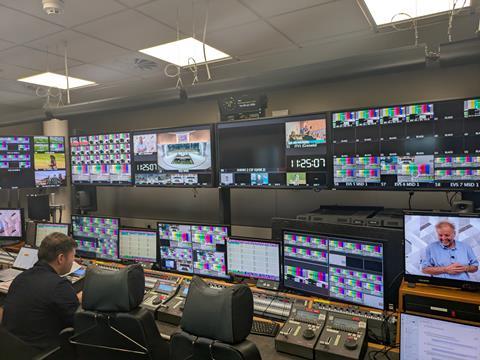
There will be roughly 200 people working on the BBC’s coverage at Media City Studios and the BBC Sport offices next door, with a focus on multi-platform content and de-duplication of efforts. This will see pundits onsite in the studio easily able to film content for platforms such as YouTube and TikTok on the same campus, and highlights and analysis segment edits completed in the VT gallery for broadcast also being used for other BBC outlets.
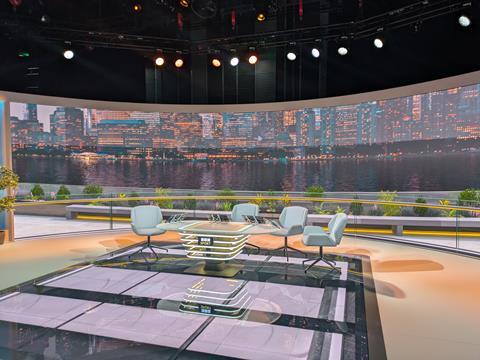
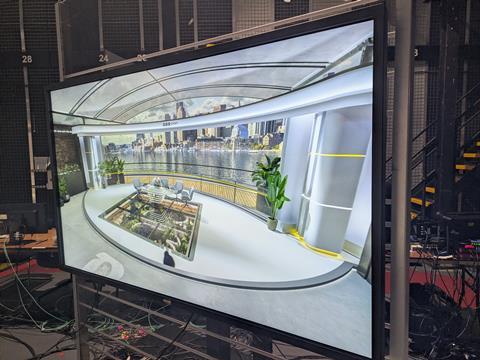
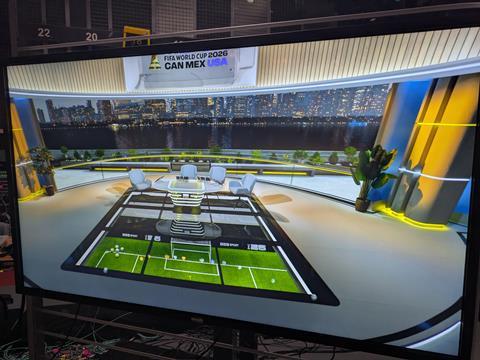
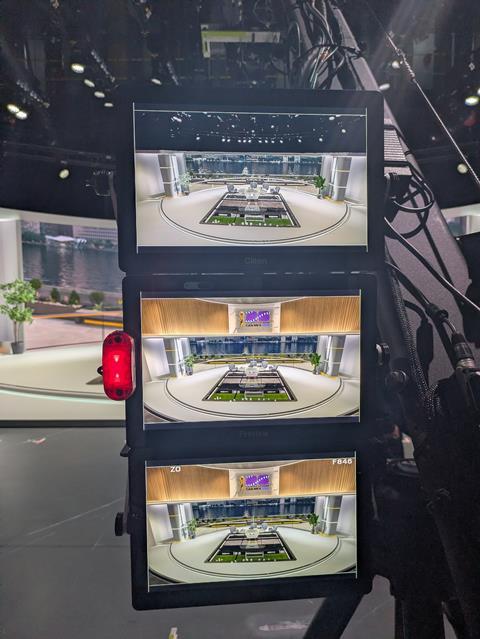
As for the studio itself, it is housed in Media City Studios’ 4,700 sq ft HQ3 studio, with a large 12mx3m LED screen providing the backdrop, showing the host cities that match coverage is coming from - and matching those cities’ time of day and weather on screen. There is also an LED screen in the floor for analysis, similar to the one used for the broadcaster’s lauded Berlin studio at Euro 2024.
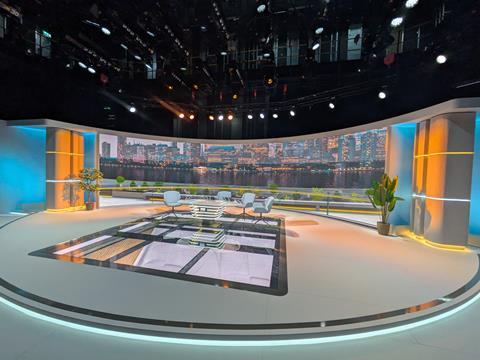
There are three main broadcast cameras as well as a jib camera covering the presentations, which will be provided by host Gabby Logan alongside Micah Richards, Wayne Rooney and Olivier Giroud for the first game on Friday 12 June, between Canada and Bosnia-Herzegovina. The first three will also be on hand for the final on 19 July, with the final pundit to be decided by who makes it to the showpiece fixture.
Other pundits are among those in the US, with the vast majority of commentary onsite in the Americas as well as the likes of Alan Shearer and Danny Murphy. Kay-Jeski said that there had been no problems with getting talent to the UK, even those like Richards who are also in the US for other platforms - the former England international is also part of Goalhanger’s The Rest Is Football show for Netflix.
Back in the UK, the studio has an adjustable table and seating, allowing for several different configurations, and elements of the set up will be used in a new studio for Match Of The Day next season. The HDR delivery of every game at the World Cup, a first for the BBC, is another aspect that will be used in future football and wider sport coverage.
Away from the traditional coverage, Kay-Jelski is keen to reach as many people as possible across digital platforms. “We have to find people where they are and talk their language,” he said, and sees the addition of live streams of the first 10 minutes of fixtures on YouTube and TikTok as a key part of that.
You can hear more about TikTok’s World Cup coverage in the latest episode of the Broadcast Sport Podcast here, where its global head of sport, Rollo Goldstaub, and creator Samantha Miller speak about the plans.
Kay-Jelski explained: “You’ve got people who, whatever happens, are going to tune in for the game. You’ve then got people who maybe aren’t aware of what games are on or aren’t in that headspace, and they are on TikTok or YouTube in part of their normal life. They find a game, and they go, ‘Oh, the World Cup’s on,’ or, ‘I’d forgotten. It’s Senegal versus Norway. Oh, great, here it is,’ and then you drive them into the broadcast.
“I think it’s quite a clever way of putting the games in front of people who aren’t obsessed and who aren’t sitting there with their day-by-day plan.”
Even with these big plans for the six weeks, for Kay-Jelski the key part won’t just be who tunes in for the next six weeks. He wants to measure success by how many are still coming back to BBC content in six months time.






No comments yet