


















Outgoing chief executive says C4’s appeal is distinct from its closest peers
Outgoing Channel 4 chief executive Alex Mahon has rejected the idea that the UK’s PSBs would be stronger through a potential merger, but has reiterated calls for closer collaboration.
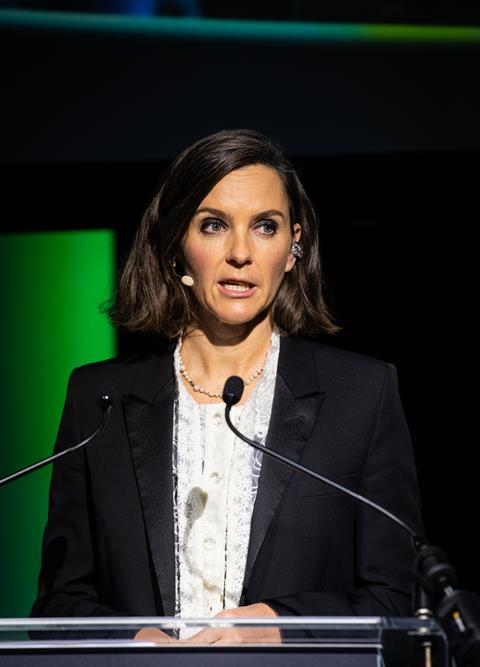
Mahon staved off privatisation during her eight-year tenure, but there is increasing momentum behind conversations, analysis and stories suggesting that the PSB ecology may need to change in the medium term. The future of the three commercial PSBs – ITV, Channel 4 and 5 – are the most prominent part of that debate.
Revealing C4’s 2024 financial performance, Mahon said:“ I think some of the articles that imply that all public service broadcasters could be magically collapsed together and be stronger are not clocking that each one appeals to a different audience,.
“The audience we appeal to as a brand is different to the ITV audience. It’s different to the 5 audience.”
She compared the situation to the newspaper industry, arguing that a merger of the British press titles would be unlikely to create a bigger audience.
“You have to think about who you appeal to in the market,” she said, adding: “I would be careful about believing that somehow, if it was just one public service company. It would have the same impact and reach that it does now.”
In terms of the commercial PSBs and the BBC banding together to achieve greater digital prominence, Mahon pointed to Freely.
She said it was an example of where collaboration between PSBs had been effective in helping to reduce technology costs, and that she thought the broadcasters “could do more” through the partnership.
“The biggest chAllange, I think, for public service media is how we evolve to be on platforms where people are,” she said, pointing out the 44% of Gen Z’s video time is spent on social platforms and 22% on YouTube.
She said the focus should be about creating “impact rather than reach” with particular audiences.
RELATED:
C4 unveils in-house production plans
Meanwhile, C4 chief operating officer Jonathan Allan, who will take up Mahon’s role on an interim basis when she departs the channel this summer, outlined the channel’s recently-announced deal with Spotify, describing it as “nascent”.
Yesterday Channel 4 announced that it had become the first UK broadcaster to partner with Spotify Video, sharing content on the platform, which began as an audio service but is in the process of expanding its video offering.
Allan said C4 has established an ad revenue share deal with Spotify, similar to the one it currently has with YouTube.
He declined to give details on the projected profits of the deal, saying: “The video product on Spotify is fairly nascent, it’s a new thing for them as well. We’re both interested to see how broadcast content will work on Spotify.”
He added that the move was part of C4’s strategy “always to try and put our content where our audiences congregate”, highlighting the growing market for visualised podcasts.
Mahon added: “If you’re over 25 which some of us are here, you listen to a podcast – but if you’re under 25 you watch the video,” she said. “There’s a demographic shift where people just want to want to watch video, even if it’s something designed for audio.”
As Spotify sought to take advantage of that, she said, “it makes sense for us to be on that platform, because it’s young consumers”.
Allan said Channel 4 is among the first broadcasters worldwide to do such a deal, but that it was “a good model” as demonstrated by C4’s success on YouTube.
The annual report revealed that Channel 4’s overall UK YouTube views rose 26% in 2024 to 340 million, with viewing of full episodes of content up 169%. Its youth-focused channel Channel 4.0 also doubled its views.
Allan said it was important to note that C4 was in control of pricing and selling of advertising on YouTube, offering a higher profit margin that allowing YouTube to do so.
“The revenue growth from YouTube over the last two or three years has been significant,” he said. “I would say it’s not as lucrative as streaming or linear yet, but we are obviously working with YouTube on that.”
Mahon added that the revue and viewing offered by the platform was additive, so was not eating into that of Channel 4’s own streaming platform.






No comments yet