

It has embedded AI across its portfolio, introducing cinematic effects, instant deblurring for fast-moving sports action, and AI-based player tracking
EVS used NAB 2026 to announce several significant creative upgrades to its products, driven by AI. It’s embedded AI across all its solutions with the aim to look at what it can enable users from the point of view of practical innovation.
One of the new AI-enabled features is the introduction of cinematic effects in EVS’s AI super slow motion product, XtraMotion. These can be applied in less than 3 seconds and give a cinematic look to any type of camera. It can work on live and archive content and is currently being used by the F1 on its F1 Explainer videos.
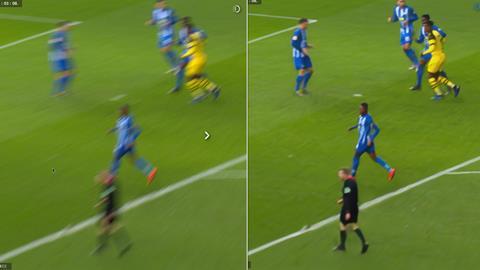
Sticking with AI, EVS has added an AI-enabled one-touch deblur to its officiating platform, Xeebra. This is useful for really fast moving action in sports. The operator just has to press a button to immediately deblur the image. XtraMotion’s AI deblurring feature was created from deep learning from millions of blurred images and EVS says it’s a unique feature on the market.
EVS has also used AI to add advanced player and item tracking features to the LSM-VIA live replay and highlights system. The LSM-VIA Zoom feature reframes wide-angle 4K feeds in real time, tracking the action using AI-based object recognition, and quickly generating vertical formats for social and digital platforms.
The user just has to highlight who or what to track and choose the level of zoom, and the software automatically tracks the player while reframing the image automatically to keep the player in shot.
EVS also showcased its recent robotics acquisitions (XD Motion and Telemetrics) at NAB, which together come under the new branding of T-Motion. It also launched Choreon, which introduces a unified orchestration layer designed to bring all robotic systems into one cohesive control environment.
Where operators previously relied on separate interfaces for each device, the platform enables simultaneous control of multiple robotic systems within a single workflow.
This opens up new creative possibilities – new angles and smooth, complex camera movements – for T-Motion systems used for indoor and outdoor multi-robot environments.



No comments yet