

Erin MacTague, Betty Warburton and Brittany MacRae discuss breaking into broadcast tech, and the value of stepping outside comfort zones
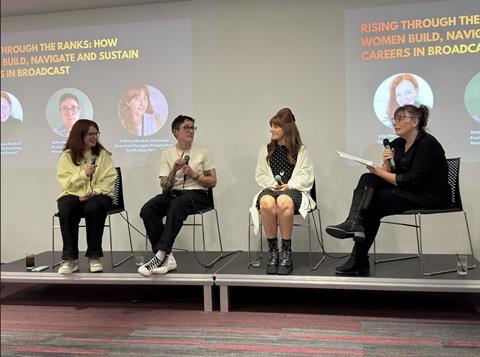
Three female leaders working in the broadcast tech sector give their advice for others trying to get into the industry and rise through the ranks in their career.
The conversation is part of a panel discussion at an event organised by Rise, which was held at Media City on 14 March.
The panel:
Erin MacTague, head of operations, Picture Shop (pictured above far left)
Betty Warburton, operations manager, Dock10 (pictured above, second left)
Brittany MacRae, technical resource manager, Picture Shop (pictured above, second right)
Chaired by Broadcast Tech director Charlotte Wheeler (pictured far right)
Brittany MacRae, technical resource manager, Picture Shop
My first break, if you count a full-time job as being a break, was getting a job at Dock10. To get that job involved a lot of volunteering beforehand for different companies, and without that, I probably wouldn’t have landed that full-time position.
I really enjoyed my job there but I was staying very much in my comfortable lane, so one day I decided to do a complete career change by joining the engineering team.
That was the first time I was like, ‘This is new, this is something that’s so out of my comfort zone’, but I really enjoyed it.
To get into a job you really want to do I think is so much about talking to people, and getting involved in events like these. I mean they are horrible in a way – nobody wants to go by themselves to a big room full of people and talk about what they know or what they don’t know and how to get here and there. But it genuinely is so much about the people you talk to.
When I was in university I thought I wanted to be a camera operator because, isn’t that the only job in the industry? And then when I actually saw what other people do, I very much was like, ‘Oh, I didn’t realise this existed’. And then someone would introduce you to another person, and then you do the same thing until eventually somebody goes, ‘Oh, there’s actually this job coming up’.
And I’d also keep my eye out and apply for everything, even stuff that I absolutely did not want to get, but by keep putting your name out there, it just takes one person to go, ‘Let’s just give her a chance and see how we get on’.
I think, just to add on to that, when I’ve done these networking events in the past, everyone takes your LinkedIn or they take your email, and actually it’s not that common for people to follow up afterwards. It’s so accessible now that people just move on straight away.
Another thing is when somebody messages and say, ‘I want to work in media’. That’s great but what do you want to do? You don’t have to have decided on what job you want to retire from but I feel like if you’re going to message a person, at least see where they work, what they do, what kind of jobs they do. And if you’re remotely interested or you don’t know what it is, then start with that. Start a conversation with that and we can go and get a coffee and have a chat.
Betty Warburton, operations manager, Dock10
I was really lucky that I started in a full-time job at Sumners 20 years ago. Now I’m an operations manager at Dock10. When I started in the industry, I really thought I wanted to be an editor, so I changed job in 2011 and started doing a little bit of editing. And it turns out I absolutely hated it.
It’s a similar thing to what Britt was saying, there are roles in broadcast that you just don’t know exist until you start to get into them. So I’ve just gone with what I’ve enjoyed doing and kept following that, finding gaps and moved into those, and I’ve ended up where I am now.
I would never have thought I’d be doing this job when I was a junior.
My foot in the door was applying for a job at Summers. And then I’d been there for a year and a half and I actually just cold emailed what turned out to be the owners of The Farm in London, although I had no idea at the time.
I just sent them an email going, ‘I need to move to London, because my girlfriend has moved to London. Like, have you got any jobs?’ And I think they quite enjoyed how naive I was. Within like a month of doing that, I had a job in London, and we moved down.
Erin MacTague, head of operations, Picture Shop
I am that old that I saw a job in the back of the Manchester Evening News and it was with a camera crew company in the middle of nowhere.
They were looking for a bookings coordinator. And because I had kind of done a bit of media when I was doing my degree, I thought, ‘Oh, I’ve got a bit of experience’.
So I had applied and really all the experience I had was just in little part time uni jobs.
I worked in the Halifax student mortgages at one point and worked in a record store as well. So I was able to bring all those skills to that first job and convince them that I was the right person, even though I had no experience really of work in the industry or anything like that.
To get into the industry or progress your career, I recommend you go on LinkedIn and have a look at all the people who work for the companies you might want to work for and who are making the programmes that you like. See who those people are, who those companies are, and hit follow or connect if they’ve got connect open.
And then just see what they’re doing and learn from that.
I think you can be persistent in looking for and applying for potential roles, and if you’re not so much getting knocked back, you’re just being told that now’s not the right time, hang on in there. Just make it very clear that you understand there’s nothing right now but is it ok if I get back in touch with you in X length of time?
I’ve had people that that approach has worked for, because I’ve then had a position come up and I’ve gone, ‘Oh, this person was really polite in their emails’ and reconnected with them. It’s just the way you go about it, I think.



No comments yet