
















“A nice cup of tea and a sit-down can be just as effective a way of getting someone to open up as stabbing a finger at them and asking the same question 12 times”
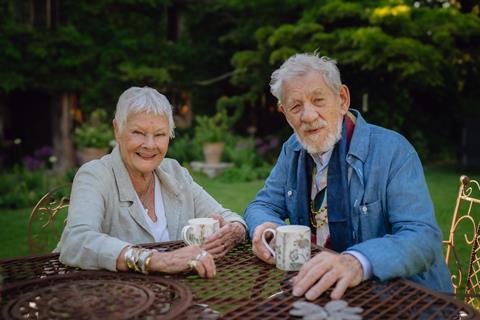
Tea with Judi Dench, Sky Arts
“Firstly, full disclosure: I would happily watch Judi Dench in conversation with a pot plant. So when Sir Ian McKellen arrives at Dench’s country home, and is indeed wielding a pot plant as a gift, I know that this Tea with Judi Dench (Sky Arts) is going to be a complete delight. Of course, it’s a little syrupy – we’re some way from the Frost/Nixon school of adversarial interrogation here – but that doesn’t mean that Dench’s method is a bust. On the contrary, it turns out that a nice cup of tea and a sit-down can be just as effective a way of getting someone to open up as stabbing a finger at them and asking the same question 12 times.”
Benji Wilson, Telegraph
“Remember that scene from Spitting Image (in the days when it was funny) that had Laurence Olivier and John Gielgud having luvvie tea and cakes and saying, “Dear, dear Larry”; “Dear, dear Johnny; “Dear, dear tea”? I imagined this episode might be a bit like that as they reminisced about the old days. At times it sort of was. But it was mostly two national treasures, he 87, she 91, being life-affirming. When McKellen read from one of his favourite books, Tales of the City by Armistead Maupin, it was moving. In it a man is writing a letter to his parents to tell them that he is gay: “If you and Papa are responsible for the way I am, then I thank you.” McKellen, who was a founding member of Stonewall, broke down reading that bit.”
Carol Midgley, The Times
“There are moments in Tea With … that you find yourself wishing that it was A Drink With … (though McKellen himself doesn’t drink any more – Dench looks suitably aghast). Because put any two actors together, let alone this pair, and the anecdotes are always much, much better than the ones that pass muster here. But perhaps it’s enough to hear about lives well lived, and contentment gained, and pay homage to a few of the tears shed along the way.”
Lucy Mangan, The Guardian
Vigil, BBC1
“The unspoilt landscape of Svalbard, with its luminous skies and frozen mountains, has an almost lunar beauty, and gives the drama a special appeal. Crime shows such as True Detective and The Killing began a tradition of staging murder investigations in unfamiliar settings with an ethereal atmosphere, but new backdrops are hard to find. It’s becoming a popular tourist destination too. Polar bears still outnumber humans, though. Keep that in mind before booking a skiing holiday.”
Christopher Stevens, Daily Mail
“This is a dry, knotty, complex story encompassing climate activism, the energy crisis, rare seabed minerals and metals, and scientists who seem strangely furtive and wear unattractive clothes. There is no glamour here but I will say this for Vigil: the dialogue is decent. Such as when a minister says that a climate change activist “won’t be happy until we’re in mud huts knitting clothes from our own hair”. I did laugh at that.”
Carol Midgley, The Times
“The task facing the producers of a drama like this one is to tip-toe down the tightrope of implausibility while holding the balancing pole of the feasible. Vigil gets it just about right, asking pertinent questions about the climate emergency without lecturing, while still allowing itself the luxury of imagining that someone is coming to fix things. But it does suffer from the old X-Files problem of “trust no one”, It’s one thing for Silva and Longacre to be asking themselves who they can trust (answer: no one), but there’s the further issue of who the viewer can trust. We know now in conspiracy thrillers that the nameless nice guys are most often the wrong’uns, but we still need to feel that the writers have interests at heart other than just getting us to the next episode.”
Benji Wilson, Telegraph
“If you can’t invest in the case, you need to be able to invest in the leads. Unfortunately, this is Vigil’s weakest link. Silva is essentially a blank slate: the closest thing she has to a personality trait is putting on and swiftly taking off a massive pair of reading glasses. Leslie assumes a very broad Glaswegian accent to play Longacre, whose defining characteristic is that she’s … quite nice? Not to suggest Silva isn’t also quite nice – she is! The pair’s working relationship is not impeded by their romantic one, either. They are both too sensible and professional for their (mild) domestic friction to tip over into popcorn-crunching drama. Instead, what we’re left with is a mystery designed to wrongfoot the viewer to a tedious degree, which plays out over a backdrop of urgent real-world jeopardy. Unfortunately, those two things end up cancelling each other out. Vigil makes it hard to keep caring, even when it’s the planet’s future that is at stake.”
Rachel Aroesti, The Guardian





No comments yet