




















 Sponsored content
GSMA Fusion Business development manager Jamie Trinh explains how existing mobile networks can be harnessed for slick, seamless production
When broadcasting from a large-scale event, such as a football match or a music festival, it’s crucial that producers and broadcasters can transfer audio, video and other files swiftly and seamlessly. To do this, production companies and broadcasters are increasingly making use of 4G and 5G mobile networks.
After all, as Jamie Trinh, business development manager at the GSMA, which represents the mobile communications industry, points out, these networks are “readily available, a bit cheaper and a lot more flexible” than the satellite-based alternative.
“They also allow someone to film a live contribution with just their mobile phone and an application which connects into the broadcaster’s backend,” he says.
But of course, those making TV aren’t the only people using the mobile networks at major live events – tens of thousands of people will be competing for that same signal, which can very easily overload the network.

This presents a major problem for TV production teams, as slow transfers can delay production or result in low-quality video and audio.
“Particularly with live contributions, broadcasters want to guarantee that it will come through and be high-quality,” says Trinh. The problem can be particularly acute for lower tier sports or Women’s Super League football grounds, which are less likely to have the permanent connectivity infrastructure offered at Premier League stadiums.
Fortunately, there is a solution. The Quality on Demand (QoD) capability allows the mobile networks to dynamically prioritise particular users, meaning that even if there’s heavy strain on the network, their data will get through.
“Basically, the networks are able to guarantee resources for a particular mobile phone SIM card on request.” Trinh says. “The broadcaster will have these SIM cards, then they press a button and are granted the resources it needs on the network.”
This all sounds great in theory but has never been put to the test at a large-scale event before. So GSMA set out to do just that, through its IBC Accelerator project, Network Control.
“The premise of this three-month project was to find operators who would be gracious enough to give us access to their live network and who could implement QoD in time to trial it,” Trinh says. This, he emphasises, was no mean feat.
Eventually, the team struck a deal to work with three German networks – O2, Vodafone, Telekom – as well as broadcaster RTL, at a DFB-Pokal football match in Hamburg, where 45,000 fans would also be watching, cheering, and crucially, using their mobile phones. The operators were only able to offer lower bandwidths in time for the experiment – up to half a megabyte – but this was enough to send audio packages which, Trinh explains, are vital for production teams sending and receiving commentary data, and communicating with each other via intercom.
The results of the test were impressive. During the most congested period of the match – normally the first five minutes of half time – QoD allowed intercom to deliver the 365 kilobits per second (kbps) it needed, where the best effort on a SIM card not given QoD on the network only achieved 73 kbps.
QoD also meant that commentary transmission remained stable. Just 127 data packets were lost, compared with 2,316 on best effort non-QoD – that’s a whopping 18 times better.
RTL has since said it would seriously look into relying on public 4G or 5G for intercom or other audio now that Quality on Demand was an option, Trinh says.
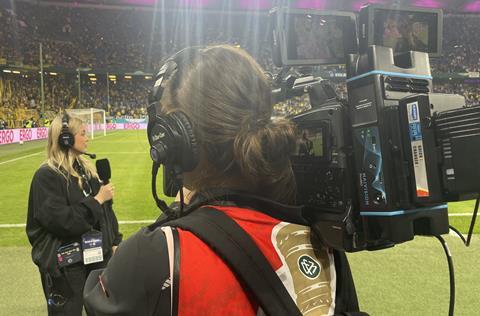
“The crew in the stadium also said they preferred the user experience of the cellular enabled beltpack over their current intercom system, which is really cool,” he adds.
GSMA is now planning further test cases. Vodafone and RTL have already signed up, but the body is on the hunt for other broadcasters and operators. The hope is that networks should be able to commercialise and launch QoD offerings in the next 12 to 24 months – and that this functionality will be available no matter which mobile network you’re signed up to.
“In terms of readiness for launch, it’s very close – it’s really just a matter of letting the operators know that there is demand for this in the form of willing, paying customers within media and entertainment,” Trinh says.



No comments yet