

Interstate Creative Partners’ James Alexander and Harry Chapman look at the challenges of balancing broadcasters’ and rights holders’ aims in broadcast
There’s always been tension between rights holders and broadcasters when it comes to TV sports. Even the language we use – ‘clean feed’ for the rights holder’s raw footage and ‘dirty feed’ for the broadcaster’s overlaid version – subtly reinforces that tension.
It used to be the case that rights holders supplied the event and broadcasters built their own presentation around it. However, there’s a trend away from this as rights holders, the Premier League among them, are driving to take presentation in-house. They have a strong sense of their own brand value and want to avoid division across territories.
Some broadcasters argue that producing a show requires creative control. They’ve paid for the rights and want viewers to know they’re watching on ITV or TF1. Rights holders argue that a complete, consistent system serves the viewer best. Some broadcasters take the full package as designed. Others layer their own graphics and identity on top, prioritising channel branding over the coherence of the show they’ve paid to air. In that gap, consistency for the viewer risks getting lost.
Both have a point, but, rather than acting as a tension, it can provide a pivotal feedback loop and lead to the best broadcast product possible.
A system, not a skin
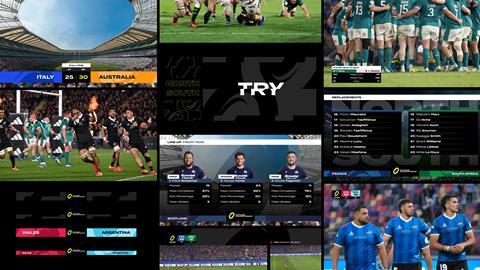
The Nations Championship gave us a good opportunity to tackle this issue from scratch. Rugby’s newest competition brings together 12 of the world’s biggest international teams. A distinctive new proposition with a fresh slate for TV rights sale. We needed to create a narrative engine that could be used effectively and attractively by two hemispheres and 12 different core territories.
We built consistency around behaviour rather than a fixed look. The brand colour is reserved for key moments, so its appearance always signals positive impact. A hemispheric pattern runs beneath everything and changes as the tournament moves from the Southern Series in summer to the Northern Series in autumn. Replays, title cards and transitions respond to what’s happening on the pitch rather than just sitting over it, and compositions are designed to travel; a director in Paris or Johannesburg is able to make different editorial choices and the broadcast still feels like the Nations Championship.
This preparation resulted in many broadcasters taking on the rights holder’s feed whistle to whistle during the matches, alongside cutaways to broadcasters’ studios pre-game, half-time and post-match.
Why imposing a package isn’t viable
The temptation for any rights holder is to hand over a complete package and insist it’s used untouched. However, broadcasters bring their own reporters, narratives and audiences, and that targeted coverage is often what boosts a sport in new markets.
We learned this with the Premier League. We initially designed a device to spotlight a star player in the line-ups, but the player we featured was not always aligned with the story particular broadcasters were building. For example, during Spurs matches, if the graphic highlighted someone other than Son Heung-min, it could be at odds with a South Korean broadcaster whose entire build-up was centred on their national star player.
The lesson was that the technology and production set-up needed to allow graphics and other assets to be updated in real time, so broadcasters could adapt them to their own audience and editorial narrative while still working within the rights holder’s overall framework.
The Premier League work also shows how the balance of identity can be redrawn. The previous package was driven by the league’s own brand colours, yet few people watch the Premier League for the Premier League. Fans care most about their club. So we put the league physically and metaphorically at the heart of the action, with the lion at the centre and a flash of League gradient in every wipe. At the same time, we provided more real estate to club colours and club moments.
Built to travel
Real-time systems have to handle every language a competition broadcasts in – and there’s lots to consider. Character lengths in Welsh and Japanese are completely different, for instance, and player names need to keep their accents, which is harder in a live workflow than it sounds. Domestic audiences know what a tricode means – BHA for Brighton & Hove Albion FC, for example – international ones may not. Directors have their creative and storytelling say too. Many want the cleanest picture possible, which is why, on one football package, we had to make the clock more legible without it covering a single extra pixel of the pitch.
It’s not just a tier-one sports issue. The rising sport of padel has far less leverage with broadcasters and needs them to build its audience. The picture is different – a tight court covered by a handful of cameras. Audiences differ as well: viewers in Spain, where the sport is well established, expect depth, while the UK needs key moments and stats distilled more simply. One system has to serve all audiences, all territories.
The strongest systems give directors the tools and structure to tell their audience’s story, while holding enough consistency to protect the property’s identity. When a system is designed with that synergy in mind, there’s a better outcome for the rights holder, the broadcaster and the viewer.

Harry Chapman (left) is senior account manager, and James Alexander (right) is executive creative director at Interstate Creative Partners



No comments yet