Sponsored: AJA’s technical director for EMEA, Andy Bellamy, speaks to Broadcast Sport about how connectivity is changing what can be done in the sector

“The days of flying everyone in around the world to a set are lessening. I think remotely connecting the people that need to use the content is really a business now. That’s happening a lot.”
As Andy Bellamy, technical director for EMEA at AJA, explains, this is the way sport productions, and live productions are going. For the recent World Cup, the BBC’s decision to broadcast from Salford was widely talked about, and even ITV’s “onsite” coverage in the US was powered by a remote production in the UK that did the bulk of the work.
The world has quickly moved to this model since the pandemic forced a quick adaptation, and shows no signs of slowing down – for both high profile events like the World Cup as well as smaller tournaments and competitions that may otherwise have been too expensive to broadcast with an onsite production.
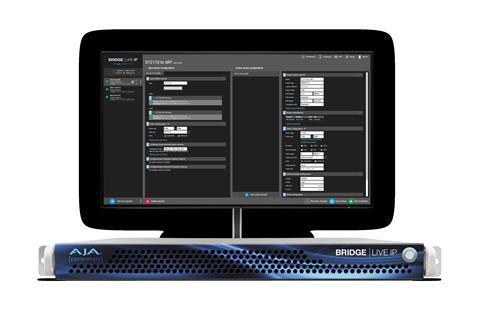
This is why AJA introduced the BRIDGE LIVE IP, which allows for broadcast-quality, low-latency streaming direct to audiences – greatly improving the flexibility of where productions can bring contributors in from and produce live events from. This can be put to use in both of the scenarios described above, moving sport production into more distributed networks than it has been able to be in before.
The growth in the use of SMPTE 2110 networks in recent years has allowed for this jump, as part of an industry-wide shift towards remote production hubs and hybrid production systems. Bellamy said, “We know that it’s going into a lot of places to connect facilities. Allowing for remote production alongside a centralised production base, or a movable production base such as an OB van or similar.”
“You are running a 2110 network that’s perhaps in an OB truck or remote, and you’re connecting that with a physical, potentially SDI-based, facility,” he continued.
Sport is an obvious place for this, and Bellamy reveals there are other benefits for these kinds of live broadcasts, “For outside broadcast, having virtually no latency is a huge boon. They’re not chasing different kinds of audio lag and things like that all the time, it’s just very straightforward for them to put this together and use it.”
For example, “If there’s single football match going on that’s being recorded by a single team, but then there’s multiple dialogue versions of that going around the world, the BRIDGE LIVE is really great at sending those multiple signals out,” Bellamy added.

However, it’s not just further production flexibility that makes the case for the BRIDGE LIVE IP; it can also help with cost. Bellamy noted, “The cost per channel on the 2110 device is particularly good for the 16 channels of HD you get, and for people in the streaming contribution world, it is usually all HD.” The BRIDGE LIVE IP is also able to run with 4K infrastructure.
There may be some reticence from those who are used to more traditional broadcast workflows, but there are opportunities to pick up knowledge on 2110 and its benefits. Bellamy said, “It’s not like you have to be a completely skilled network engineer, but you have to understand the fundamentals of networking,” and, “One of the things that is important about the 2110 world is that there can be a skills gap between the world of IT and the world of video. It sits neatly between those two worlds. So, if 2110 is to continue to be successful, we need to educate, and we’re doing our part in that with a lot of really interesting workflow information on our website.”
2110 pipelines will continue to evolve, and AJA will evolve with them. Bellamy explained, “We like a ratified set of standards, and we’ll continue to. Even over the time that 2110 has been around, there’s been some newer standards within it, and we’re continuing to grow as those grow.”
“We always try and over-engineer and then continue to support through the useful lifetime of the product. This is no different,” concluded Bellamy.