

Broadcast Tech visits Wales to talk to the people behind four of the country’s biggest TV and film studios about the key features that attract some of the biggest global productions to the region, their plans for expansion and their focus on sustainability and training
DRAGON STUDIOS
Dragon Studios is the largest film and TV complex in Wales, spanning more than 100 acres. The studio is located near Bridgend, 22 miles west of Cardiff along the M4. It has five sound stages, spaces for construction, props, set decoration and storage, as well as a six-acre film studio backlot with a 50m x 50m floodable concrete slab – and a private lake.
Despite its stature today, the studio had an inauspicious start. The build was first announced back in 2001, but eight years later the project was in administration, with the complex lying in a semi-built state of abandonment.
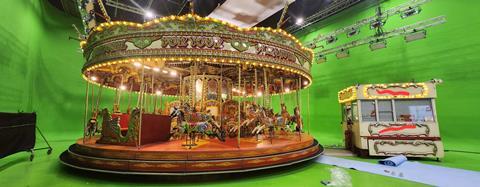
Gareth Skelding, now head of operations, ended up using the unfinished studio space for a production back in 2015. Once filming was complete, he took the opportunity to talk to the administrator about opportunities to put the studios to more permanent use.
He teamed up with Gethyn Mills, now managing director, to take control of the studio and bring it to market. “Gethyn put his money where his mouth is and bought it, and we were lucky enough to secure [Peacock’s 2020 drama] Brave New World, followed by [2022 Disney+ series] Willow,” says Skelding.
The facility has since added production space, costume, prop stores, construction and all the usual facilities found at a major film and TV studio.
More recently, a fifth stage has been added, Dragon Studios’ biggest to date, which was built in 18 weeks during the Covid lockdowns. Stage Five is also the facility’s highest studio, at 18 meters tall.
KEY FACTS
- Five sound stages and 100,000 sq ft of support space
- On-site services such as SFX, virtual production, set construction, rigging and lighting
- 100+ acres of land, including woodland
- Versatile backlot space for exterior sets or unit bases
- Support services including background casting, location scouting and travel management
- Comfortable facilities, trailers and an on-site gym
There are a growing number of companies resident at the site. Skelding says: “We have a company called Location Solutions based here, as well as Compass Travel Management. We have some big brand industry names that want to be part of it and be here all year, so our rent is paid by them. And then the cream comes when you get your shows in.”
In terms of demand for studio space, Skelding says Dragon is finding its feet again after the writers’ strike. “It’s busier and I won’t have a building empty in a month’s time,” he says. “But to get to that point, it’s been a sad old winter. It’s really sketchy, the landscape has changed. I think the high-end American stuff has disappeared a little bit.”
He says that the studio will soon be full until “pretty much November. There are a couple of little shows coming in and out, but something goes in and something goes right behind it. And there’s a really big booking for the whole site pencilled in from February next year.”
Location benefits
As a result of the heavy demand, Skelding says he’s now planning to build two or three more studios at the back of the lot, creating an additional 80,000 sq ft of space. Longer term, he has plans to build a hotel on site, as well as another four stages.
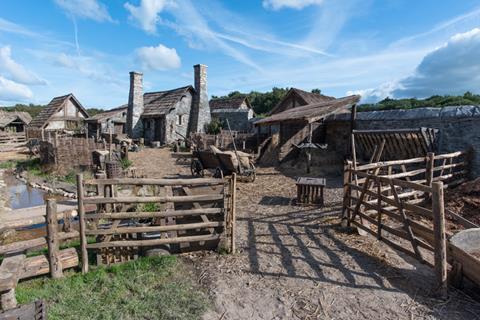
Beyond the draw of filming at Dragon Studios, Skelding notes, productions benefit from the region around it. “We are 20 minutes from Cardiff, 55 minutes from Bristol and Swansea is 30 minutes away, which opens up a whole world of locations. We have 363 castles to play with, we’re in the national park, we have amazing 100-metre beaches and people fall in love with north Wales, although that is five hours away. We’re very fortunate we have so much on our doorstep.”
In common with other Welsh studios, Dragon is involved in helping inspire the next generation of behind-the-scenes talent.
Skelding says: “I have 80 kids coming here next week to see what goes on and to be inspired. I say to them, ‘Any job that’s out there is also available here. We have a gym here so if you want to be a personal trainer, you can do that. If you want to be a medic, an accountant, a plasterer, painter or chef, it’s all here’.”
FIVEFOLD STUDIOS
Fivefold Studios is a virtual production company, housed at Dragon Studios, that opened in 2024. As well as housing productions, Fivefold provides industry-led training programmes in partnership with Media Cymru.
The company is run by managing director David Levy and head of production Tom Murphy. The pair met while working at Arri in Uxbridge, where they built one of the largest virtual production sets in Europe.
The creation of Fivefold Studios was co-funded by UK Research and Innovation’s (UKRI) Strength In Places Fund, a £316m-plus programme designed to drive regional economic growth. Having been funded by UKRI, research and development is a big part of what Freefold Studios does.
Levy says the range of services offered by the company spans in-camera visual effects, artificial intelligence, digital twins, performance capture and “a whole load of additional real-time technologies. Basically, it’s a way of doing far more with far less.”
Murphy adds: “A big thing we try to do is de-stigmatise what the umbrella of virtual production is, as our offering is so much more than just LED walls.”
KEY FACTS
- Total studio space of 10,000 sq ft
- Green Screen Cove: 5,000 sq ft (33 ft height)
- LED Volume: state-of-the- art, supporting real-time in-camera VFX (ICVFX)
- Specialties: virtual production, ICVFX, motion capture, post-production
- In-house VFX artists for clean-ups and removals
Fivefold is based in a relatively small space just off Europe’s largest green screen studio at Dragon. “What we’ve been able to do in this small space is a huge amount,” says Levy.
“We specialise in virtual production because that’s what we’ve been doing for the past five years. But we are also skilled in new forms of asset creation, including digital twinning, LiDAR scanning, photogrammetry, and using AI workflows to fast prototype environments and spaces.”
Virtual production
Fivefold also works with clients at script stage to suggest where scenes could benefit from being shot in a virtual production environment, for creative, sustainability and potentially cost-saving reasons.
Murphy explains: “You could break a script down and 80% to 90% could be shot in VP, but that doesn’t mean it should be shot in VP. There are bits where you read it and it jumps off the page, and other bits where you don’t think there’s going to be any benefit, so you could just go and film it on location in a beautiful town in Wales.”
Fivefold keeps a small permanent virtual production stage set up at Dragon Studios. It’s a smaller version of what it can create for a production, with Fivefold having access to more than 1,500 display panels it can use to construct much larger-scale volume stages.
“We validate image pipelines here in a small, cheap way, and then when everyone’s ready, we build it at the agreed scale it needs to be next door,” says Levy.
“This means you don’t have to build a gargantuan volume when the show and the budget don’t need that,” adds Murphy.
Fivefold is big on training, in particular to equip people with the skills needed to succeed in virtual production and AI-created production.
Levy says: “We’ve been working with University of South Wales, [virtual production company] Final Pixel and [Welsh post-production house] Gorilla to deliver the final two days of a virtual production fellowship. We also work with Screen Alliance Wales, having people from the One Stop Shop initiative join us on several jobs.”
WOLF STUDIOS
Production house Bad Wolf, which opened in 2015, created its own studio facility shortly after its inception, unveiling Wolf Studios Wales to the world in 2017. The company’s HQ is adjacent to its studios in central Cardiff, and it also has offices in London and LA. Wolf Studios has seven sound stages, offering a total of 137,000 sq ft of stage space. One of the stages is 57.5 ft tall, making it the tallest studio space in Wales.
“It’s great to have our main office on site next to the studio. I think we’re unique as a production company to have that,” says Bad Wolf director of production Kate Crowther.
Lee Jackson, studio manager at Wolf Studios, explains that the idea for the studios was conceived at the time Bad Wolf was created. “We opened our first stage and then grew quite quickly to cater for the kind of creative work we were making, including A Discovery Of Witches and His Dark Materials – both of which are big fantasy shows. Jane [Tranter, chief executive and co-founder of Bad Wolf] brought that genre into Wales with Doctor Who and made it successful.”
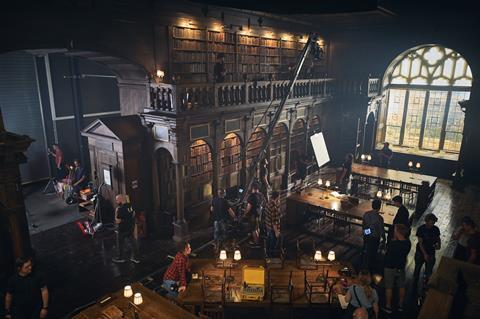
Welsh government economic development agency Creative Wales has supported the growth of Wolf Studios, with its investment helping to keep crew in work throughout the year.
The studio is predominantly filled with Bad Wolf shows but can also accommodate third-party programmes when space is available. Crowther says: “We are open for people who want short or long periods of time because we can build flexibility into the scheduling.”
Given the type of productions the studio often houses – big fantasy dramas – it is able to cater for the demands of the most ambitious film and TV productions. “We’ve stress-tested every inch of this building – we’ve had spaceships, we’ve had things flying, we’ve had water rigs, we’ve had huge water tanks, we’ve had waterfalls and a trading floor,” says Collins.
Environmental credentials
Bad Wolf cites how easy it is to find shooting locations locally as a benefit to being based in Cardiff. For its Jane Austen spin-off The Other Bennet Sister, the location manager was able to find properties that would fit the criteria in and around Wales.
Crowther says: “People watch [BBC financial drama] Industry and think that it must be shot in London, but apart from a couple of high-value shots in the capital for exteriors, we mostly shoot it in Wales.”
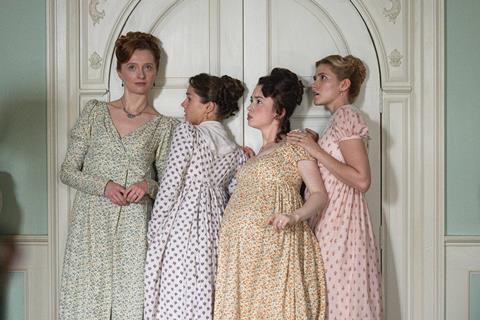
Alongside the seven large-scale stages, Wolf Studios has facilities including 13 edit rooms (including six accessible rooms), fabrication spaces, costume spaces, production offices and an ADR suite.
It is also the only studio in Britain that is ISO14001 environmentally accredited, says Jackson. He explains: “We have an environmental management plan in place and everything we do is logged and audited. It keeps us compliant and focused on environmental aims. We do rainwater harvesting and we’ve been 100% renewable energy since 2018.”
“We’re trying to support producers not to use generators, and people cycle and walk to get here as we’re close to the centre of Cardiff. We also run buses taking people to the site to discourage them from using their cars.”
KEY FACTS
- 137,000 sq ft of production space across seven state-of-the-art sound stages
- Ceiling heights between 32ft and 57ft
- Auxiliary and production spaces
- Edit suites
- Costume workshops
- Front and back lots
- Two hours direct from London by train (eight minutes from Cardiff Central station)
- Home of Screen Alliance Wales, founded by Bad Wolf in 2018, to educate, promote and train production crews and build infrastructure
- Albert studio sustainability standard rated excellent
- First studio in the UK to be awarded ISO14001 environmental certification
- TAP audited
To provide training and skill up people wanting to work in film and TV production, Bad Wolf created Screen Alliance Wales, which is now run as a separate concern.
It works to provide training and opportunities for both entry-level roles and to encourage mid-level career progression. “It has the most up-to-date crew database of Wales and we advertise all our jobs through there,” says Crowther.
“Every show we do has a minimum of 11 trainees across different departments, and Screen Alliance Wales outreaches everywhere to find trainees. It goes into the most under-represented parts of the community to explain to people that there’s something for everybody in the TV industry – there are electricians, caterers, it’s not just writers, directors and producers, which is what people immediately imagine. All the trainees are fully paid as members of our departments.”
GREAT POINT STUDIOS
Great Point Studios is based in the docklands area of Cardiff and was previously Pinewood Studios Wales and then Seren Stiwdios. One of its distinctive features is an on-site wind turbine, which generates more than 80% of the studio’s power needs.
The building used to be a solar panel factory and first became a TV and film studio 11 years ago when the Welsh government bought it and refurbished the building. Pinewood came in to run the studio in 2015 under a 15-year lease, with a remit to fill the studio. The relationship with Pinewood ended in 2020, through a five-year break clause, just before the pandemic hit. The studio was then taken over under lease by an investment company called Great Point Media. A few years later, in 2023, it was bought by New York-based Great Point Studios, which has facilities across the US.
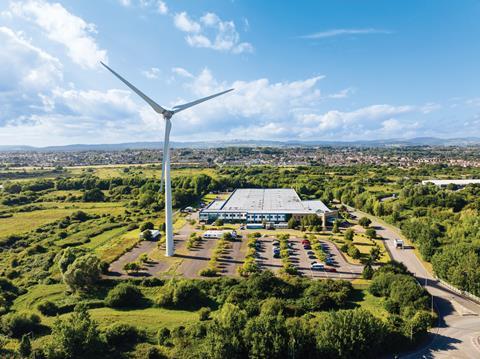
Cardiff’s Great Point Studios is the company’s first footprint in the UK. It has ambitions to expand its services and facilities here, but these ambitions were put on hold in the short term while the market continued to find its feet after the writers’ and actors’ strikes.
“Last year, we did OK because we had Young Sherlock up until April, and then we had A Colt is My Passport, an indie film with Sopé Dìrísù who is the lead actor in Gangs Of London,” says Gerwyn Evans, head of studios, UK, during Broadcast Tech’s visit to the studio complex. However, he adds: “But we’ve been empty since November, so it’s been a challenging couple of months.
“We have an indie film that started recently, and I another coming in a couple of weeks. There are a couple of bigger shows then floating about, so we’ll be OK, but it’s very challenging.”
KEY FACTS
- A 200,000 sq ft facility with four sound stages and support spaces, with a further four stages scheduled for completion in 2026
- Set against a scenic dock, with proximity to diverse exterior locations
- Ample mill and office spaces
- Dedicated scenic, prop and wardrobe facilities
- Good connectivity to M4 motorway and a short distance to London and Heathrow Airport
- Powered significantly by a 2.3MW on-site wind turbine, making it a highly sustainable site
Evans adds that this is the nature of the beast with running a studio business, but says it can sometimes be extra challenging for Welsh studios to get shows to move from London to Cardiff.
For example, series two of Amazon Prime Video’s Young Sherlock has gone to Shepperton, where Amazon MGM Studios has established a major, long-term production hub.
As well as its four sound stages, Great Point Studios has a dozen or so tenants on site, including TV and film vehicle hire company ADF Sunbelt, which provides lenses and lighting, post-production house Dragon, DI company Access Bookings, a costume company and more.
Evans singles out the turbine as a major potential cost saving for productions using the facility. “For a large production, you’re talking about saving in the region of £100,000 just in electricity cost over the lifetime of a production, so that’s a significant saving.”
The studio has also installed electricity points around the building so service vehicles, actors’ trucks, catering and so on can all be run from the building, reducing the need to have generators on site.
It also works with a company called Get Set Cymru that recycles sets back into local communities, theatre groups, health and wellbeing. “They come in and take whatever bits are about to be thrown in the skip and recycle them into the community,” says Evans.
Great Point Studios has an on-site training facility, in partnership with Screen Alliance Wales and the University of South Wales. Furthermore, apprentices from the Skills Cymru careers and skills event start their training programme by being based at the studio. “When they first come in, I show them around and give them a tour. At this stage, they’re all rabbits in the headlights and then six months later you see them and they’re working on a job,” says Evans.
Expansion ambitions
Despite the slightly quieter-than-hoped-for start to the year, Great Point Studios looks set to greenlight ambitious expansion plans to supercharge its offering and appeal to a wider range of potential clients.
“We currently have four stages, providing 72,000 sq ft of stage space. The plan is to add to that by building another three 20,000 sq ft stages to give us another 60,000 sq ft of stage space,” explains Evans.
“To do that, we have to buy the land next door, which will give us an extra 30 acres. We can then put in another car park and back lot, because we’ll be building on our existing car park. There will be lovely waterways in the expanded site too, and there will be a new entrance to the studio.”
After the expansion, Evans says, Great Point will become the biggest studio in Wales and the south-west, which will enable it to bid for the kind of blockbuster productions that may typically require six or seven stages. The expansion plans will require a 12-month build time, with the studio remaining open during the works phase. The aim is to have it completed by the beginning of 2028.
CREATIVE WALES
Creative Wales is six years old and offers bespoke production funding packages. Creative Wales also offers support around locations, helping to find crew and studio space. The organisation mandates that production companies receiving financing provide a certain number of freelance roles for local crew and that they also create some trainee apprenticeships.
With Creative Wales’s production funding, the aim is to secure an impressive 11 to 1 return on investment. So far it has supported more than 70 projects through production funding, which has generated just under half a billion pounds for the Welsh economy over the past six years.





No comments yet