

Development spending, European regulation and future of US partnerships dominate annual scripted event in Lille

As Series Mania Forum wraps its 16th edition in France with springtime sunshine and showers, it’s fitting that there may also be some green shoots finally emerging following what has felt like a long, cold scripted winter.
Events in Lille this week have by no means suggested the industry is back to where it was several years ago and there are no signs those peak TV days will return.
But talk of development pushes, upticks in streamer spending and expanded collaboration point to an industry that might just be coming to terms with its new reality.
‘Develop, develop, develop’
Budget squeezes have dominated the scripted industry over recent years, so the suggestion that development is being increased should come as a relief to producers across Europe and beyond.
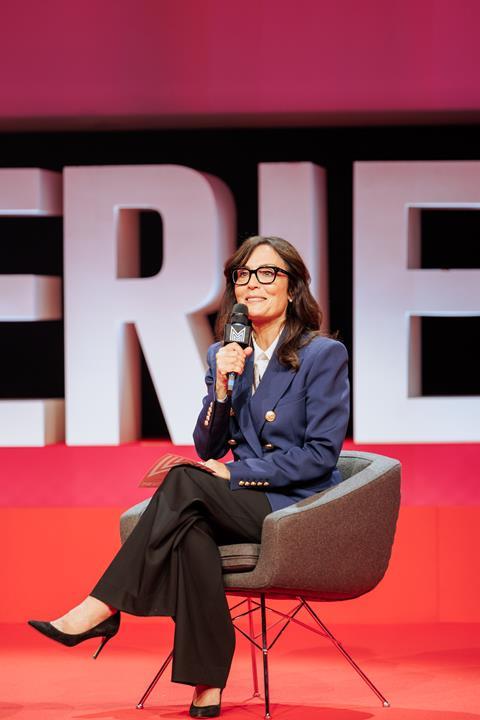
HBO Max and BBC Studios were among those being bullish, with US-based head of originals Sarah Aubrey outlining how her recent months have been spent priming teams across Europe to drive their development plans.
Aubrey said HBO Max, like its rivals, is “open to different business models” and is looking to ramp up its originals across Europe, with flexibility the name of the game. “One of the things we pride ourselves on at HBO – and something we really want to support our local teams in doing too – is ensuring that we don’t have rules written on the wall that no-one shall break. We’re a much more bespoke operation than that,” she said.
How that translates remains to be seen, but the direction of travel towards more development is also being replicated over at BBC Studios, where Global Production president Matt Forde told Broadcast International that he wanted to increase scripted revenues from 15% to 25%.
Fittingly, BBCS is also planning to ramp up its development spending by 25% this year, an indicator that those at the coal face of the industry see richer seams ahead.
Streamer spending
There are also noises coming from the streamers that content investment will be rising, with Prime Video’s originals chief in Southern Europe Nicole Morganti and French counterpart Thomas Dubois pointing to “more series”, with particular focus on young adult series.
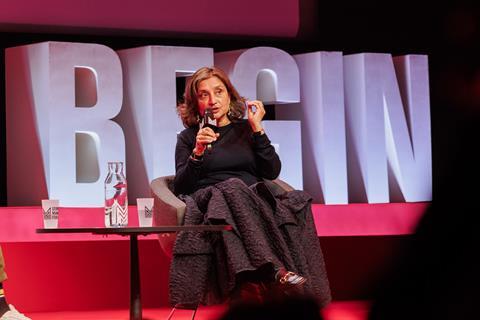
Disney+’s recently anointed EMEA content chief Angela Jain also outlined plans to significantly ramp up spending.
“We’re going to invest,” she said, “and there’s already evidence that we’re ramping up,” Jain told delegates during her keynote conversation at Series Mania, her first public address since she took up the role in September. “Otherwise, I’d be sitting her making false promises.”
Indeed, some may reflect on similar promises being made by HBO Max in 2022 when its top brass appeared at Series Mania to talk up its spending plans, which were followed by a gutting of its regional creative teams.
But given Aubrey’s push detailed above, alongside similarly bullish comments from Prime Video and Disney+, the feeling from producers is that a corner might have been turned.
There were also actual greenlights rather than just talk of them, with Disney+ shows such as Stellify Media and Rare TV’s doc exploring the life of reclusive popstar Duffy, Spanish documentary Abandoned, Italian original drama Murder on Lake Garda (w/t) and Turkish comedy The Strange Story of Gustav Maier.
Netflix was a noticeable omission from this year’s session schedule, with the streamer’s main presence being on the tote bags handed out to delegates.
And it is also worth noting the ongoing reliance on PSBs – not global streamers – for producers across Europe. The European Audiovisual Observatory’s latest report unveiled this week found that just 14% of titles in Europe were greenlit by streamers in 2024 (the most recent data available). That doesn’t reflect spend, of course, but does underline the major role that PSBs continue to play across the continent despite the focus on global streamers.
Europe and US tensions
Series Mania Forum’s 2026 edition did not eschew the political realities of the world and this year’s edition was no different, underlined by a speech from Council of Europe secretary general Alain Berset.
Berset was in town for the signing of the Convention on the Co-production of Audiovisual Works and used his keynote to talk up the role of series in delivering European cultural diversity.
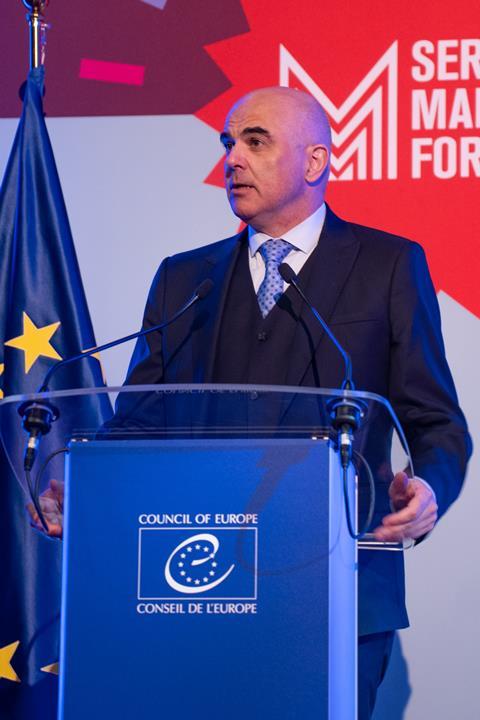
Anne Bouverot, president of Series Mania, introduced Berset to stage by pointing to a US that is “looking inward” and an industry that is undergoing “profound transformation”. She said the industry must “seize the chance for reinvention” and enter an “era of new alliances”.
The president then reflected on recent events including Donald Trump’s vision to own Greenland, US-driven political change in Venezuela and the Iran war, adding that the world was being pushed ”deeper into rupture”.
“The temptation is to tell oursleves that this is the new reality, that we need to accept this and that we can compromise on our values without losing out who we are. We can call this pragmatism, but if we stop asking what order we want to defend, we will drift from concession to concession until we stand for nothing at all.”
Such logic applies to culture too, he added, with the new co-production legislation set to come into force upon ratification by three countries. The result, Berset said, promises “clearer criteria” for financial and creative contributions, as well as more predictable rules around ownership and rights.
His speech concluded with a demand for “fair access to audiences” in order to allow European cultural diversity to flourish, adding that the coproduction convention was a “strategic signal for the future resilience and competitiveness of European productions”. (An exclusive interview with Berset will follow next week).
Creative focus
Such European focus was reiterated by numerous creatives, including Alex Berger of The Bureau fame.
“We’re in a new era and the new era is more European-centric than ever,” said Berger, founder of The Originals Group (TOG), who put European prestige series on the map with Eric Rochant’s hit French thriller The Bureau (Le Bureau des légendes).
“The incentives in Europe are amazing, the quality of work is amazing and the variety of setting is amazing,” continued Berger, whose credits include La Maison for Apple TV, El Dorado with Arte, the latter selected for the Series Mania Festival.
“We need to pair that with the very qualified crew, directors, actors and production companies here, and the relative sophistication of the broadcasters, who have to be a lot bolder.”
Risk aversion has regularly been cited as a factor in the quality of shows on offer over recent years, and Berger admitted there has been “tremendous stagnation” in the market.
“Audiences are more discerning in terms of what they want to watch. This means producers and broadcasters have to be bolder. It’s the beginning of another innovative era of being more audacious.”
Series, serie, series
On the festival side of Series Mania, titles showcased offered a blend of both politically-charged content echoing the current tumultuous geopolitical climate and, on the opposite end of the spectrum, escapist fare offering audiences an escape from such global political and economic uncertainty.
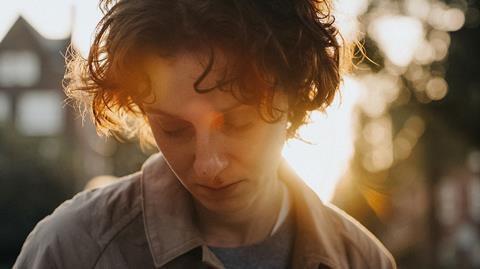
Series Mania Festival opened with Hulu’s dystopian drama The Testaments and will close on Friday evening with 1990s-set Canadian family comedy The Glass House, illustrative of the full range of genres on offer.
Several other trends emerged: there were, for example, a slew of series set during Nazi occupation in Europe, including festival selections such as Belgian six-part limited series Breendonk, Hagai Levi’s Etty (about a young woman navigating life in occupied Amsterdam), and Norwegian drama - and Buyers’ Upfront pick - The Traitor Within for Prime Video and TV2 Norway (based on the story of the country’s most notorious Nazi collaborator and young men joining the resistance).
Period dramas also dominated, with French series Summer of ’36 set in Nice in the 1930s and Unchained set in the early 19th Century. As per recent years, strong, safe bets using popular IP dominated both Festival and Forum, with Disney’s burlesque western Lucky Luke (based on the popular comic book hero) getting a special gala screening and France Televisions bringing talent from its adaptation of Stendhal’s famed novel The Red And The Black to its showcase.
Festival founder and director Laurence Herszberg also suggested series have entered a more diverse era of storytelling. “For a few years, every series had a strong female heroine. Now, we are seeing new forms of masculinity emerge as well,” citing festival selections Dear Killer Nannies (about Pablo Escobar’s son), US series The Audacity (about a tech boss in an existential crisis) and the UK’s Waiting For The Out (about a philosophy educator teaching prisoners).
Vertical thinking
Microdrama’s move into the mainstream was also apparent in Lille, with Series Mania Forum – traditionally a place for the more premium side of the drama biz – dedicating a strand of sessions to the fast-growing vertical video output.
Banijay used the event to reveal its expanding efforts in the space, with its German division among those prepping a series, while former Channel 4 drama boss Caroline Hollick argued that the cheaper-to-produce shows could offer a more accessible route into the industry for up-and-coming writers.
“Vertical drama can become that engine, if we start to fund it properly, oversee it properly and make sure there are people with expertise supporting people,” she said.
Greenacre Films co-founder and Riches exec Nadine Marsh-Edwards echoed Hollick’s sentiments, arguing the industry should “see them [microdramas] as an opportunity”.
She also called for funding opportunities and said the medium offered “a really interesting way to get new people coming into the industry, telling different types of stories in different ways, but also being quite aware and more responsible about what those stories are and what the representation is.”
The comments might have been focused on microdramas but the sentiments reflect a broader challenge that was evident here in Lille, as national cultural interests compete with the financial imperatives of global giants.
It is an uneasy balance but for the first time in a while, there are signs that the industry is beginning to find its feet again in this fast-changing landscape.





No comments yet