

WBD Sports Europe head Scott Young tells Broadcast Sport how TNT Sports is gearing up for Milano Cortina 2026, its debut Winter Olympics
WBD Sports Europe head Scott Young has spoken to Broadcast Sport about how his team is preparing for the Milano Cortina 2026 Winter Olympic Games.
In what will be TNT Sports’s debut Winter Olympics, the broadcaster will cover over 850 hours of action from every sport, venue, and medal event.
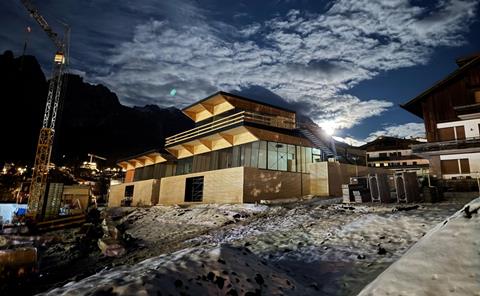
The team on the ground will be based at WBD House studios in Cortina, which is currently under development.
Pictured above is how it looked in the middle of this month (January 2026).
WBD House will be the central hub for Team GB athletes to tell their stories of the Games and re-live their experiences.
A futuristic Snow Dome in Livigno, overlooking the freestyle and snowboard competitions, will add a depth of dynamism to the broadcast.
The broadcaster also has a UK-based studio for the Winter Olympics, which will host a daily live morning show and end of day wrap-ups, plus discussion on key topics throughout the day.
Exclusive: Scott Young, EVP at WBD Sports Europe talks to Broadcast Sport about how TNT Sports is gearing up for its first Winter Olympics
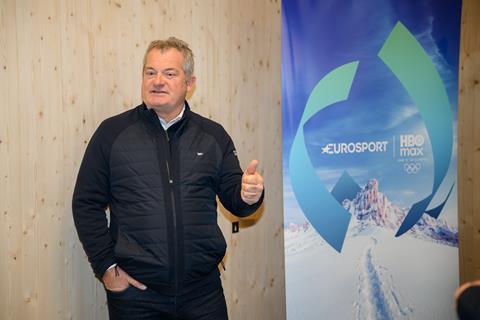
Any Olympic Games is an exciting time, particularly as a sports broadcaster, and I think it’s exciting for us to have an Olympics Games again in our own back yard and in our time zone.
The team in Italy have been incredibly excited since Paris, when the flame was handed from Paris to Italy.
The entire team has been leaning into how we take the learnings from Paris and that immersive experience of covering every moment of the Olympics, and translate that into a Winter Olympics.
One of the challenges is geography. Mobility and getting around isn’t as easy as it was in Paris with the weather playing a major part in that, not just the geographical distances.
We have a home base that can operate from morning until night, so we don’t have to move as many people around that challenging geography.
We’re originating content from the beginning of the day and then touching base to not only our main studios in Cortina and Livigno, but also to every mix zone around every competition venue.
A team of thousands
Like Paris, we have somebody in every mix zone to make sure we capture every story as it unfolds.
The scale of these Olympics is less than the Summer Games but the relevance is just as high for our markets.
For our team working on Milano-Cortina for the last couple of years, it’s been that real sense of joy going back to our home games.
Now we’re on site with nearly 90 people on the ground. That will swell to 470 people by the time we get to games time in Italy.
And this is complemented by nearly 2,000 people around our markets in home bases.
Warner Brothers Discovery House will be a hybrid studio. The weather means the studio needs to have a roof this time (unlike the Paris Olympics) and be a bit protected from the elements.
When you turn the television on, we want you to instantly go, it’s Winter Olympics time, I’m in Cortina, I can see the background of the venues, and I know there’s something special about to take place.
It was important to be in Livigno and Cortina and bookend both sides of that geographic split, as well as have people and athletes on the ground.
We have 109 different Olympians as part of our on-air team that have collectively been a part of 218 Games. That’s quite an extraordinary depth of knowledge.
The Winter Olympics studios
The multilevel traditional studio in Cortina (WBD House) was a bit easier to visualise than the snow dome, which hosts a lot of those younger, edgier style sports.
We thought we should have a studio to match that, so we have built a snow dome or an igloo to the scale that enables us to build a broadcast studio inside. It will look spectacular at night, and I think people will really enjoy the space.
The next piece of technical innovation we have developed is the ability to receive the Olympic Broadcasting Services (OBS) feeds [from the host broadcaster], curate those and distribute them back into our co-los [remote production hubs].
We’ve now built our own International Broadcast Center (IBC) network system that will service our needs between now and Brisbane 2032, as well as our major sporting events such as the Australian Open and Roland-Garros.
This is a very significant investment and allows us the flexibility – as we look to big multisport events, including grand slam tennis – as we have the ability now to plug-and-play and get those feeds back to our own network.
Social media content
We saw record numbers for Paris with an explosion of engagement on both our streaming platform and on social media. We had over 7.4 billion engagements in social media.
This became an important marker for us to explain our story in shortform and push that audience to find our content, particularly on streaming. For us, social media has become so relevant to our broadcasting in any sport.
We’ll have our team out there engaging in the different parts of the venues with the athletes as well as taking content from OBS, who are now starting to produce more vertical video.
Key Moments and Medal Alerts
The other innovative piece for fans on streaming is Key Moments and Medal Alerts, which our digital product team developed and rolled out for Paris.
Key Moments makes it possible to find the moments that matter in each sport by accessing them on a timeline. With Medal Alerts, an alert comes up to let you know a medal is about to be competed for in one of the live sports. You can then click on that and it will take you straight to the competition. That was one of our most successful features on our streaming platform during Paris.
We also have Multiview where you’ll be able to watch four sports at once and toggle through the audio of those channels and enlarge any screen of your choice.



No comments yet