











A love of high-concept blockbusters unites the creator and executive producer of Doctor Who spin-off Torchwood. They tell Chris Curtis how a tie-up with Starz has taken the show to the next level.
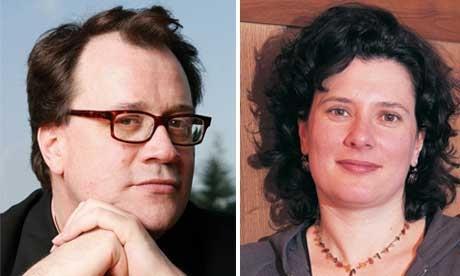
You mess with sci-fi franchises at your peril. Doctor Who inspires a kind of feverish puritanism among its fans and spin-off Torchwood is not much different. So taking it to the US and introducing both CIA agents and a film-star cast might be considered a major risk. Is creator and showrunner Russell T Davies nervous? Not a bit of it.
“I never worry about preserving the tone of the show, because I’m running it. You might call Torchwood very Welsh, or very sci-fi; I’d call it very me. I could move it to the moon and I’d be comfortable.”
It’s just as well, given Torchwood’s nomadic history. It debuted on BBC3 and moved to BBC2 for its second run, with storylines focusing on a time rift in Cardiff that led to an unusually high concentration of aliens stalking the Welsh capital.
But Torchwood really found its feet with series three, the five-part Children Of Earth, which was stripped across a week on BBC1. And it now has a new home, as an international co-pro with Spartacus cable network Starz. Fear of change
The deal has catapulted the show into the US and provided a million-pound-plus budget per episode to ramp up its scale and ambition. But while Davies was grateful for the extra cash, he was not overwhelmed: “I was excited by the challenge. There was twice as much money, but everything costs twice as much.”
Executive producer Julie Gardner, meanwhile, seems almost keen to play down the explosions and helicopter chases. “A thriller across 10 episodes necessitates on-the-run, 24-style story telling and production, but that’s only one part of the show,” she says.
“We want to entertain and thrill, but also look at big issues about the rules that govern how we live changing - for society, for governments, for health services, for pensions.”
She admits there is a tendency for fans to “live in fear of change”, but is keen to stress that the show has not been reformatted. “It’s not like the BBC sold Torchwood in to the US and walked away. If it had, it could have become all kinds of things. But Russell is the creator of Miracle Day, and Torchwood runs through his DNA.”
That the show became a co-pro was down to several factors: funding from the BBC was getting tighter; the scope of Davies’ ambition to realise a genuinely global storyline was promising to be expensive; and Davies decided to try his hand in LA, where Gardner had moved to work for Jane Tranter’s BBC Worldwide Productions.
For both, the move has been a bit of a culture shock. Gardner identifies with Gwen Cooper, “the eyes and ears of the audience, their touchstone”, whose fi sh-out-of-water moments in Miracle Day, when she is transported to the US, mirror those of CIA agent Rex Matherson when he finds himself in Wales.
These kind of differences bring humour to the show, and are embraced by Gardner in real life, too.
“I’m too Welsh and old to arrive in LA and try to be more American than the Americans. That’s not what the [BBC Worldwide Productions] experiment should be. When Ang Lee made Sense And Sensibility, his experiences and cultural background brought a great perspective to a classically English piece. There’s something very interesting about being a foreigner in another culture, looking at the TV landscape and using your experience to make shows.”
Davies too is enthused with LA, without quite seeming to buy into its glamour. His attitude to the city is similar to a lot of things we discuss: an odd mixture of unbridled effervescence (a bacon sandwich and cup of coffee send him into raptures) and downbeat pragmatism. “People see me and tell me I’m not very tanned, and I say: ‘Well, I’m not a farmer, I do sit indoors.’ At the end of the day, I might as well be at the north pole if I’m sitting in front of a keyboard.”
He’s in the middle of buying a house in Swansea and admits he misses British TV, but he has been trying to bring some of its techniques to the US. He ran a kind of hybrid writers’ room for just four weeks, and instead of working out every little detail, he gave the team more responsibility than usual.
“Quite a lot of them expected it to be very rigid; some US writers’ rooms can be very hierarchical, where they wouldn’t let a junior writer speak. It’s hilarious - too much testosterone - but it’s what I went there for.”
Buffy’s Jane Espenson and Torchwood scribe and Camelot creator Chris Chibnall (“he always gets left out of interviews”) helped Davies storyline the 10 eps. Espenson then joined the writing team and Davies brought John Fay (Mobile, Children Of Earth) over from the UK after Starz execs looked at his proposed team of writers and wondered why there were no Brits on it.
Davies adds: “When the writers were going off with their synopses, they’d ask if they were allowed to change the order. I was amazed - are you asking permission? That’s what I expect. I want the 2am brainwave that changes the episode.”
Anglo-American model
The result was the “very extraordinary” situation of having nine of the 10 scripts written before production began. Although the bulk were shot in the US, there was three weeks of block shooting in Wales.
“No one in the US had ever done that before and it was really funny - they literally didn’t think it was possible,” Davies says.
“There were still alterations later, but I wanted Wales all the way through the series, not vanishing after the first few episodes, so they had to be ready for the shoot. I’d do it again - we’d just have to warn them next time.”
On the flipside, he wishes he’d been on set more often, and bemoans the lack of prep time given to directors.
It feels a bit as though Davies and Gardner are hoping to uncover an Anglo-American production model that draws on the best of both.
Tranter recently revealed BBCWP has around 20 scripts at different stages with US cable and network broadcasters, including remakes of Criminal Justice and I, Claudius. But Miracle Day, Gardner says, is not typical of that slate.
“I don’t know if there’s been anything like it in recent TV history: we were shooting 25 hours a day at some points - in the UK on UK hours, and in the US on US hours; it’s a fourth season for the BBC and a first for Starz; there’s some returning cast and some new actors. It’s been mental, really funny, and feels like a distinct new model.”
At the heart of that model is the duo’s working relationship. Davies “clings to Julie’s coat-tails” over budgets, while she creates the best environment for him to work in.
Gardner says they just click: “He’s intense but he can be a bit of a laugh, too. The joy of working with Russell is that he’s very clear about his aspirations, he’s good at taking notes when he sees their value, and he’s ferociously hard-working.”
Most of that hard work has been in the sci-fi genre since their resurrection of Doctor Who in 2005, but both Davies and Gardner are now thinking of branching out.
Gardner says: “I love sci-fi. I love its melodrama - not in the cheesy sense, but when the stakes are huge and there’s a sacrifice moment for a hero or there are terrible moral choices. I’ve also worked on things like Life On Mars and Ashes To Ashes, which helps with the balance.”
They might not be classic sci-fi, but they are still time-travel shows - perhaps it’s high-concept drama that she’s most drawn to? “Well spotted, you’ve got me. That’s true. If I’m going to the cinema, I’m always drawn to the blockbuster.”
Davies too professes his love for sci-fi while enthusing about moving away from it. “There are other things to write. I’d love to do a Dickens adaptation. I’ve been dying to do The Old Curiosity Shop for ages but ITV did it about four years ago so I’ll have to wait.”
A fan of the Andrew Davies school of adaptation, he’s clearly enamoured with the novel - best known for its death-of-Little Nell tearjerker - for typically perverse reasons.
“It’s a mess. There’s a narrator who disappears at the end of the second chapter. He says ‘that’s it, I’m off now’. Dickens obviously realises he can’t be in every room to tell the story. I love that quality.”
There’s a kind of Dickensian feel to Miracle Day’s story arc too, which as a 10-part serial is an odd mix of slowburn development and quick resolution, Davies says.
“Its cliffhangers aren’t literally cliffhangers; they don’t pick up at exactly the same moment. But episodes five and six are what Steven Moffat would call the game-changer, when it’s clear what the miracle is really about, and that almost feels like a two-parter. It’s all about your instinct for how slowly and quickly you want things revealed, and it gets faster and faster until episodes eight, nine and 10, which are a real rollercoaster.”
In a fortnight’s time, it will become clear whether audiences on both sides of the Atlantic enjoy the same kind of ride.
RUSSELL T DAVIES ON …
Producers
“Great producers - Julie, Nicola Shindler, Tony Wood - create space for writers to be themselves. They know when there might be cutbacks, they know when to tell you to go for it, and when to deliver bad news - which is why you stick with them.”
High-concept ideas
“I like ideas that you can pitch in one line. A lot of British writers have complained quite fairly and naturally about the pitching side of things in America, but I like it - it’s what you do with your mates when you’ve seen a film.”
Sex and violence
“Starz probably would have wanted a bit more, and it does work in fantasy - look at Game Of Thrones - but sometimes you’ll be watching something on HBO or Showtime and you’ll think ‘enough with the nakedness’.”
Moffat’s Doctor Who
“It feels older and more complicated, in a good way, and he’s gone for long story arcs. But Doctor Who defies analysis - it regenerates like the Doctor himself.”
TORCHWOOD: MIRACLE DAY
WHAT YOU NEED TO KNOW
The fourth run of Torchwood is a co-pro with Spartacus cable network Starz and will air on BBC1 on 14 July, six days after its 8 July TX in the US.
The 10-part serial is based on a simple premise: one day, people across the world stop dying. They keep ageing, and get sick, but they never die. The result is an overnight population boom, and Miracle Day investigates both the mystery behind the miracle and its consequences for society.
John Barrowman, Eve Myles and Kai Owen reprise their roles as Captain Jack Harkness, Gwen Cooper and Rhys Williams respectively. They are joined by ER star Mekhi Phifer as CIA agent Rex Matheson, who investigates the phenomenon and is led to Torchwood, which has been dormant since the downbeat end of Children Of Earth (series three).
The other main new character is Bill Pullman’s Oswald Danes - a condemned child killer who survives his execution thanks to the miracle and achieves a kind of celebrity.
Creator Russell T Davies wrote the first and last episodes and storylined the series, liaising with a team of other writers that included Buffy’s Jane Espenson.
Julie Gardner, Davies’ long-term collaborator on the likes of Doctor Who and Casanova, again executive produces.

No comments yet