

Studio Lambert brought in VFX house Lux Aeterna to maintain the high-end visual standards of the original Korean drama
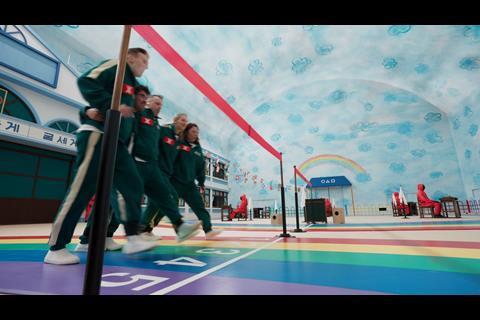
When Squid Game first landed, its look became instantly iconic – pastel playground colours, cavernous sets that felt both childlike and sinister, and challenges unfolding in environments designed to unsettle. So when it came to expanding the universe with reality series Squid Game: The Challenge, there was never any question that the visuals had to match the original. If anything, Season 2 had to go further.
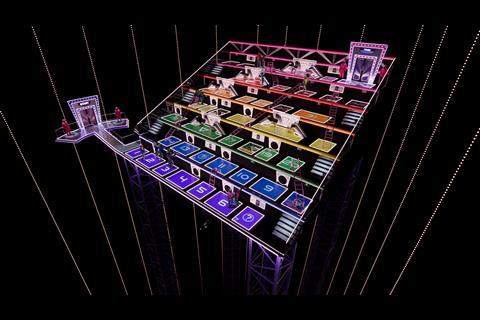
New challenges cribbed from later moments in the scripted series needed large-scale environments built around real contestants, rather than actors. The brief was to treat the show with the same visual ambition as the iconic high-end drama, working within the tight turnaround of reality television. To keep that standard without compromising delivery, Studio Lambert brought in VFX studio Lux Aeterna.
“Squid Game has such a strong visual language that we needed to replicate effectively,” says Emma Kolasinska, executive producer at Lux Aeterna. “The production team wanted the reality show to feel like it belongs in that same world, without losing the unpredictability and immediacy of unscripted television. That meant applying our high-end workflows to a format that moves at a completely different pace.”
From the outset, Lux Aeterna’s team knew that a traditional post-heavy pipeline wouldn’t fit the rhythm of the show. Reality timelines move quickly, with edit decisions and episode structures evolving almost in real time. To keep pace, the studio agreed to begin work on low-resolution proxy files.
“Starting on proxies allowed us to get moving as soon as the edit began to take shape,” Kolasinska explains. “We completed around 90% of the work before we had access to the full-resolution material. Once the final plates arrived and the edit was confirmed, we had only a handful of days to bring everything up to delivery standard.”
While the stakes were high in terms of scale and schedule, the role of VFX in Squid Game: The Challenge was deliberately understated. In unscripted television, there is little room for overt spectacle that might remove the sense of reality. Instead, visual effects had to extend and enhance what was physically present on set, preserving the authenticity of the environment and the contestants’ actions.
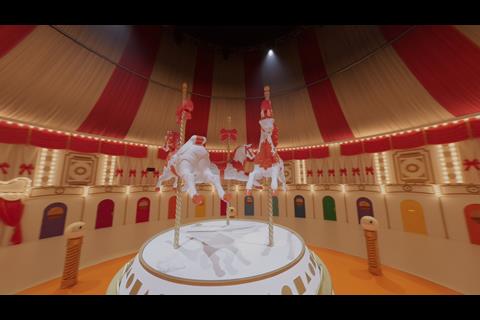
One of the most demanding sequences came in the fourth episode, where contestants play a game of ‘Mingle.’
“Rather than a few isolated hero shots, the ‘Mingle’ carousel involved some of the most technically challenging work we delivered,” Lux Aeterna compositing supervisor, Tav Flett, explains. “We were compositing CG extensions through highly dynamic, animated on-set lighting, with the camera moving constantly and contestants visible from multiple angles. The team did an excellent job turning these around in the quality they did.”
To achieve that realism at speed, Lux Aeterna leaned heavily on high-fidelity data capture. The majority of assets were built on detailed LiDAR scans captured during filming, supported by extensive high-resolution texture reference. These proved invaluable for precise camera tracking and environment alignment throughout the project.
“Historically, visual effects in reality and factual entertainment have often been limited to small clean-up jobs or fixing continuity issues in the background,” said Kolasinska. “I think they’ve sometimes been discounted because of the speed and flexibility that unscripted edits demand. Squid Game: The Challenge shows what can happen when VFX is included in the planning from day one and treated as a core part of the creative toolkit.”






No comments yet