


Cinesite reimagined iconic sequences, while Vine FX delivered VFX shots across 18 sequences for Season 4 of the fantasy drama
Cinesite made a “significant contribution” to the fourth season of Netflix’s Witcher, having delivered VFX for all three previous seasons, while Vine FX delivered nearly 70 VFX shots across 18 sequences to support some of the show’s most intense and memorable sequences.
Cinesite’s teams in London and Montreal worked closely with production VFX supervisors Richard Reed and Sara Bennett to bring to life the show’s creatures battles and complex magic.
Season 4 follows Geralt, Yennefer, and Ciri as they traverse a war-ravaged world.
Season 4 opens with a retelling of Geralt’s fight against the Kikimora, a sequence Cinesite crafted back in 2019 for the very first episode.
This time, we see the battle from a new perspective, as a folk-tale being recounted to children.
The familiar sequence is reimagined with Liam Hemsworth as the new Geralt. Cinesite’s artists gave the Kikimora a new lease of life, presenting a re-choreographed fight which is more dangerous and intense.
Creating the battle required extensive planning, meticulous compositing and complex animation and choreography to bring the four creatures, and their combined 32 limbs, to life.
“It was a fantastic creative challenge to revisit a sequence so iconic to the series,” said Zave Jackson, Cinesite VFX supervisor. “The storytelling device gave us the opportunity to add new layers of complexity and action, showcasing Geralt’s powers in a fresh way while paying homage to the original action.”
The Cinesite London team also revisited a key battle from Season 3 between Geralt and sorcerer, Vilgefortz. This reimagined sword fight, which takes place on a beach near Aretuza, allowed Cinesite to add a lineup of briefly glimpsed magical beasts – the amphibious Aeschna, airborne Chernobog, and deadly Basilisk – along with other invisible and magic related battle visual effects.
Cinesite’s Montreal team took on a magic duel between Yennefer and Vilgefortz. They designed and created a fresh aesthetic and colour scheme for Yennefer’s magic, to signal that she’s unleashing her full power in a way not seen before.
Vilgefortz’ evil power manifests as a black, tar-like substance which oozes out of the storm of sorcery. The visual effects for this sequence were created as a close collaboration between the FX and compositing teams, overseen by VFX supervisor Nathalie Girard.
“The creative liberty was a true gift. We had a fabulous opportunity to show our true colours and bring a new light to magic duals,” said Nathalie Girard, Cinesite VFX supervisor. “We approached the technical challenges with our expertise and teamed up with the client to make this a memorable experience and great visual effects to admire.”
Additional work by this team included another sequence set in a swamp, with Geralt fighting to free himself from vine-like Rusalka creatures, hidden beneath the water’s surface. The series is now streaming on Netflix .
VINE FX
Vine FX worked on a multi-episode VFX delivery spanning creature development, close-up FX, environment extensions, combat enhancements, and established magical effects.
The Vine FX team was led by Ole-Aleksander Nordby, compositing supervisor and creative lead/CG supervisor Tim Kilgour and VFX supervisor, Simon Carr.
The team worked on seven episodes of the season, and delivered nearly 70 VFX shots across 18 sequences to support some of the show’s most intense and memorable sequences.
One of the most technically demanding sequences delivered by Vine FX for The Witcher Season 4 centred on a tentacle-like creature emerging from a character’s psychological fear.
Building the creature entirely around a pre-shot performance, the team handled the full asset lifecycle – concept development, mood boards, sculpting, animation, Houdini-driven muscle and skin simulations, lighting, and final macro-scale compositing.
“We were given the sequence and a few early concepts, but it needed full development,” said Kilgour. “It became a collection of ideas from both sides, mixing the Netflix show team’s references with our own. We had tentacles from octopus and jellyfish motion to tree roots, ink drips and even some early AI imagery.
“There were a couple of iterations on colour, but the show team approved the first looks almost immediately. From there it just started to breathe and take on life.”
As the creature’s look became clearer, the team pushed its personality and aggression. The refinement stage focused on behavioural nuance, particularly how the creature interacted with the actress in extreme close-up. “Netflix really liked the direction we had taken and wanted us to push the performance further, asking for more tension, more anger, even moments of the tentacle forcing its way toward her mouth,” explained Kilgour.
“You’re watching it with a macro lens, so you can’t hide anything. We needed to find a way to make the interaction look real on the actress’s face,” added Carr. “We had to track tiny indents in her cheek to generate accurate shadow passes and maintain contact fidelity.”
To support the creature’s organic motion, Vine FX expanded its internal pipeline, introducing new Houdini-based muscle, skin sliding and deformation systems.
“It was the first time we’d developed this part of our pipeline, and it gave us the realism we needed,” said Carr. “It was incredible to see how such a small group could deliver something so complex. A very small team of talented people doing exactly what they do best.”
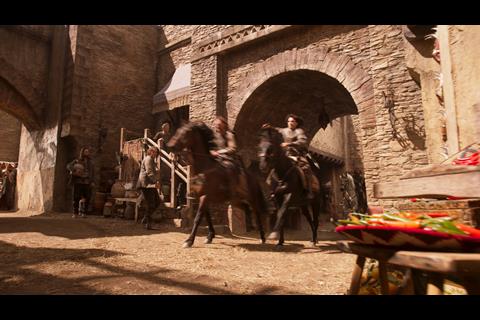
Vine FX also delivered extensive invisible VFX enhancements across the season’s environments, including city extensions, sky replacements, mountain builds, clean-up work, and Digital Matte Painting shots.
Across the season, the team also handled plates ranging from partial location rebuilds to blue screens and scaffolding-heavy setups, often reconstructing and extending environments from minimal physical elements.
“We had a big mix of work in our department. Some plates were blue screens, some were location, some were scaffolding,” said Nordby. “These became a mixture of buildings and mountains and skies, whatever the show needed to help enhance the narrative.”
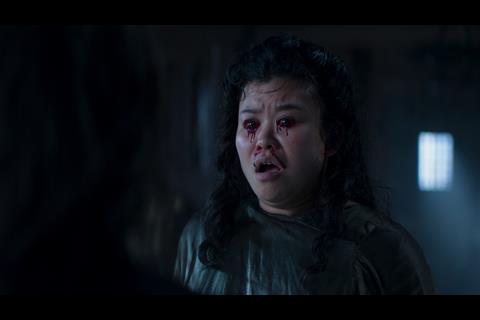
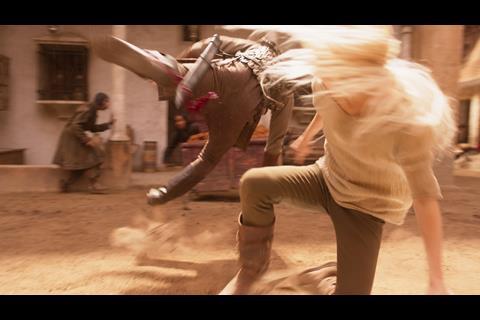
The season’s combat sequences required extensive digital augmentation, including CG sword replacements, digital arrows, blood and wound simulation – including moments of blood/black ooze spurting from a character’s eyes – and retimed reactions to maintain stunt continuity.
“Typical of the series, there was a lot of fighting and stabbing happening. So we added CG swords, CG wounds and blood coming out of almost everywhere. It was a big mix of combat work and it gets quite gory but it’s fun to work on.” said Nordby.
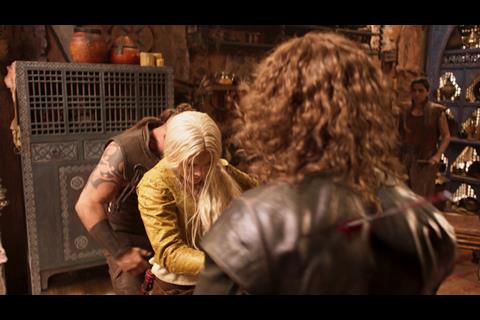
Some shots required full digital reconstruction. One of the most complex involved a warped practical sword. “We had to replace the jacket, rebuild the arm and the leather jacket with all the straps and buckles that one of the characters was wearing. That’s all CG but it’s blended seamlessly,” said Carr. “Sometimes the prop swords in the plates just didn’t behave the way swords should, bending or in unrealistic positions, so we also had to fix anything that wasn’t physically possible.”
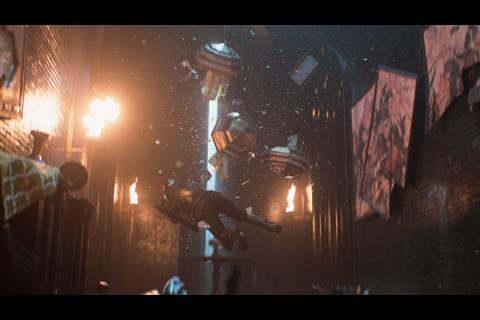
Corrective timing was also a major focus. “People were reacting too early or too late, so timing was a big part of the work too,” said Nordby. “Sometimes you had to make the whole thing feel heavier or faster. The team had to re-time a lot of the action, adding CG arrows and making sure everyone actually fell when they were supposed to.”
Alongside combat, Vine FX continued the franchise’s signature magic effects, force-like energy bursts that interact with characters and environments. Maintaining visual continuity with previous seasons was essential.
“The magic in the series has rules, it’s not just a random effect,” Nordby said. “It always needs that punch, that physical push, otherwise it’s not The Witcher.”
All eight episodes of The Witcher Season 4 are streaming now on Netflix.
IMAGES SUPPLIED BY VINE FX






No comments yet