

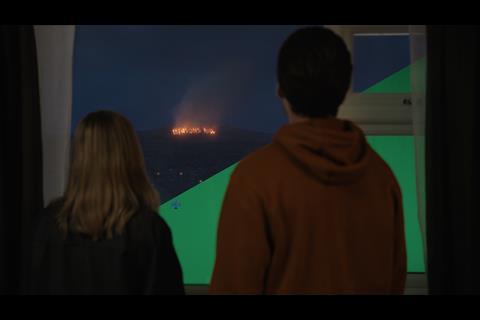
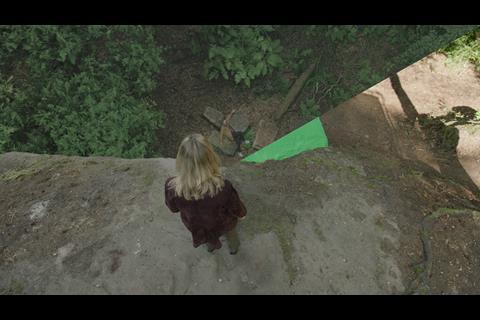
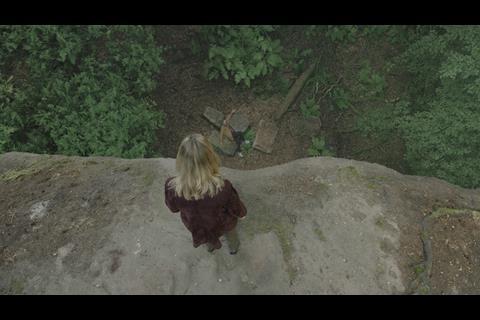
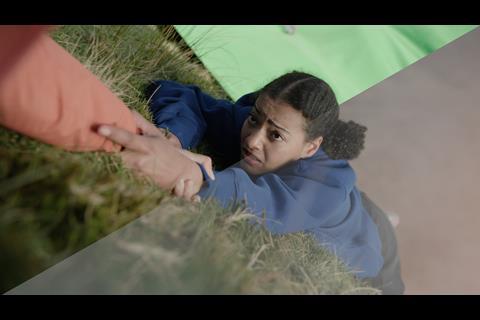
Vine FX delivered a full suite of effects across 336 shots and 94 sequences spanning all six episodes
Produced by Quay Street Productions for ITV, After the Flood returns for a second season.
The series is set one year after the catastrophic floods that devastated the town of Waterside.
As newly promoted DI Jo Marshall, portrayed by Sophie Rundle, investigates an unconscious man discovered amid simmering moorland fires, with the renewed threat of fl ooding looming over the community, she is drawn into a case that rapidly escalates in scale and consequence.
With scorched peatlands increasing runoff risk framing the unfolding mystery, After the Flood Season 2 expands its environmental scope, placing fire and unstable terrain at the centre of both the narrative stakes and visual challenges.
Working as the sole vendor, Vine FX delivered a full suite of effects across 336 shots and 94 sequences spanning all six episodes.
“There was a real spirit of creativity on set, especially as we had established a great relationship with director Azhur Saleem and the QSP team on Season 1. Azhur trusted us to explore bold ideas, and we were able to take on much more ambitious shots as the collaboration evolved during filming,” says Michael Illingworth, executive VFX supervisor.
“Being part of those early recces meant that the team and I could offer direct insights on what was captured on set, which made a huge difference for our work, such as the Gaussian Splatting, later in the pipeline.”
“With the mutual respect we had developed, we were able to find some really creative solutions and work together to get the best possible result on screen. From dramatic environmental augmentations to subtle continuity fixes, the team’s focus was always on heightening tension and maintaining realism,” he added.
For Season 2 of After the Flood, Vine FX encountered the challenge of bringing sprawling moorland fire sequences to life on protected terrain, where practical burns were restricted, and on-set smoke was minimal.
“A lot of our initial work was the big fire sequence in episode one,” says executive producer Kaitlyn Beattie. “It was filmed in a protected area, so they couldn’t actually burn anything on it. Our job was to build upon the smoke captured on set, using a combination of 3D and 2D techniques and close collaboration among departments to bring everything together.”
“Thankfully, we were involved early, attending shoots while production was still underway,” adds VFX supervisor Alesja Surubkina. “We gathered reference photography and studied how grass and smoke behave, which is very different from structural fires.”
Using custom fire simulation systems, procedural controls, and real wildfire references, Vine FX crafted fire sequences with varied behaviours.
“The fires had to feel natural at every scale, from wide open landscapes to closer medium shots, without repetition,” explains CG supervisor, Tim Kilgour.
“We couldn’t rely on a single asset repeated across shots, it had to feel random and organically develop over time. Josh Curtis, our primary FX artist, created a beautiful, highly creative system that gave the client a flexible platform they could adapt and expand. Alesja was then able to provide rapid feedback, and together we literally drew curves and painted areas on plates, using some geometry to produce fires that appeared alive. Once early tests landed, the client’s brief quickly expanded: more shots, more embers, more intensity – all heightening narrative impact.”
Another major challenge was the season’s climax, which required reimagining a real-world low cliff edge into a dramatic fall.
The Vine FX team combined extensive research with close interdepartmental collaboration, merging multiple geospatial captures with CG elements to create a visually cohesive, treacherous environment.
As Beattie, executive producer, says: “Our early tests didn’t merely meet expectations, they inspired the client to expand the scope of the sequence. That growth was only possible through effective collaboration between the R&D, CG, DMP and compositing departments.”
A key example of this was the innovative use of Gaussian splats to extend the cliff environment. Using drone-captured photography, the team reconstructed scenes as highly detailed, volumetric representations, effectively creating a three-dimensional photographic base of real locations.
Rather than relying on traditional mesh-based geometry, this approach enabled the team to build directly from accurate captures of the natural world, forming a realistic foundation that could then be adapted to suit each shot’s requirements.
These splats were integrated with additional techniques to produce a seamless, believable environment.
Research & Development engineer, Peter Noble said: “We start with photography and solve for camera positions, which gives us a spatial understanding of the scene. From that, we train Gaussian splats, points that carry colour and can vary in shape and density, to reconstruct the environment. It’s essentially like building up a scene from lots of soft, fuzzy points rather than rigid geometry. We captured multiple drone scans and assembled them into a single scene, but combining these areas wasn’t always straightforward. Where transitions between scans didn’t work perfectly, we introduced a hybrid approach using CG environment patches and matte painting to blend everything together.”
“The splats form a highly realistic base because they directly represent what was captured in the real world,” he adds. “But the tools are still evolving, so when stitching different areas together or resolving gaps and edges, we relied on CG and compositing to smooth those transitions and maintain continuity across the environment.”
“We saw real progression on this show from earlier experimentation to a production-ready workflow. The hybrid approach brought together the strengths of each technique we had at hand,” said CG lead, Jake Newton.
“This shot was highly collaborative. Everything, from 3D grass patches to layered sky domes, parallax layers, and volumetric splats, demanded minute coordination between departments to avoid any pop or visual discontinuity,” added lead compositor, Preet Katta.
By combining Gaussian splats with CG environment patches and compositing, Vine FX created a treacherous cliff environment which proved both narratively compelling and technically robust.
The approach supported rapid iteration, maintained image consistency across intricate shots, and showcased how research-driven, collaborative workflows can transform real-world locations into high-impact, story-forward sequences.
Beyond the high-impact moorland fire sequences and dramatic finale, Vine FX delivered extensive invisible effects across the season.
From photographic inserts and slight environmental fixes to continuity enhancements critical to plot development.
These often small but narratively significant shots called for meticulous compositing under pressing production deadlines.
Simon Carr, VFX supervisor & creative director, explains: “There were a large number of shots involving photographic inserts, incident boards, CCTV frames, and scenes that hadn’t yet been filmed. It’s the kind of invisible work that keeps continuity and quality consistent throughout the series.”
The studio also amplified practical performance elements using advanced face-tracking tools to strengthen emotional beats. Carr adds: “For some of the closer performance moments, we used face-tracking to integrate minor adjustments for blood, sweat, and even small injuries, without ever distracting from the actors’ performances. With this type of work, it’s always about supporting the story, not drawing attention to the VFX.”
Water continuity further tied the season to its predecessor, with Vine FX delivering a detailed shot of the flood wall built after the events of Season 1.
Kilgour said: “What was nominally a small shot - adding a flood wall and water - was given detailed treatment to appear real and consequential. This meant that the water simulation was turned around quickly and ended up feeling far richer than its brief would suggest.”
Together, these invisible and continuity-driven effects reinforced narrative stakes, supporting the story without ever drawing attention away from the drama onscreen.
All six episodes of After the Flood Season 2 are currently streaming on ITV.





No comments yet