

Computer vision, RFID tracking and automated commentary are opening new possibilities for personalised sports coverage, says Tatiana Verbitskaya
Major sporting events draw millions of viewers, though their interests rarely align completely. Traditionally, television broadcasters have decided which moments the audience sees, shaping the event into a single editorial narrative.
However, digital platforms have changed those expectations and viewers are now accustomed to choosing their own content and deciding how they consume it.
Furthermore, broadcasters are now experimenting with ways to give audiences greater control over live coverage.
Take Formula 1. Apple TV offers viewers up to 30 additional live feeds and viewing options, including onboard cameras from every car, driver tracking, telemetry, and dedicated channels that automatically follow the race leaders.
Its Multiview feature lets fans watch up to four feeds at once and arrange them as they wish. In motorsport, where battles for position can unfold across different parts of the circuit, this gives viewers a chance to follow moments that might otherwise be missed by the main broadcast.
BBC Sport took a rather different approach at the 2026 FIFA World Cup. Using official FIFA tracking data, the broadcaster introduced an interactive 3D experience, enabling fans to explore matches from perspectives unavailable on conventional television.
Fans could look down on the pitch from above, follow a particular player or watch a passage of play from a first-person perspective, all within a digitally recreated match.
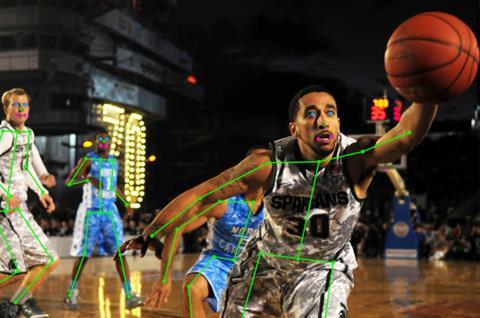
Unlike switching between television cameras, this technology reconstructs the match in a virtual environment. Specialised tracking cameras around the stadium record players’ positions and body movements several times a second, providing the data needed to animate digital avatars. Viewers can then explore the action independently of where the physical television cameras are positioned.
Meanwhile, PGA TOUR has been exploring a different kind of personalisation with AWS, focusing on automatically generated shot commentary and individual player recaps.
“It’s really about helping our fans be better informed as they consume our sport in a wide variety of ways,” said Scott Gutterman, PGA TOUR senior vice president of digital and broadcast technologies.
The technology produces written analysis of more than 30,000 shots per tournament. It can also generate performance summaries for an entire field of more than 150 golfers.
These are different approaches to giving viewers more choice. But taking personalisation further, particularly when decisions need to be made automatically during a live event, depends on a system’s ability to interpret what is happening in the sport itself.
Computer vision is already at work in self-driving vehicles, robotics and industrial automation. Analysing a sports match might seem a relatively simple task by comparison. Yet the pace and unpredictability of play present problems that even sophisticated models struggle to resolve.
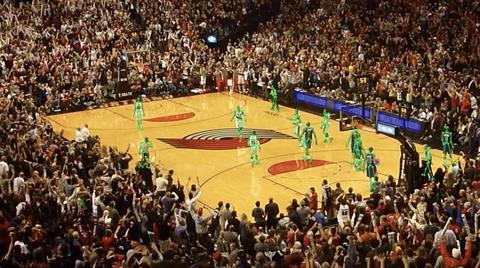
Tracking a player throughout a football match can be considerably harder for an AI system than for a human viewer. Players can disappear behind one another or reappear from a different camera angle, making it difficult to establish who is who. While a person knows the context of the game and can infer what a player is trying to do, a system must be trained to recognise specific events.
If something confuses you, it will confuse AI too. When it’s hard for a person to follow what’s happening on the pitch, a model needs even more training to make sense of it.
Sport is fast, chaotic and unpredictable. Unlike in many typical traffic or industrial settings, players are actively trying to outwit their opponents — and that makes life difficult for the camera too. Factor in the movements peculiar to each sport, constant changes of position and near-identical kits, and it’s enough to confuse almost anyone, apart from perhaps the most dedicated fans.
Datasets that cover the finer details of individual sports are scarce. Developers often have to build their own, with human annotators studying footage and recording what players are doing. Some situations can look remarkably similar on screen, even when they mean very different things under the rules of the game.
Training a model to tell events apart requires carefully labelled examples of play.
In some projects, annotation starts with the playing field rather than the players.
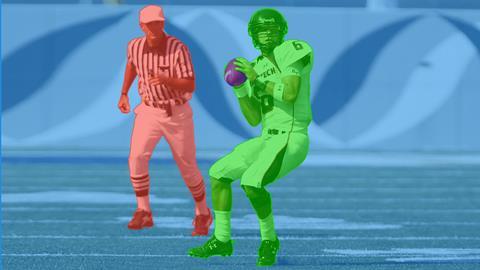
In American football, for example, specialists mark field lines, corner points and hash marks in the footage. These reference points help calibrate the footage, allowing the system to relate what appears on screen to the field’s actual geometry. The same position can look quite different depending on the camera angle.
Tracking the players themselves is a separate task. Object tracking and re-identification are used for this purpose, although preparing the training data involves considerably more work than drawing bounding boxes around people.
Shirt numbers aren’t always easy to read, either. In football, they may appear on the back of a shirt or on a player’s shorts, while American football players also have numbers on their shoulders. A partly obscured digit, motion blur, or a fold in the fabric can make it difficult even for a human annotator to tell whether a number reads 41 or 47. Datasets may therefore include labels such as blur, occlusion, and unclear to distinguish legible numbers from those that cannot be identified with confidence.
Event recognition requires a different level of detail. For automated highlights, the system needs to identify passes, shots, interceptions and other events, establish who was involved and pinpoint when each action began and ended. A single moment of play may require numerous attributes to be annotated, particularly when its interpretation depends on the sequence of movements and the rules of the game.
Some basketball and football projects involve professional coaches or other sports specialists, who help review the data and interpret situations that require detailed knowledge of the game.
A fan looking for every assist by their favourite basketball player would need more than a video archive. The relevant passages of play must be tagged with the player’s identity and linked to the correct timecodes.
Computer vision and event recognition models can generate this metadata from synchronised video feeds. A search and personalisation system could then use it to retrieve the relevant clips.
Computer vision is not necessarily the only source of data. Amazon’s Prime Vision with Next Gen Stats, an alternative NFL broadcast featuring its Prime Insights AI tools, offers another approach. Much of its analysis draws on data from RFID tags embedded in players’ shoulder pads and sensors installed around the stadium. Together, these track players’ positions, speed, and acceleration.
The system uses this data to analyse plays and add information directly to the broadcast. Viewers can see which receivers are open for a pass or which defenders might rush the quarterback. The graphics also help explain defensive formations as the action unfolds.
One of the dangers in utilising AI is the more decisions broadcasters hand over to AI, the greater the consequences when it makes a mistake. If a system misidentifies a footballer, viewers could see inaccurate statistics or hear commentary about another player’s actions. A wrongly classified incident might also end up in an irrelevant highlights package. Errors in recorded footage can be fixed during editing. In live coverage, viewers see them as they happen.
Some errors begin with the training data. If two players are assigned the wrong identities when they overlap, or their trajectories are incorrectly matched between cameras, the model may learn those false associations. Checking individual frames won’t catch everything. Player identities and event annotations need to remain consistent throughout the footage.
Even carefully annotated data cannot guarantee accurate results in real time. Picture quality, camera angles and unfamiliar passages of play can all affect performance, as can limitations in the model’s architecture.
Broadcasters could reduce the risk by setting confidence thresholds for automated decisions. If a system cannot reliably establish who has possession, for example, it could hold back an update to the personalised on-screen graphics. Such decisions would need clear rules, with the main director-led feed available as a fallback.
Video analysis and event recognition must also keep pace with the live pictures, or a personalised stream could start to lag behind the main broadcast. A fan might receive a goal notification before seeing the ball hit the back of the net.
Additionally, some situations call for an editorial decision, regardless of how accurately the algorithms perform. Serious injuries on the pitch, clashes between players or dangerous incidents in the stands require human judgement and sensitivity. Contentious refereeing decisions may also need careful editorial handling.
“One area in particular that I think is worth addressing is impact on the fan experience. One of the things that we’re beginning to see already is how we’re going to be able to more than personalise, almost hyper-personalise our telecasts, allowing people to experience the game in any way they want,” said NBA commissioner Adam Silver at his 2026 All-Star press conference.
Delivering that vision would mean integrating AI technologies into existing production workflows at a cost broadcasters can sustain. What they can offer will also depend on the cameras and tracking data available at each event. For now, new broadcast formats are likely to be tested as AI systems become better at interpreting live sporting action and using that information to shape coverage in real time.
The shared experience, after all, is a large part of what makes sport so compelling for fans. There are limits to hyper-personalisation, and the industry will have to work out where those limits lie as it experiments with the technology.

Tatiana Verbitskaya is solution architect at Keymakr






No comments yet