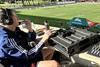
The production facility wanted a system to manage limited RF spectrum, reduce setup times, and enable more effective remote production

NEP Australia has invested in Sennheiser’s Spectera wideband wireless ecosystem to simplify its RF workflows. 

The company, which delivers sports and studio content to Australia’s major networks and streaming platforms, identified growing challenges in managing limited RF spectrum, reducing setup times, and enabling more effective remote production.

To address these needs, it brought in Sennheiser’s Spectera wideband wireless ecosystem.

NEP Australia’s productions include the AFL, NRL, netball, international football, headline boxing events such as SBW vs Gallen, and entertainment shows including The Chase.

“We provide broadcast facilities for the majority of sporting codes in Australia, as well as a wide range of studio shows. We’ve been looking forward to using Spectera across all of them,” explains Alex Wong, senior supervising audio director at NEP Australia.

“NEP’s commitment to pushing the boundaries of broadcast workflows made them the ideal partner for Spectera’s rollout in Australia,” adds Peter Hall, sales manager, Pro Audio, Sennheiser Australia. “They had a clear vision for how it could work across their productions, and it was great to help shape that from the ground up.”

Anubis In Action - Photo credit Alex Wong

NEP’s audio team faced challenges with an increasingly congested RF environment and the logistical burden of deploying multichannel systems.

Spectrum coordination became especially difficult in cities like Sydney, where dense RF traffic limited flexibility.

“It’s a pretty hostile world out there for frequency management. We need something agile and easy to set up,” says Wong.

The logistical demands of outside broadcast production heightens the need for streamlined systems that reduce time and equipment load on site. Additionally, NEP’s shift toward remote production required systems that were reliable, remotely manageable, and light on on-site configuration.

NEP implemented a Spectera wireless system that integrates microphones, IEMs, and control data into a single RF channel, simplifying RF planning and reducing equipment complexity.

The system includes a compact 1U Base Station, SEK bidirectional bodypacks, and DAD antennas, with remote monitoring handled through LinkDesk and the browser-based Spectera WebUI.

Initially drawn to the compact footprint and simplified cabling, NEP deepened its understanding through an in-depth RF session led by Volker Schmitt, manager technical application engineering at Sennheiser. “That session really helped us see how Spectera could address our spectrum issues and support more effective remote control,” says Wong.

Neumann 1 - Photo credit Alex Wong

Spectera is now active across several key productions, including The Chase, Fox Footy, and AFL coverage, improving audio and streamlining workflows.

Trials are also underway for sports and NRL events.

Since adopting the system, NEP has reduced setup time from several hours and resources to under 40 minutes, enabling the team to focus on content production rather than technical logistics.

Remote management is more effective, too. With Spectera WebUI and LinkDesk, engineers can monitor battery levels, RF performance, and pack status remotely, reducing the need for onsite adjustments and supporting NEP’s shift toward a centralised, remote-first production model.

“The build quality is exactly what we expect from Sennheiser,” says Annabelle Salomon, audio director at NEP. “But the flexibility and ease of use really stood out. We had the system installed and running in under an hour, and its footprint is just a quarter of what we’d typically need.”

Also being used in NEP’s setup are Neumann monitors and Merging’s Anubis audio interface. When used alongside Spectera, it is “a very powerful setup” that enables the team “to transport, setup and run the system single-handed,” Wong says. “[Our] clients were impressed with the small footprint, ease of use, versatility and of course, how it all sounded.”

Merging Anubis and Sennheiser HMD 27 - Photo credit Alex Wong

A recent trial during the live broadcast of SBW vs Gallen, a headline boxing match at Sydney’s Qudos Bank Arena, an indoor venue that seats up to 20,000, offered an opportunity to test Spectera at scale.

Despite the complexity of the environment, NEP says the system performed seamlessly alongside its existing RF gear.

“Even though this was a new type of setup, there were no nasty surprises, and I was able to do most of the rigging myself,” says Wong. “Once the system was up, our field crew, who hadn’t seen Spectera before, were able to get across it quickly and run it live. It sounded great and the talent was very happy.”

Anubis and Spectera Base Station - NEP - Photo credit Alex Wong 2

Following the success of this test, NEP is now looking at the broader Spectera use across live sports, including upcoming NRL events, where the combination of flexibility, fast setup and reliable coverage could transform referee comms and IEM deployment.

“We’re testing Spectera for referees and IEMs in live games. The idea of putting a Base Station in the OB truck and running antennas out is a new opportunity for us,” says Wong.

A major focus is the upcoming integration of SMPTE 2110, a technology that allows audio signals to travel over IP networks rather than traditional cabling. This will enable Spectera to connect directly to mixing consoles, intercom systems, and commentary units remotely. “Its scalability and flexibility have already impressed us,” says Salomon. For NEP, 2110 will facilitate a more flexible, connected broadcast workflow, overcoming geographical limitations.

Wong adds: “If we can stream signals from anywhere to anywhere, we’re not limited by geography anymore. That’s the future.”

“Sennheiser has always built what we need. The MKH 8018 mic filled a World Cup gap for us, and Spectera is the same,” continues Wong. “They’re not just selling gear, they’re listening to end users.”

As early members of the Spectera Pioneer Program, NEP provided feedback on UI design, hardware ergonomics, and pack monitoring, an opportunity Wong describes as rare in the industry. This level of collaboration allowed NEP to contribute to the product’s evolution, ensuring it meets real-world broadcast demands. Salomon adds that the collaborative process has been beneficial, with the system’s adaptability fitting well into NEP’s evolving workflows.

NEP Australia’s implementation of Spectera represents a major step forward in simplifying and enhancing live and remote broadcast audio. With faster setup, enhanced sound, and scalable architecture, NEP is improving its production environments.

“Spectera isn’t just another RF system. It’s a shift in how we think about broadcast audio. And we’re ready for what’s next,” says Wong.