

Robert Green, senior manager, pro AV, broadcast and consumer at AMD, looks at how the technology can be used in live production environments
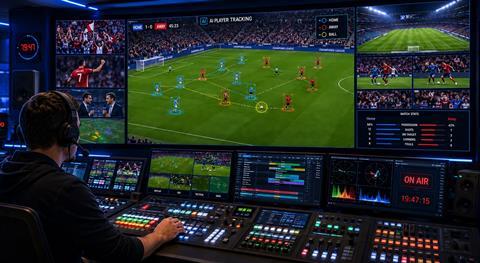
The practical value of AI in broadcast AV environments is increasingly defined by where it runs. Cloud-based AI compute delivers clear benefits for broadcast AV operators in areas such as analytics and postproduction. Whereas live broadcast and professional AV environments require AI closer to the data source to achieve stricter requirements around latency, determinism and trust. More distributed production workflows and leaner operational teams are also pushing AI closer to the point of capture and control.
At AMD, we see the opportunity: AI-driven intelligence at the edge is emerging as a solution within the realities of modern broadcast operations.
Remote operations, IP-based workflows and faster turnaround expectations increase pressure on live production systems, while budgets and staffing restraints multiply. In this environment, reliance on cloud-hosted intelligence can introduce unpredictable latency, bandwidth dependencies and governance challenges that are difficult to navigate during live broadcasts. Edge AI addresses these concerns by running AI inference locally – directly within broadcast AV systems, allowing intelligence to operate within the signal chain rather than as an external service.
In practical terms, edge AI refers to machine learning models embedded into production equipment, AV endpoints or on-premise systems where data can be processed locally in real time. These deployments are designed for continuous operation and predictable performance with full visibility into how decisions are made. For broadcasters, this approach avoids the need to send sensitive operational data beyond the production environment and allows AI to function within network connectivity constraints.
Enhancing broadcast UX
One area where we see a tangible impact is system interaction. Large language models (LLMs) and vision‑language models (VLMs) can be directly integrated into broadcast AV platforms, enabling users to interact with complex systems using natural language rather than navigating often-unintuitive user interfaces. Running these models on‑chip allows a user to query system status, diagnose faults or request specific actions without relying on external services. Visual understanding adds context, allowing AI to interpret what a camera feed or control surface shows rather than relying solely on metadata.
The significance here is operational efficiency. In live environments where speed and confidence matter, reducing cognitive load on users can be as valuable as adding new functionality. By embedding AI directly within systems, broadcasters and AV installers gain assistive capabilities that are always available, responsive and aligned with existing workflows, rather than adding another layer of tooling.
For example, our partner RaiderChip offers a neural processing unit (NPU) running GenAI models offline, enabling private, low-latency inference at the edge. RaiderChip implemented its NPU architecture on programmable hardware to accelerate transformer-based AI inference, leveraging efficient high-bandwidth memory utilisation and AMD Versal™ adaptive system-on-a-chip (SoC) technology to deliver real-time GenAI performance at the edge.
This enables AI‑driven capabilities that include live speech enhancement, transcription in studio and live production workflows; intelligent camera tracking and vision‑based analytics for automated control room monitoring; chat-based assistants for AV system or network set-up and diagnostics; and advanced voice, vision and language processing in collaboration systems.
Evolving audio experience
Audio is another area where edge AI offers immediate, measurable benefits. Control rooms, collaboration spaces and hybrid production environments are acoustically challenging, with multiple conversations, background noise and changing conditions. Rebuilding rooms or redesigning layouts is costly and disruptive, but edge‑based audio intelligence offers an alternative.
One emerging application is to create localised “sound bubbles” or “microphone bubbles” around users. BdSound, another of our partners, is one of the first companies implementing this to create higher-quality audio experience. By leveraging AI, the technology effectively creates a virtual gooseneck microphone positioned close to the user, while relying solely on embedded MEMS microphones integrated into the device. This allows the device to isolate and capture only the user’s voice while suppressing background noise, echo, reverberation, and unwanted voices. Rather than globally suppressing background noise, AI selectively enhances the audio relevant to a particular listener while minimising distractions. As processing happens at the edge, latency remains low enough for natural conversation, and audio data never leaves the room.
For broadcast teams coordinating live output or managing remote contributors, improved clarity can reduce errors and fatigue without changing established working practices. Sound bubbles can also separate voices in collaboration systems, so each person is heard clearly and evenly, improving meeting equity – particularly in hybrid settings. In BdSound’s design, an AMD Zynq adaptive SoC combines deterministic FPGA-based audio digital signal processing (DSP) with embedded AI processing on Arm cores to deliver low‑latency noise cancellation and voice enhancement.
The edge AI value-add
What these examples have in common is restraint. Effective edge AI deployments address specific operational pain points. In broadcast AV, AI is increasingly judged on whether it improves reliability, reduces manual intervention or makes systems easier to operate under pressure. We see this reflecting a broader shift in the industry – one from experimentation toward demonstrable return on investment.
This shift is accelerated as AI compute is brought directly into production endpoints and on‑prem systems without sacrificing the real‑time behaviour broadcast AV workflows depend on. By keeping inference close to the signal path, embedded platforms can reduce bandwidth dependence, simplify integration and support governance requirements by keeping sensitive media and control data onsite, turning edge AI from a bolt‑on service into a native capability of broadcast AV equipment.
Edge AI is already embedded in shipping broadcast AV solutions and pulled into production and event environments by workflow demands rather than technology cycles. It is no longer theoretical.
Robert Green is senior manager, pro AV, broadcast and consumer at AMD






No comments yet